
Search Intent SERP Matching: Complete Guide for Higher Rankings in 2026
By the Marketing Scrappers SEO SME · Reviewed August 2026
Search Intent SERP Matching is the process of comparing a search query against the dominant intent already demonstrated by the highest-ranking results for that query. Instead of guessing what a page should say, you read the SERP as an instruction set — the format, depth, and angle Google already rewards — and build content that matches it. Done well, it improves relevance, rankings, and the odds of being cited in AI-generated answers.
Most content underperforms not because it’s poorly written, but because it answers the wrong question in the wrong format. A comparison article ranks for a query that wanted a definition. A 4,000-word guide competes against product pages. A blog post tries to outrank a tool. Search Intent SERP Matching exists to prevent that mismatch before a single word is written.
This guide explains what Search Intent SERP Matching is, why it has become more important — not less — in an AI-search environment, and how to apply it using a repeatable framework. It is an educational resource, not a keyword research manual or a full SEO strategy. For those, see the SEO Strategy Guide and Keyword Research Guide.
What Is Search Intent SERP Matching?

Search intent is the underlying goal behind a query — what the searcher wants to know, do, find, or buy. Google’s own Search Quality Rater Guidelines describe this in similar terms, sorting queries into “Know,” “Do,” “Website,” and “Visit-in-person” needs.
SERP matching is the practical discipline of reading a search engine results page as evidence of that intent. A results page is not just a ranking list — it’s Google’s (and increasingly, an AI system’s) best current judgment about what a searcher wants when they type a specific phrase. If eight of the top ten results for a query are comparison articles, that’s not a coincidence. It’s a signal that the dominant intent is evaluative, not instructional.
Search Intent SERP Matching, then, is the combination of the two: identifying a query’s intent by systematically analyzing what the current SERP already rewards, then building content that matches — or deliberately improves on — that pattern.
This is distinct from keyword research (finding what people search for) and content optimization (structuring a page for relevance and readability). It sits between them: a diagnostic step that determines what kind of page should exist before any writing begins.
Why Search Intent SERP Matching Matters More in 2026

Search intent mismatches have always cost rankings. What’s changed is what a mismatch now costs beyond rankings.
AI Overviews and AI Mode have compressed the informational SERP. Ahrefs’ analysis of AI-Overview-triggering keywords found that 99.2% of them carry informational intent — which means the queries most exposed to AI-generated summaries are exactly the ones content teams are most likely to misjudge. When Ahrefs re-ran its original click-through study in 2026, position-one clicks on informational queries with an AI Overview present had fallen further than its initial 34.5% baseline measurement, and SISTRIX’s own tracking showed position-one CTR compressing from roughly 27% down to around 11% once an AI Overview appears on a query.
That sounds like a reason to give up on informational content. It’s the opposite. The same research shows a clear counter-effect: pages that get cited inside the AI Overview see meaningfully higher click-through than pages that rank without being cited — Seer Interactive’s 2025 analysis put the lift at roughly 35% for organic clicks and higher still for paid placements on the same query. Reporting on that data throughout 2026 has consistently found that citation, not raw position, is now the more valuable outcome on intent-compressed queries.
Citation is not won by writing more. It’s won by writing the right thing — a page whose structure and depth match what the query actually needs, stated clearly enough for both a human skimmer and an AI system to extract. Search Intent SERP Matching is the mechanism that gets you there. Skipping it doesn’t just cost rankings anymore; it costs AI visibility on the same query.
The Four Types of Search Intent (and What They Look Like in a SERP)
Every query carries one dominant intent, even when it looks ambiguous on the surface. The table below maps each type to what actually shows up on the results page — the signal you’re reading for.
| Intent Type | User Goal | Typical Query Signals | Dominant SERP Features | Content Format That Wins |
| Informational | Learn something | how, what, why, guide, meaning | Featured snippets, People Also Ask, AI Overviews | Definitions, explainers, step-by-step guides |
| Commercial Investigation | Compare options before deciding | best, top, vs, review, alternative | Comparison content, “best of” lists, AI Overview comparison digests | Comparison tables, structured pros/cons, expert evaluation |
| Transactional | Take action now | buy, price, hire, book, near me | Shopping units, local pack, direct service/product links | Service pages, product pages, booking flows |
| Navigational | Reach a specific site or page | brand names, product names | Sitelinks, Knowledge Panel, direct brand result | Homepage, brand page (rarely a candidate for new content) |
A useful cross-check: Google’s Search Quality Rater Guidelines describe the same four patterns as “Know,” “Do,” “Website,” and “Visit-in-person” needs — two independent frameworks converging on the same underlying reality. If your SERP read and the rater-guideline framing disagree, re-check your assumption before you write.
Two nuances matter more in 2026 than they did a few years ago:
- Modifiers are a first signal, not a verdict. Words like “best” usually indicate commercial investigation, but ambiguous head terms (a bare product category, an acronym, a brand-adjacent phrase) get classified differently by different tools and even by Google itself across regions. Treat modifiers as a hypothesis to test against the actual SERP, not a rule to apply blindly.
- A single query can carry mixed intent across its SERP features. It’s common to see a featured snippet (informational) sitting above a local pack (transactional) on the same page. When that happens, the featured snippet tells you what to lead with; the local pack tells you what to offer once you’ve answered the question. Build for both rather than picking one.
How to Read a SERP for Intent Signals
Before writing anything, run the target query and work through this sequence. It takes fifteen minutes and prevents the single most common cause of underperforming content: building the wrong asset.
- Run the query as the user would type it — not a “cleaned up” version. Mobile and desktop SERPs can differ; check both if the query has commercial weight.
- Catalog every SERP feature present: AI Overview, featured snippet, People Also Ask, image pack, video carousel, shopping units, local pack, Knowledge Panel. Each feature is Google telling you what kind of answer it believes satisfies the query.
- Identify the dominant content format among the top five to ten organic results. Are they guides, product pages, tools, comparison articles, forum threads, or news? The majority format is the one you need to match or deliberately outperform — not ignore.
- Read the People Also Ask questions as sub-intent data. These are the adjacent questions the same searcher is likely to ask next. They tell you what your page should cover in support of the primary answer, without wandering into a different primary intent.
- Note the depth and angle of what’s ranking: beginner-level or expert-level, generic or highly specific, recent or evergreen. Matching depth is as important as matching format — a beginner explainer will not outrank ten expert-level breakdowns, and an expert breakdown will underperform against ten simple explainers if the query is genuinely beginner-level.
- Note what’s absent. If no page in the top ten answers an obvious follow-up question, that’s not always a gap to fill — sometimes it means the question belongs on a different page entirely. Absence is a signal to investigate, not an automatic invitation to expand scope.
The Search Intent Alignment Framework™
Reading a SERP once is diagnostic. Doing it consistently, across every page in a content plan, requires a repeatable process. This is the framework Marketing Scrappers uses internally, built specifically to prevent intent drift across large content libraries.
Stage 1 — Query Classification Assign the target query to one of the four intent types using modifier analysis plus SERP verification (never modifier analysis alone). Record the classification with the query, not just in a spreadsheet header — intent drifts over time, and you need to know what you originally assumed.
Stage 2 — SERP Feature Audit Document every feature present on the live SERP: AI Overview, snippet, PAA, packs, carousels. This becomes your structural checklist — a page competing for a featured snippet needs a direct, extractable answer near the top; a page competing for AI Overview citation needs the same, formatted for machine parsing.
Stage 3 — Top-10 Pattern Analysis Identify the shared structural pattern across the ranking pages: format, approximate depth, angle, and the sub-questions they answer. You are not copying any one competitor — you are identifying the consensus Google has already validated.
Stage 4 — Format Matching Choose your content format based on the pattern from Stage 3, not on internal preference. If the SERP consensus is comparison tables and the brief calls for a narrative guide, the brief is wrong for this query — flag it before production, not after publication.
Stage 5 — Gap Identification Identify what the ranking pages fail to explain, oversimplify, or get wrong. This is where original insight, first-hand data, and named frameworks belong — differentiation happens inside the matched format, not by abandoning the format the SERP has already validated.
Stage 6 — Validation Loop Re-check the live SERP after publication and again at each scheduled content review. SERPs are not static — a query that was purely informational eighteen months ago may now carry an AI Overview or a shifted commercial slant. Intent matching is a maintained state, not a one-time decision.
Decision rule for overriding the SERP: match what’s ranking unless you have a specific reason not to — a SERP that is visibly stale (outdated screenshots, broken tools, superseded information), one where every ranking page is thin relative to the query’s actual complexity, or one where you hold first-hand data no competitor has. In those cases, matching format while exceeding depth is usually the right call. Abandoning the format entirely, on a healthy SERP, rarely is.
Search Intent SERP Matching in Practice: Three Examples
Example 1 — “technical seo audit” (Commercial Investigation) The SERP mixes service pages from agencies with a handful of “what’s included in a technical SEO audit” explainers. The pattern: searchers already understand the concept and are evaluating providers or scope. A page targeting this query should lead with what’s included, how it’s delivered, and what differentiates one approach from another — not a beginner definition of technical SEO, which belongs on a separate, lower-funnel page.
Example 2 — “what is technical seo” (Informational) The SERP shows an AI Overview, a featured snippet, and a run of definitional guides. The pattern is unambiguous: this query wants a clear, front-loaded definition followed by a structured breakdown of subtopics (crawlability, indexability, site speed, structured data). Comparison content or a sales pitch here would mismatch the intent regardless of writing quality.
Example 3 — “best hotels near [regional landmark]” (Local Commercial Investigation) The SERP shows a local pack, a map, and review-aggregator results ahead of any editorial content. This tells you two things: first, that a Google Business Profile and review signals will outweigh a blog post for this exact query; second, that any content built for it needs to include the comparison signals users already expect — price range, distance, and traveler ratings — rather than a narrative description. This is a useful illustration of why local intent so often calls for profile optimization and structured comparison data over long-form prose.
Search Intent SERP Matching for AI Overviews and AI Search
Because the large majority of AI-Overview-triggering queries are informational, intent classification is now a prerequisite for AI visibility, not a separate discipline from it. An AI system building a summary is doing a version of the same SERP-reading exercise described above — synthesizing what the top-ranking, well-structured sources already agree on, then favoring the ones that state the answer most clearly and attribute it credibly.
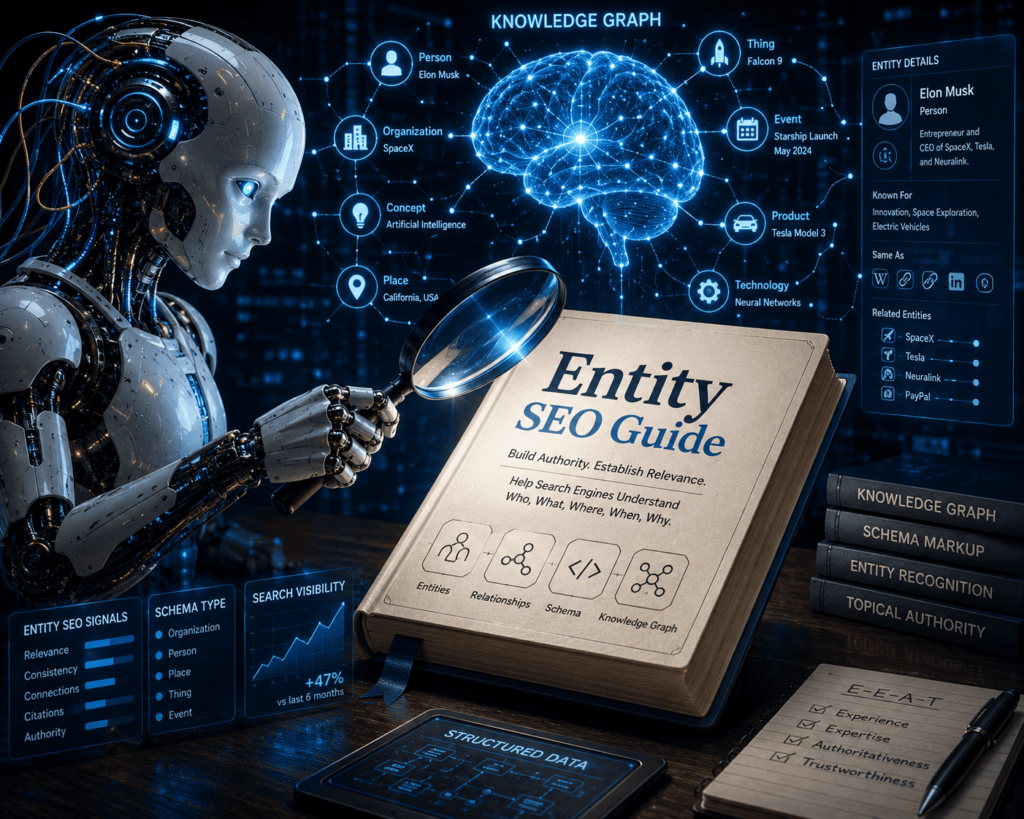
Practically, this means a page that has correctly matched its SERP’s intent is already most of the way to being GEO-ready: it leads with a direct answer, structures supporting information in a way that’s easy to extract, and doesn’t bury the point a searcher (or an AI system parsing the page) came for. The deeper mechanics of formatting for AI extraction — schema strategy, citation-friendly structuring, definition blocks — are covered in the Entity SEO Guide and the forthcoming GEO framework article; this page’s job is narrower: making sure the underlying intent read is correct before any of that formatting work begins.
Common Mistakes in Search Intent Matching
- Optimizing for the keyword instead of the intent behind it. The keyword is a proxy. The SERP is the evidence. When they disagree, trust the SERP.
- Classifying intent once and never re-checking it. SERPs shift — a query can move from purely informational to AI-Overview-and-commercial within a single core update cycle.
- Writing for comprehensiveness instead of format match. A long, thorough article that ignores the format the SERP already rewards will underperform a shorter page that matches it.
- Treating SERP features as decoration instead of instructions. A featured snippet, a local pack, or an AI Overview is Google telling you what wins. Ignoring that signal and building something else anyway is the single most avoidable mistake in this discipline.
- Assuming intent is identical across devices and markets. Mobile SERPs skew more local and transactional than desktop SERPs for the same query; regional SERPs can carry different dominant intent entirely.
- Confusing modifier-based intent with confirmed intent. “Best,” “how,” and “buy” are useful first signals — they are not a substitute for actually checking the live results.
Search Intent SERP Matching Checklist
- Query run on both mobile and desktop
- All SERP features cataloged (AI Overview, snippet, PAA, packs, carousels)
- Dominant content format identified across top 5–10 results
- PAA questions reviewed for sub-intent coverage
- Depth and angle benchmarked against ranking pages
- Format decision documented and matched to Stage 3 pattern
- Differentiation angle identified (Stage 5 gap)
- Re-check scheduled for the next content review cycle
A fully detailed, downloadable version of this checklist — with scoring guidance — is available in the Scrapper Growth Engine™ SEO Checklist.
Best Practices
- Read the SERP before the brief is written, not after a draft exists. Retrofitting intent onto finished content rarely works cleanly.
- Match format first, differentiate second. Novelty inside the wrong format underperforms competence inside the right one.
- Treat AI Overviews as a SERP feature to satisfy, not a threat to work around. The formatting habits that win snippet placement generally support citation eligibility too.
- Revisit intent classification on a schedule, not only when rankings drop. SERP drift is often invisible until traffic has already declined.
- Document the “why” behind every format decision. A content team that understands the reasoning stops re-litigating format choices project after project.
Frequently Asked Questions
What is search intent SERP matching in simple terms? It’s the practice of checking what’s already ranking for a query and building content that matches the format, depth, and angle Google has already validated — rather than guessing what a page should contain.
How is search intent SERP matching different from keyword research? Keyword research identifies what people search for and how often. Search Intent SERP Matching determines what kind of page should be built once a keyword is chosen. They’re sequential steps, not the same task.
Does search intent SERP matching still matter with AI Overviews taking over informational queries? It matters more. Nearly all AI-Overview-triggering queries are informational, and pages that earn citation inside those overviews see a meaningful click-through advantage over pages that don’t. Getting the intent read right is a precondition for that citation.
How often should search intent be re-checked for an existing page? At minimum, every scheduled content review (quarterly for competitive terms) and immediately after any core algorithm update that visibly reshuffles the SERP.
Can one page satisfy more than one search intent? Rarely, and not by design. A SERP showing mixed features (for example, a snippet above a local pack) usually means two distinct intents are competing on the same query — the better response is often two purpose-built pages rather than one page trying to satisfy both.
What’s the fastest way to check search intent for a new topic? Run the exact query, screenshot the SERP, and work through the six-step read in the “How to Read a SERP” section above. Fifteen minutes of manual review outperforms most automated intent-classification tools, which still struggle with ambiguous head terms.
Next Step
Search Intent SERP Matching answers one question well: what should this page be? It doesn’t cover how to build the keyword map that feeds it, or how to structure the page once the format is chosen — those live in the Keyword Research Guide and Content Optimization Guide.
If your content is already published and rankings still aren’t moving, the mismatch is often diagnosable in an hour. That diagnostic work — SERP-by-SERP, page-by-page — is exactly what an SEO audit is built to surface.
Ready to Find Your Content-Intent Mismatches?
If your content is published but rankings aren’t moving, our team can diagnose your SERP intent alignment page-by-page.
Get the Scrapper Growth Engine™ SEO Checklist
Download our fully detailed, downloadable checklist with step-by-step scoring guidance for your next content review.