AI Search Experience Optimization (AIXO): A Practical Guide for 2026 and Beyond
Author: Hassan Shroff – Founder, Marketing Scrappers
Credentials: SEO Strategist & Digital Marketing Consultant
Experience: 8+ years in SEO, content strategy, and growth marketing
Introduction: Why Search Visibility Feels Harder Than Ever
Many businesses are doing “everything right” in SEO—publishing content, optimizing pages, earning links—yet still struggle with inconsistent visibility and lead quality. Search results feel less predictable. Users get answers without clicking. AI-generated summaries appear above traditional rankings.
This isn’t because SEO suddenly stopped working. It’s because search itself has changed.
Modern search engines increasingly act as answer engines, powered by generative AI systems that interpret intent, synthesize information, and present complete responses. In this environment, ranking alone is no longer the only goal. How your brand appears inside AI-driven search experiences matters just as much.
This guide explains AI Search Experience Optimization (AIXO)—what it is, how it works, and how businesses can adapt responsibly for 2026 without chasing hype or shortcuts.
What Is AI Search Experience Optimization?

AI Search Experience Optimization (AIXO) is the practice of optimizing content, structure, and signals so that a brand is accurately understood, selected, and presented within AI-powered search experiences.
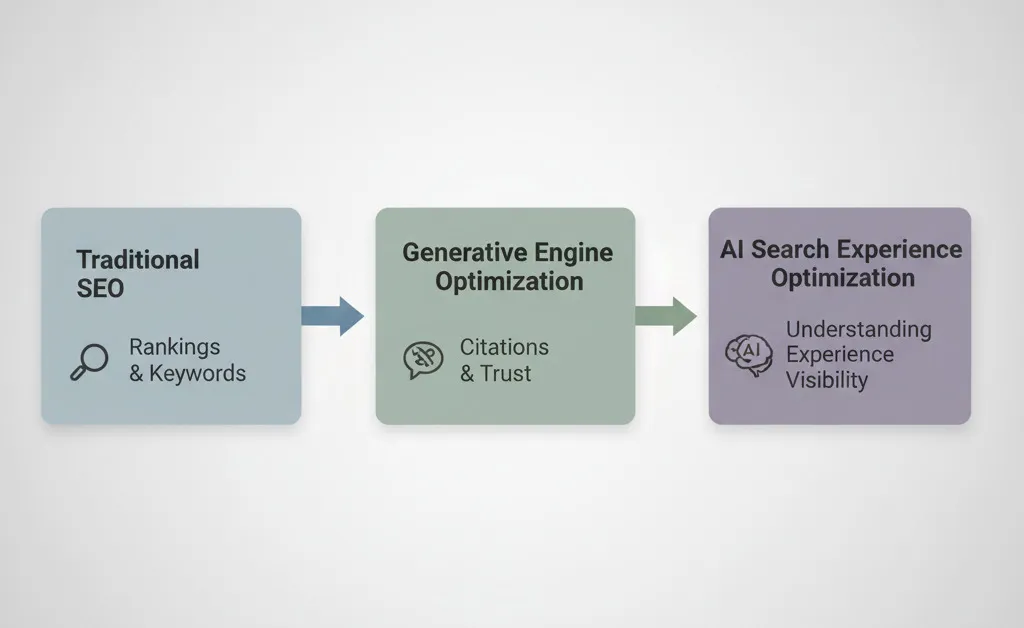
Unlike traditional SEO, which focuses primarily on rankings and clicks, AIXO focuses on:
- How AI systems interpret your content
- Whether your information is trusted enough to be summarized
- How users experience your brand inside AI-generated answers
The term is sometimes referred to as:
- AI search optimization
- Search generative experience optimization
- SEO for AI search
In practice, these all describe the same shift: from ranking pages to shaping search experiences.
How AI Search Is Different From Traditional Search
AI Search vs Google Search (Classic SERPs)
Traditional search engines return a list of ranked pages. AI-driven search systems often return direct answers, summaries, or conversational responses, sometimes without requiring a click.
According to Google’s Search documentation, modern systems aim to “help users quickly understand topics and explore deeper when needed,” which increasingly involves AI-generated overviews.
AI-Generated Answers vs Blue Links
AI answers:
- Synthesize information from multiple sources
- Prioritize clarity over completeness
- Favor trusted, well-structured content
This means being “ranked” is not always enough to be included.
Conversational and Multimodal Results
AI search experiences can:
- Handle follow-up questions
- Combine text, images, and product data
- Adapt responses based on inferred intent
Optimization must account for these behaviors.
How AI Search Engines Understand Content
AI Summarization Logic
AI systems summarize content by extracting:
- Clear definitions
- Structured explanations
- Consistent terminology
Content that is vague or purely promotional is less likely to be used.
Context and Entity Interpretation
Modern search relies heavily on entities—people, brands, topics, and concepts—and how they relate to each other. According to industry-wide SEO consensus, entity clarity improves both understanding and trust.
User Intent Prediction
AI systems attempt to predict:
- Why a user is searching
- What level of detail they need
- Whether they want explanation, comparison, or action
Content must align with these intent layers.
How AI Search Experiences Are Built

Generative AI Over Indexes
AI models generate responses using indexed content, not raw opinions. Visibility still depends on crawlable, accessible pages.
Retrieval-Augmented Generation (RAG)
RAG systems retrieve trusted documents first, then generate answers. This reinforces the importance of accuracy, structure, and authority.
Trust and Authority Weighting
According to Google Search guidelines, systems prioritize content that demonstrates experience, expertise, and reliability—especially for informational and decision-making queries.
How to Optimize a Website for AI Search

Optimizing for AI search does not replace SEO fundamentals. It builds on them.
How to Rank in AI Search Results
Ranking Signals in AI Search
While algorithms are not fully transparent, observed patterns across campaigns suggest AI systems favor:
- Clear topical focus
- Consistent entity signals
- High-quality explanatory content
Why Links Alone No Longer Work
Backlinks still matter, but they are no longer sufficient on their own. AI systems evaluate meaning, not just popularity.
Content Depth vs Clarity
Long content is not inherently better. Content that:
- Answers questions directly
- Uses clear subheadings
- Avoids unnecessary filler
- performs more consistently in AI-driven environments.
On-Page Optimization for AI Search
AI-Readable Structure
Use logical heading hierarchies and concise paragraphs. This helps both users and AI systems parse information.
Semantic Headings
Headings should reflect real user questions, similar to Google Autosuggest phrasing.
Answer-First Formatting
Lead with the answer, then explain. This aligns with how AI extracts summaries.
Technical SEO for AI Search Engines
Schema and Entity Markup
According to Google’s structured data guidelines, schema helps clarify meaning—not rankings—but clearer meaning improves eligibility for enhanced results.
Page Speed and Crawl Clarity
AI systems rely on accessible content. Core Web Vitals and clean indexing remain foundational.
Content Retrievability
Avoid hiding key information behind scripts or inaccessible elements.
AI Search Performance Optimization
Measuring AI Visibility
Traditional metrics like rankings don’t tell the full story. Businesses should also track:
- Branded search growth
- Referral patterns
- Assisted conversions
AI Impressions vs Clicks
AI answers may generate visibility without clicks. This still influences brand trust and downstream decisions.
AI-Driven Engagement Signals
User behavior after exposure—search refinement, brand queries, conversions—matters more than raw traffic volume.
AI Search Experience Optimization Strategy for 2026

AIXO is not a one-time setup. It’s a systematic approach.
Designing Content for AI Search Experiences
Experience-Led Content Design
Content should anticipate:
- Initial questions
- Logical follow-ups
- Decision-related concerns
Follow-Up Question Modeling
In practice, businesses struggle most when content answers only one question. AI favors content that supports conversation flow.
Multi-Intent Answer Paths
One page can serve:
- Informational intent
- Comparative intent
- Decision-support intent
if structured correctly.
Entity-Based Optimization for AI Search
Brand Entity Clarity
Consistent naming, positioning, and expertise signals reduce ambiguity for AI systems.
Topic Authority Signals
Covering a topic comprehensively—across multiple related pages—reinforces authority.
Knowledge Graph Alignment
Structured data, consistent references, and authoritative mentions help align with knowledge graph understanding.
AI Search Optimization vs GEO
When GEO Is Enough
If the goal is citations inside AI answers, Generative Engine Optimization may be sufficient.
When AIXO Is Required
When user experience, brand perception, and conversion paths matter, AIXO becomes necessary.
Experience vs Citation Optimization
Citations show presence. Experience optimization shapes how that presence is perceived.
AI-Driven Search Visibility Systems
Continuous Optimization Loops
AI systems evolve. Content must be reviewed, refined, and expanded over time.
AI Feedback Signals
Changes in impressions, mentions, and user behavior provide indirect feedback.
Human-in-the-Loop Models
Platform guidelines consistently recommend human oversight for accuracy, quality, and compliance.
AI Search Experience Optimization Examples
Real-World AI Search Optimization Use Cases
Blogs
Well-structured educational content is frequently summarized by AI systems.
Ecommerce
Clear product data, FAQs, and comparisons improve inclusion in AI-assisted shopping experiences.
Service Businesses
Decision-oriented content helps AI systems surface providers at the right moment.
AI Search Optimization Tools
- AI visibility tracking platforms
- Search experience analyzers
- AI citation monitoring tools
Tools should support strategy—not replace judgment.
AI Search Optimization Courses & Skills
Skills Required for AI Search Optimization
- Technical SEO fundamentals
- AI literacy and prompt understanding
- Entity engineering
- UX writing for AI summaries
Who Should Learn AI Search Experience Optimization
- SEO professionals adapting to AI-driven search
- Content strategists and editors
- Agencies and founders planning for long-term visibility
AI Search Optimization vs Traditional SEO

Does Traditional SEO Still Matter for AI Search?
What Still Works
- Technical health
- High-quality content
- Clear site architecture
What No Longer Works
- Keyword stuffing
- Thin content scaled for volume
- Purely link-driven strategies
What Must Change
- From ranking-first to experience-first thinking
AI Search Experience Optimization vs Search Engine Positioning
- Search engine positioning focuses on where you rank
- AIXO focuses on how you appear, are summarized, and are trusted
Visibility without trust is fragile. Trust without visibility is invisible. AIXO balances both.
Common Questions About AI Search Experience Optimization
Is AI Search Replacing Google?
No. AI is becoming part of search, not a replacement for it.
Can AI Search Be Manipulated?
Short-term manipulation exists, but platform guidelines and model updates consistently reduce its effectiveness.
How Do AI Search Engines Choose Sources?
They favor content that is accurate, structured, authoritative, and aligned with user intent.
Closing Perspective
AI Search Experience Optimization is not about chasing algorithms or abandoning SEO. It’s about aligning with how search actually works now—and how it’s likely to evolve.
Businesses that focus on clarity, credibility, and user experience are better positioned for sustainable visibility than those chasing shortcuts.
Some organizations choose to work with agencies like Marketing Scrappers for execution support, audits, or system design. Others apply these principles internally. Both approaches can work when grounded in long-term thinking.
What matters most is adapting deliberately—without panic, hype, or shortcuts—to a search ecosystem that increasingly values experience over exposure.