Marketing Scrappers Case Studies
Real Business Results, Documented End to End
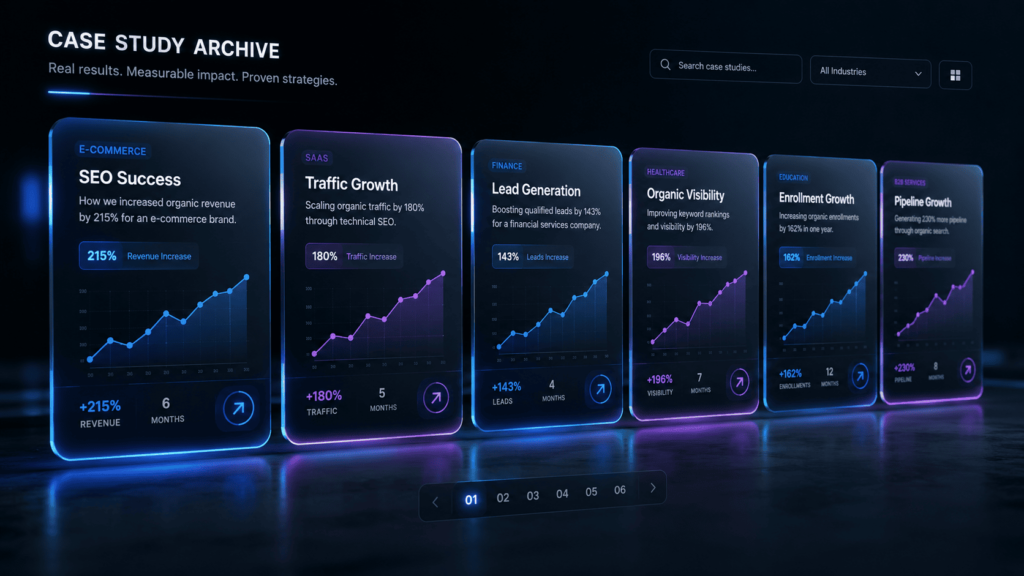
This is the complete archive of Marketing Scrappers client projects, growth experiments, and implementation results. Every case study documents the full engineering journey — research, diagnosis, strategy, implementation, measurement, and lessons learned — not just the headline number at the end.
Browse by service, industry, or business objective to find projects that resemble your situation, then review the decision rationale behind each one.

Full methodology disclosed
Measured against business outcomes
Failures and iterations included
Reproducible frameworks
Why Our Case Studies Are Built Differently
Most agency case studies are marketing artifacts. They present a percentage, a logo, and a quote, then omit everything a buyer actually needs to judge whether the result is repeatable. A number without a method is not evidence — it is a claim.
What is a valuable marketing case study?
A valuable marketing case study is a documented account of a specific business problem, the diagnostic reasoning used to identify its cause, the strategy selected and why alternatives were rejected, the implementation performed, the measurement framework applied, and the resulting business outcome — including what did not work. Its purpose is to let a reader assess whether the same approach would transfer to their own situation, not to persuade them that a provider is talented.
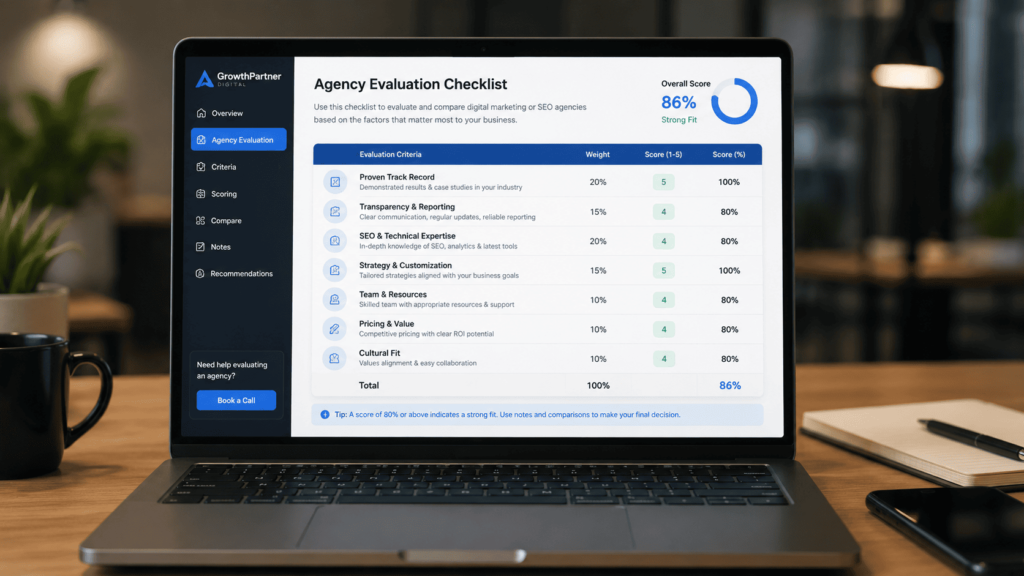
How to Evaluate Any Agency Case Study Before You Hire
Use this checklist on our case studies and on every competitor you are evaluating. If a study cannot survive these questions, treat it as advertising rather than evidence.
Evidence Quality
- Is the starting baseline stated, not just the ending figure?
- Is the measurement window defined and long enough to rule out seasonality?
- Are percentage gains paired with absolute numbers?
- Is the data source named (analytics platform, CRM, search console)?
Method Transparency
- Can you tell what was actually implemented, step by step?
- Is the reasoning behind each decision explained?
- Are confounding factors acknowledged (paid spend, PR, market shifts)?
- Are failed tests and course corrections documented?
Business Relevance
- Does the metric connect to revenue, pipeline, or qualified demand?
- Is the client’s business model comparable to yours?
- Were the starting conditions similar to your own?
- Is the timeline realistic for your budget cycle?
Repeatability
- Is there a named framework behind the work, or was it improvised?
- Does the same method appear across multiple client projects?
- Are the limitations of the approach stated honestly?
- Could your internal team audit the work described?
Featured Success Stories
Each project below is documented as a full engineering record. Open any study to see the diagnosis, the implementation sequence, the measurement design, and the lessons carried forward into later work.
Technical SEO
Rebuilding Crawl and Index Architecture on a Large Catalogue Site
How a crawl budget diagnosis, canonical consolidation, and rendering fixes restored visibility to pages that had been effectively invisible to search engines for months.
Outcome focus: indexation recovery and qualified organic sessions
Conversion Optimization
Diagnosing a Lead Quality Problem Disguised as a Conversion Rate Problem
Why raising form completions initially made pipeline worse, and how qualification-first redesign changed which visitors converted rather than how many.
Outcome focus: qualified lead rate and sales-accepted opportunities
Website Development
A Redesign That Protected Existing Rankings Instead of Resetting Them
The migration sequencing, URL mapping, and pre-launch validation used to avoid the traffic collapse that follows most rebuild projects.
Outcome focus: ranking retention and Core Web Vitals
AI Search Optimization
Earning Citations Inside AI Answer Engines
How entity clarity, extractable definitions, and structured comparison content changed whether an assistant referenced the brand when answering buyer questions.
Outcome focus: assistant citation frequency and branded demand
Browse Case Studies by Service
Start here if you already know which capability you are evaluating.
SEO Case Studies
Organic visibility programmes, topical authority builds, and search demand capture. Supported by the SEO services hub
Technical SEO Case Studies
Crawlability, indexation, rendering, and site architecture repair work. See the Technical SEO definition.
CRO Case Studies
Conversion research, experiment design, and decision-support redesign. Supported by the conversion optimization hub.
Website Development Case Studies
Rebuilds, migrations, and performance engineering. Supported by the web development hub.
Local SEO Case Studies
Multi-location visibility, proximity demand, and local conversion pathways.
AI Search Optimization Case Studies
Entity clarity and citation visibility inside AI answer engines. See the AI Search Optimization definition.
Browse Case Studies by Industry
Sector context changes buyer behaviour, competitive density, and which levers move revenue. Filter to the environment closest to your own, then compare it against the industries hub.
B2B & Professional Services
Long sales cycles, committee buying, and pipeline-weighted measurement.
SaaS & Technology
Product-led acquisition, trial conversion, and category education content.
Hospitality & Travel
Seasonal demand, direct booking recovery, and aggregator competition.
Local & Multi-Location Business
Proximity demand, location page architecture, and offline attribution.
Ecommerce & Retail
Catalogue scale, faceted navigation, and margin-aware growth decisions.
Service Businesses
Enquiry quality, capacity constraints, and lead-to-booking economics.
Browse Case Studies by Business Goal
If you are clearer on the outcome you need than the tactic that delivers it, navigate from the objective instead. Each row maps a business goal to the diagnostic question it raises and the projects that address it.
| Business Goal | Core Diagnostic Question | Primary Service Applied | Explore |
|---|---|---|---|
| Grow qualified organic traffic | Is the ceiling demand, visibility, or content coverage? | SEO Systems | SEO projects |
| Increase revenue from existing traffic | Where does intent leak before conversion? | Conversion Optimization | CRO projects |
| Improve lead quality, not lead volume | Are we optimizing the wrong conversion event? | Conversion Optimization | CRO projects |
| Recover lost rankings after a rebuild | Was the migration architecture preserved? | Website Development | Development projects |
| Fix indexation and crawl waste | Can search engines reach and understand the site? | Technical SEO | Technical projects |
| Win visibility in AI answer engines | Is the brand a recognizable entity with extractable answers? | AI Search Optimization | AI search projects |
| Expand across multiple locations | Does location architecture scale without duplication? | Local SEO | Local projects |
When should you review case studies during agency selection?
Review case studies after you have defined your own problem, and before you request proposals. Reading them earlier tends to make you adopt someone else’s problem definition. Reading them later means you are comparing pricing rather than method. The sequence that produces the best decisions is: define the business outcome you need, identify the constraint most likely blocking it, then use case studies to test whether a provider has reasoned through that same constraint before.
MS Project Delivery Framework
The Growth Engineering Methodology Behind Every Project
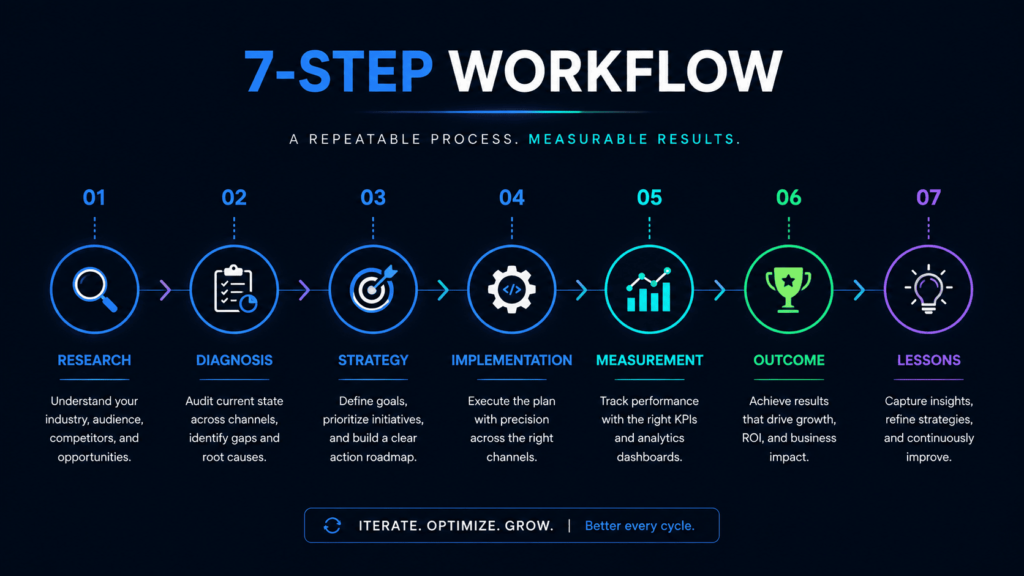
Every case study in this archive follows the same seven-stage sequence. The consistency is deliberate: it makes results comparable across clients, and it means the reasoning can be audited rather than taken on trust.
01 — Research
Establish demand reality, competitive position, technical baseline, and how the business actually earns revenue.
02 — Diagnosis
Separate the presenting symptom from the binding constraint. Most engagements begin with the wrong problem stated.
03 — Strategy
Select the intervention with the strongest expected effect per unit of effort, and record why alternatives were rejected.
04 — Implementation
Build and ship in sequenced phases, with each change instrumented before it goes live.
05 — Measurement
Compare against a stated baseline over a defined window, and name the factors that could confound the reading.
06 — Business Outcome
Translate the channel metric into the commercial term the business actually manages: revenue, pipeline, or cost of acquisition.
07 — Lessons Learned
Document what underperformed, what was revised mid-project, and what transfers to comparable situations.
Project Outcomes Dashboard
This index summarises the archive at a glance: the situation each client faced, the intervention selected, and the outcome dimension measured. Figures are reported inside the individual case studies alongside their baselines and measurement windows, because a percentage without those two things is not information.
| Industry | Problem | Solution Applied | Outcome Measured | Service Used |
|---|---|---|---|---|
| B2B Services | High traffic, low qualified enquiries | Intent-based content restructure and form qualification redesign | Sales-accepted lead rate | Conversion Optimization |
| SaaS | Category pages absent from search results | Entity mapping, topical cluster build, internal link architecture | Non-branded organic sessions | SEO Systems |
| Hospitality | Direct bookings losing share to aggregators | Local visibility programme and booking path simplification | Direct booking share | SEO + CRO |
| Ecommerce | Crawl budget consumed by faceted URLs | Canonicalisation, parameter handling, index control | Valid indexed product pages | Technical SEO |
| Professional Services | Rankings lost following site rebuild | URL mapping, redirect audit, template-level recovery | Pre-migration ranking retention | Website Development |
| Multi-Location Retail | Location pages competing with each other | Location architecture redesign and duplication resolution | Local pack visibility by location | Local SEO |
| Technology | Brand absent from AI-generated answers | Entity clarification, definition blocks, structured comparisons | Assistant citation frequency | AI Search Optimization |
How we report results
- Every figure is stated with its baseline, measurement window, and data source.
- Percentage changes are always accompanied by absolute numbers where the client permits disclosure.
- Where paid media, PR, seasonality, or market shifts contributed, we say so rather than claiming full attribution.
- Where a client requires confidentiality, we anonymise the brand rather than omit the constraint or inflate the outcome.
- Projects that underperformed are documented with the same rigour as those that succeeded.
Research & Experiments
Client work is one source of evidence. Independent research and controlled experiments are the other. Our studies test the assumptions that agency case studies usually leave unexamined.
Expert Perspective
Growth Experiments
Controlled tests run on our own properties, including the ones that failed to produce the effect we expected.
Industry Reports
Sector benchmarks that give context to individual project results and clarify what “good” looks like in a given market.
Research Center
Original studies on search behaviour, site performance, and growth system design, with methodology published alongside findings.
The most useful thing a case study can contain is the moment the original hypothesis turned out to be wrong. That is where the method becomes visible. Results tell you what happened once; documented reasoning tells you whether it can happen again.
Marketing Scrappers — Growth Engineering practice
Frequently Asked Questions
Are these results typical of what my business would see?
No case study should be read as a forecast. Outcomes depend on starting conditions, competitive density, budget, internal capacity, and how much of the recommended work actually gets implemented. Use these studies to evaluate whether the diagnostic reasoning applies to your situation, not to estimate your own numbers. We will give you a realistic range for your specific circumstances during a strategy session, including cases where we think the opportunity is smaller than you expect.
Why are some client names withheld?
Some clients operate in competitive markets where publishing their growth strategy would work against them. In those cases we anonymise the brand but publish the full method, constraints, and outcome dimension. We consider the reasoning more valuable to a reader than the logo, and we will not fabricate identifying details to make a study look more impressive.
How long did these projects take to produce results?
Timelines vary by discipline. Technical fixes and conversion changes can register within weeks because they alter existing behaviour. Content and authority programmes generally need several months before search engines have enough signal to re-evaluate a site. Each case study states its own measurement window explicitly so you can judge the pace rather than infer it.
Do you publish projects that did not work?
Yes, with client permission. Underperforming projects and abandoned hypotheses are documented in the lessons learned stage of each study and in our experiments archive. A practice that never publishes a negative result is either not testing anything or not reporting honestly.
How do I find a case study relevant to my business?
If you know the capability you need, browse by service. If your market context matters most, browse by industry. If you are clearer on the outcome than the tactic, use the business goal table above. Relevance usually comes from matching the constraint rather than matching the sector.
What happens after I book a strategy session?
We review your current visibility, technical baseline, and conversion pathways before the call so the conversation starts with evidence rather than discovery questions. You leave with a diagnosis of the constraint most likely limiting growth and a prioritised view of what to address first — whether or not you engage us to do the work.
Find Out Which Constraint Is Limiting Your Growth
Every project in this archive began with the same first step: an honest diagnosis of what was actually blocking growth. That is what a strategy session gives you — a specific, evidence-based reading of your situation and a prioritised path forward.
Continue exploring
Services Hub
See how each capability is delivered.
Research Center
Original studies and published methodology.
Industries
Sector-specific growth context.
Glossary
Definitions for every concept referenced here.