
Competitor Analysis Framework: The MS Competitive Intelligence Matrix (MS-CIM)
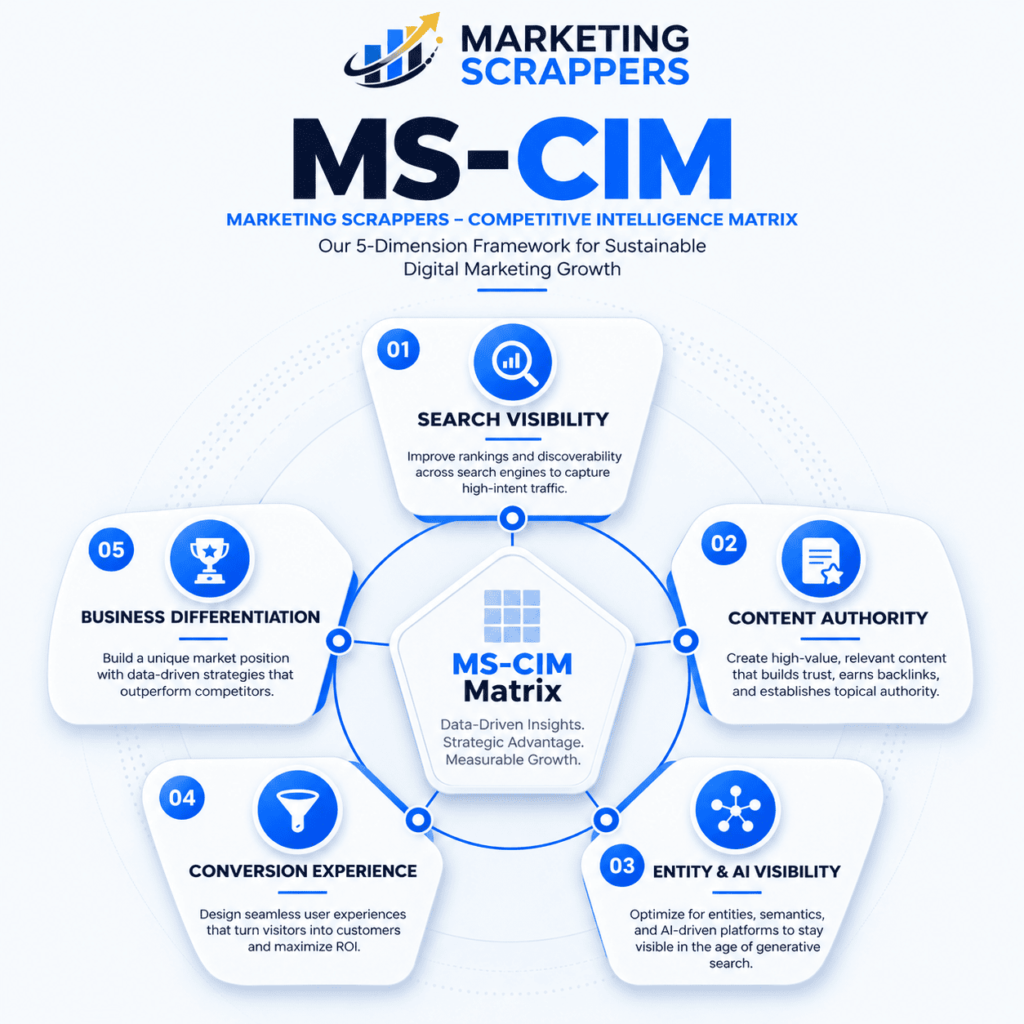
A competitor analysis framework is a repeatable system for evaluating competitors across search visibility, content authority, AI visibility, conversion experience, and business differentiation, then converting those findings into a prioritized action plan. Unlike a one-time audit, a proper framework produces the same categories of insight every time it’s run, which is what makes competitive intelligence usable at scale rather than a collection of disconnected observations.
Most businesses don’t lack competitor data. They lack a way to interpret it consistently. This guide introduces the MS Competitive Intelligence Matrix (MS-CIM) — the framework Marketing Scrappers uses internally to evaluate competitive positioning before building a growth strategy under our broader Research System…”
What Competitive Intelligence Means in 2026
Competitive intelligence is the ongoing practice of collecting, interpreting, and acting on information about competitors’ strategy, positioning, and performance. It differs from a “competitor audit” in one important way: intelligence is a system, an audit is an event.
An audit answers a question at a single point in time — what does this competitor’s site look like today? Intelligence answers a standing question — how is this competitor’s position changing, and what should we do differently because of it?
Three shifts have changed what competitive intelligence needs to cover:
- Search results are no longer a single list. AI Overviews, chat-based answers, and traditional rankings now coexist, which means a competitor can be invisible in one surface and dominant in another. Evaluating rankings alone misses half the picture. This shift aligns directly with Rand Fishkin’s framework on brand influence, proving that modern search visibility is often a trailing indicator of demand generated across fragmented external channels.
- Authority is measured by entities, not just links. Search systems increasingly evaluate who a brand is and what it’s known for, not only how many pages link to it. A competitor with fewer backlinks but clearer topical ownership can still outperform.
- Conversion experience has become a competitive variable. Two competitors can rank for the same terms and produce very different business outcomes depending on how well their content and pages guide a visitor toward a decision.
A modern framework has to account for all three. This is the gap most “competitor analysis” content leaves unaddressed — it treats the exercise as an SEO checklist rather than a business intelligence process connected to revenue.
Why Traditional Competitor Analysis Is No Longer Enough
Most competitor analysis processes fail for the same structural reasons, regardless of which tool is used to run them.
They measure activity, not advantage. Tracking a competitor’s posting frequency, backlink count, or keyword rankings tells you what they’re doing — not why it’s working or whether it matters to your business.
They stop at basic search engine optimization metrics. Domain rating, referring domains, and keyword counts describe visibility. They say nothing about whether a competitor’s content actually satisfies search intent, whether their site converts visitors, or whether AI systems associate them with a category.
They’re run once and forgotten. A one-time competitor audit has a shelf life of weeks. Competitive positioning moves continuously — a framework needs a review cadence, not a single delivery date.
They don’t produce a decision. The most common failure: a spreadsheet full of competitor data with no scoring logic, no prioritization, and no clear “do this next” output. Data without a decision framework is just research homework.
They ignore modern AI competitor analysis and engine visibility entirely. Traditional frameworks were built for a search landscape that ranked ten blue links. They have no mechanism for evaluating whether a competitor is being cited, summarized, or recommended by AI-assisted search systems — a visibility layer that behaves differently from traditional ranking.
MS-CIM was built specifically to close these five gaps.
MS Competitive Intelligence Matrix (MS-CIM)
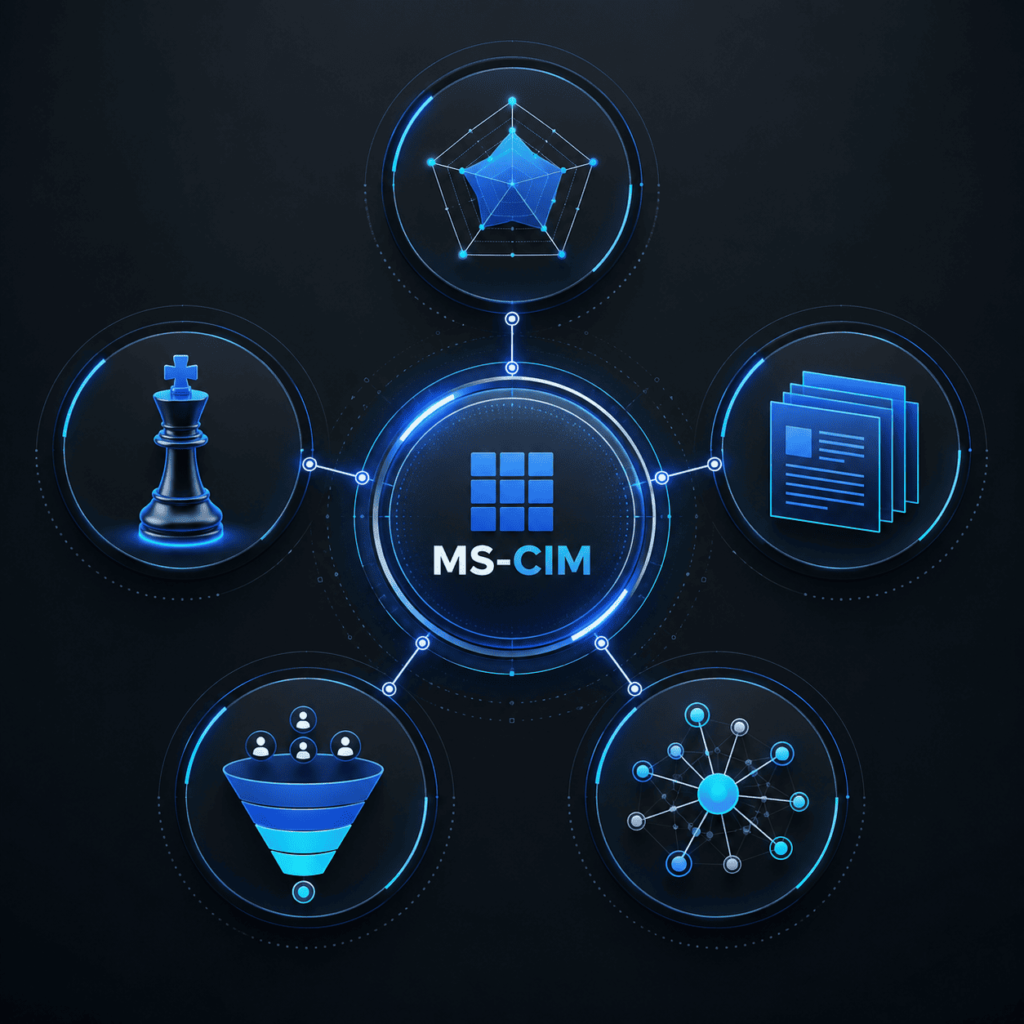
The MS Competitive Intelligence Matrix is a scoring framework that evaluates any competitor across five dimensions. Each dimension is scored independently, then combined into a composite competitive position — which is what makes the output comparable across every competitor in a set, and repeatable every time the analysis is refreshed.
The Five MS-CIM Dimensions
1. Search Visibility: How well the competitor is found across traditional organic search. This includes ranking breadth across the customer journey (not just head terms), share of visibility for category-defining keywords, and consistency of visibility over time rather than a single snapshot.
2. Content Authority: Whether the competitor’s content actually owns its topics — depth of coverage, structural completeness against search intent, and whether their material reads as a primary source or a summary of someone else’s. Authority is about ownership of a subject, not word count.
3. Entity & AI Visibility: Whether the competitor is recognized as an entity by search and AI systems — appearing in AI Overviews, being cited by AI-assisted answer engines, having a clearly defined knowledge graph presence, and demonstrating structured, extractable content (definitions, frameworks, comparisons) that aligns with Google’s structured data guidelines so AI systems can reference it directly.
4. Conversion Experience: How effectively the competitor’s site turns visibility into pipeline — clarity of value proposition, trust signals, CTA logic matched to visitor awareness stage, and the number of steps between “learning about a problem” and “taking action” on the competitor’s site.
5. Business Differentiation Whether the competitor has a distinct point of view, methodology, or positioning — or whether they’re functionally interchangeable with the rest of the category. This dimension catches competitors who look strong on paper but have no defensible strategic identity.
Why Five Dimensions and Not One Score
Combining everything into a single “competitor strength” number hides the information that actually matters. A competitor can score high on Search Visibility and low on Conversion Experience — meaning they’re winning traffic but likely losing a large share of the resulting demand to someone else. That’s a strategic opening. A single blended score would never surface it.
Download the MS Competitive Intelligence Matrix Template
Skip manual spreadsheet setups. Download the ready-to-use 5-dimension scoring model, evaluation
criteria, and decision prioritization matrix to audit your market competitive set immediately.
Competitive Intelligence Process
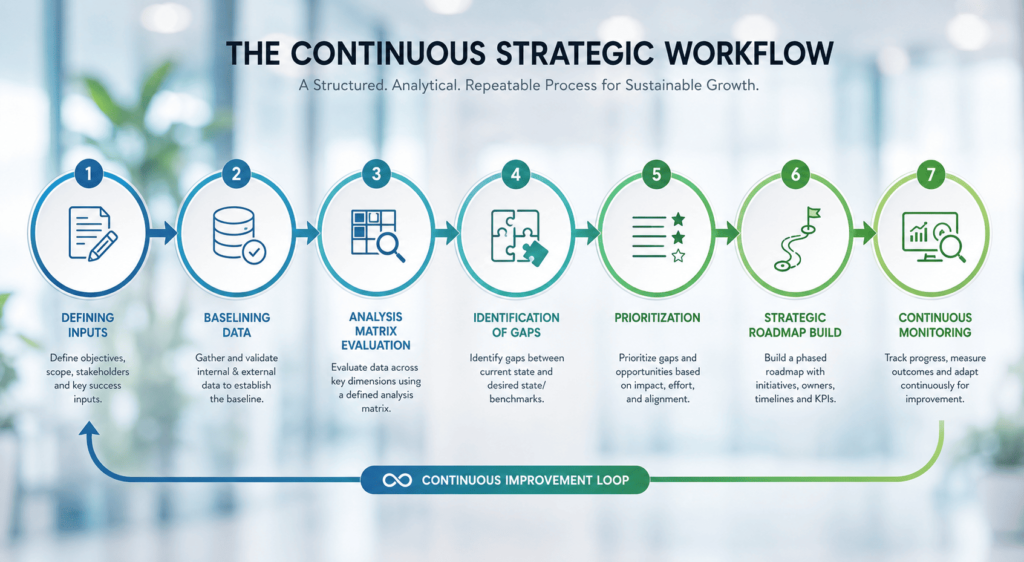
Applying MS-CIM follows a consistent seven-stage process. The stages are sequential the first time you run them, then several stages repeat on a review cycle.
Stage 1 — Define the Competitive Set Separate competitors into three categories: direct competitors (same offer, same audience), indirect competitors (different offer, same problem), and aspirational competitors (the position you want to occupy in 18–24 months). Scoring all three against the same matrix reveals gaps a same-category comparison alone would miss. This foundational exercise anchors cleanly into our primary “Market Research Framework.”
Stage 2 — Establish Baseline Metrics Collect the raw inputs each MS-CIM dimension depends on: organic visibility data, top-performing content by topic, backlink and referring-domain profiles (modeled after Ahrefs’ competitive analysis methodology for data integrity), presence in AI-generated answers for category queries, and a structured walkthrough of each competitor’s core conversion paths.
Stage 3 — Run the MS-CIM Evaluation Score every competitor across the five dimensions using the scoring framework below. Score consistently — the same criteria, applied the same way, to every competitor in the set — or the comparison loses validity.
Stage 4 — Identify Strategic Gaps For each dimension, compare your own score against the strongest competitor. The gap itself is the finding — not the competitor’s raw score. A competitor scoring high on Content Authority only matters if your own score is meaningfully lower in the same category.
Stage 5 — Prioritize Findings Not every gap deserves the same response. Route findings through the Prioritization Model below to separate quick wins from long-term strategic bets.
Stage 6 — Build the Action Roadmap Convert prioritized findings into a sequenced set of initiatives with owners and target dates. This is where competitive intelligence exits the Research Hub phase and becomes an execution plan — typically feeding directly into an SEO Strategy Framework or a dedicated Content Strategy roadmap.
Stage 7 — Monitor Continuously Re-score the matrix on a fixed cadence (quarterly is typical) rather than treating the exercise as a one-time deliverable. Positioning changes; a framework that isn’t revisited becomes stale within a single quarter in most competitive categories.
Evaluation Dimensions: Scoring Criteria
Each MS-CIM dimension is evaluated against specific, observable criteria rather than subjective impression. This is what keeps the framework consistent across analysts and across review cycles.
| Dimension | What to Evaluate | Evidence to Collect |
|---|---|---|
| Search Visibility | Ranking breadth across the funnel, share of visibility for category terms, visibility trend over time | Ranking data across informational, commercial, and transactional queries |
| Content Authority | Topical completeness, depth vs. search intent, originality of explanation | Content audits of top-ranking pages by topic cluster |
| Entity & AI Visibility | Presence in AI Overviews and chat-based answers, structured data usage, knowledge graph presence | Manual AI query testing, schema markup review |
| Conversion Experience | Clarity of offer, trust signal density, CTA-to-awareness-stage alignment | Site walkthroughs mapped to buyer journey stages |
| Business Differentiation | Distinctiveness of methodology or point of view, defensibility of positioning | Messaging and positioning review across owned channels |
Competitor Scoring Framework
Score each competitor from 1 (weak) to 5 (dominant) on each of the five MS-CIM dimensions. Weight the dimensions if one matters disproportionately to your business — for most companies, an even weighting is the right starting point.
Composite Score = (Search Visibility + Content Authority + Entity & AI Visibility + Conversion Experience + Business Differentiation) ÷ 5
Use the composite score to place each competitor into one of four positioning categories:
- Leader (4.0–5.0): Strong across nearly every dimension. Study their approach; look for the one dimension where even leaders are weak.
- Challenger (3.0–3.9): Strong in one or two dimensions, exploitable gaps elsewhere. Usually the most actionable competitor to analyze in depth.
- Emerging (2.0–2.9): Building momentum in a specific dimension, worth monitoring rather than reacting to.
- Laggard (below 2.0): Low competitive threat currently, but useful as a baseline for how far the category has moved.
The categories matter less than the pattern across the set. If every competitor in a market scores low on Entity & AI Visibility, that’s not a competitor weakness — it’s a category-wide opportunity.
Prioritization Model
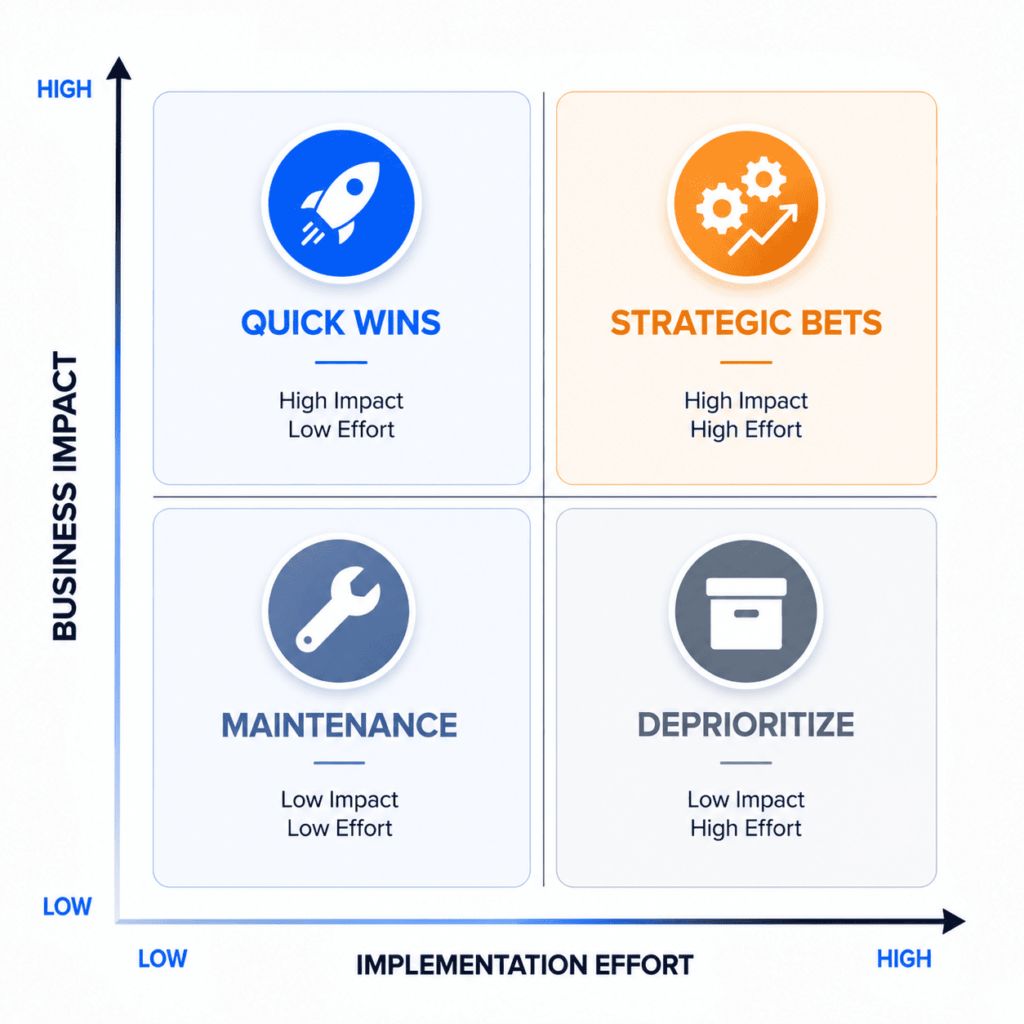
Scoring produces findings. Findings only become useful once they’re prioritized against effort and business impact.
Plot every identified gap on two axes:
- Business Impact — how directly closing this gap affects revenue, lead quality, or authority (Low / Medium / High)
- Implementation Effort — how much time, budget, and coordination closing the gap requires (Low / Medium / High)
This produces four categories:
- Quick Wins (High Impact, Low Effort): Execute immediately. These typically include content gaps, missing structured data, or weak CTAs on high-traffic pages.
- Strategic Bets (High Impact, High Effort): Sequence into the roadmap deliberately. These often include building a pillar content cluster or a proprietary framework to compete with a Leader-category competitor’s authority.
- Maintenance Items (Low Impact, Low Effort): Batch and handle opportunistically.
- Deprioritize (Low Impact, High Effort): Document the finding but don’t allocate resources yet — revisit at the next review cycle if conditions change.
Implementation Roadmap
Phase 1 — Baseline (Weeks 1–2): Define the competitive set, collect raw data across all five dimensions, and score every competitor using MS-CIM.
Phase 2 — Gap Identification (Weeks 3–4): Compare scores against your own baseline, document every meaningful gap, and separate category-wide gaps from single-competitor gaps.
Phase 3 — Roadmap Build (Weeks 5–6): Run findings through the Prioritization Model, sequence initiatives, and assign ownership across content, SEO Consulting, and Conversion Rate Optimization workstreams.”
Phase 4 — Continuous Monitoring (Ongoing): Re-score the matrix quarterly. Track whether prioritized initiatives actually closed the identified gaps in the following cycle — this is the step most businesses skip, and it’s the one that turns competitive intelligence into a compounding advantage rather than a recurring report.
Common Mistakes
- Comparing too many competitors at once. Five to eight well-chosen competitors produce better decisions than twenty superficially reviewed ones.
- Scoring inconsistently across competitors. If the criteria shift between evaluations, the composite scores stop being comparable.
- Treating tool output as the analysis. Rank tracking and backlink tools supply inputs to MS-CIM; they are not a substitute for the scoring and prioritization steps.
- Ignoring AI visibility because it’s harder to measure. Manual query testing across AI-assisted search surfaces is more time-consuming than pulling a rankings report, but skipping it means missing an entire visibility layer competitors are already contesting.
- Analyzing competitors without analyzing yourself first. MS-CIM only produces a usable gap when your own score exists on the same scale.
- Building a roadmap that never gets revisited. A framework run once and filed away has the same shelf life as a single audit — the value comes from the review cadence.
Where This Framework Draws From
MS-CIM synthesizes established thinking from several distinct areas of search and marketing practice rather than inventing them from scratch: Rand Fishkin’s Share of Search concept informs the Search Visibility dimension; Koray Tuğberk Gübür’s work on entity-based and semantic SEO informs how Entity & AI Visibility is evaluated; Lily Ray’s research on E-E-A-T and search quality informs the trust criteria within Content Authority; Aleyda Solis’ work on technical and international SEO informs the rigor of the baseline data collection stage; and Andy Crestodina’s approach to content and analytics informs how Conversion Experience is measured against real visitor behavior. MS-CIM’s contribution is combining these into a single, weighted, repeatable scoring system rather than treating each as a separate analysis.
Competitive Intelligence Audit Checklist
Use this checklist before considering an MS-CIM cycle complete:
- Competitive set defined across direct, indirect, and aspirational competitors
- Baseline data collected for all five MS-CIM dimensions
- Every competitor scored using identical criteria
- Composite scores calculated and positioning categories assigned
- Gaps documented against your own baseline, not just competitor strength
- Findings routed through the Prioritization Model
- Roadmap built with owners and target dates
- Next review cycle scheduled
Frequently Asked Questions
What is a competitor analysis framework? A competitor analysis framework is a repeatable system for evaluating competitors against consistent criteria, then converting the findings into prioritized actions — as opposed to an unstructured review of competitor tactics.
How is competitive intelligence different from a competitor audit? An audit is a single-point-in-time review. Competitive intelligence is an ongoing process with a defined review cadence, designed to track how competitive positioning changes over time.
How often should competitor analysis be repeated? Quarterly is a reasonable default for most industries. Fast-moving categories — particularly ones where AI visibility is actively shifting — may warrant a review every eight to ten weeks.
How many competitors should be included in the analysis? Five to eight is typically enough to surface meaningful patterns without diluting analysis time. Include at least one aspirational competitor outside your immediate category.
Does MS-CIM replace an SEO audit or keyword research? No. MS-CIM evaluates competitive positioning across search, content, AI visibility, conversion, and differentiation. An SEO audit and keyword research are inputs into the Search Visibility dimension, not substitutes for the full framework.
How does AI visibility get measured in a competitor analysis? Primarily through manual query testing against AI Overviews and AI-assisted answer engines for category-defining questions, combined with a review of structured data and how clearly a competitor’s content states definitions, frameworks, and comparisons that are easy for AI systems to extract.
Next Steps
A completed MS-CIM evaluation identifies where your business is exposed and where competitors are vulnerable — but the framework’s value comes from what happens after the scoring is finished. From here, most businesses move in one of two directions:
Need Macro Market Context First?
Evaluating specific competitors works best when paired with broader search demand and category analysis in our overarching research cluster.
Deeper research into market conditions through the Market Research Framework, or straight into execution through an Opportunity Analysis that converts prioritized gaps into a growth plan.
If you’d rather have this run for your specific market, MS applies the MS-CIM methodology directly during a Strategy Consultation.
Looking for done-for-you execution? Marketing Scrappers applies the MS-CIM methodology directly during a comprehensive Strategy Consultation to
build a defensible digital growth roadmap tailored to your competitive market.