
Audience Research Framework: A 5-Layer System for Understanding Who You’re Actually Selling To
An audience research framework is a repeatable system for discovering who a business’s real customers are, what problems they’re trying to solve, how they describe those problems in their own words, and how they make the decision to buy. It replaces guesswork and internal assumptions with evidence gathered directly from the market, and it produces the raw material that personas, ideal customer profiles (ICPs), and segmentation models are built from.
Most teams get this backwards. They start by drafting a persona template, filling it with assumptions, and calling it “audience research.” That produces a document that feels complete but isn’t grounded in anything real. The MS Audience Research Framework below reverses that order: evidence first, artifacts second.
Why Audience Research Is Different From Market Research
It’s worth drawing a hard line here, because the two get conflated constantly.
Market research looks outward — examining market size, competitive positioning, industry trends, and demand signals.
Audience research looks at the individual decision-maker — their problems, language, motivations, and buying behavior — independent of what competitors are doing or how large the market is.
A business can have excellent market research and still lose deals, because the messaging doesn’t speak to how buyers actually think. Audience research fixes that specific gap. It answers “who is this for and what do they need to hear,” not “how big is the opportunity” or “who else is competing for it.”
This article stays inside that boundary intentionally. It focuses purely on understanding the buyer, rather than covering competitor analysis, search demand patterns, or how these insights feed into downstream opportunity analysis. Those strategic applications build directly on top of the audience foundation established here.
💡 Looking for broader market insights?
Understanding your specific audience is just one piece of the puzzle. Visit our research hub to Explore the Market Research Framework and analyze industry trends, competitive positioning, and market demand.
Why Audience Research Matters
Every part of a marketing and sales system depends on an accurate understanding of the audience:
- Positioning and messaging only land when they reflect language the buyer already uses to describe their problem.
- Content strategy only earns attention when it addresses questions the audience is actually asking, in the order they’re asking them.
- Sales conversations move faster when the team already understands the buyer’s decision criteria and typical objections.
- SEO strategy depends on knowing the intent behind a search query, which is an audience research output, not a keyword tool output.
- Content marketing depends on knowing which awareness stage a piece of content needs to serve.
Skip this step, and every downstream decision — copy, content, targeting, sales enablement — gets built on assumption instead of evidence. That’s the most common reason marketing programs underperform despite reasonable execution: the strategy was aimed at an imagined customer, not the real one.
How Audience Research Actually Works
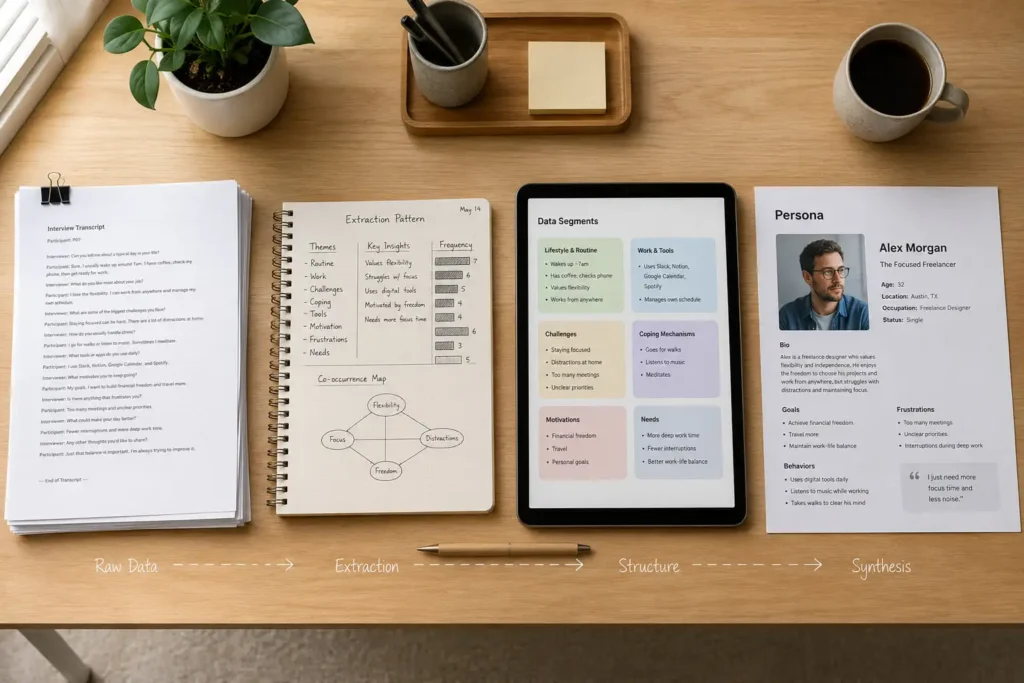
Good audience research follows a simple discipline: collect raw evidence from real people before constructing any summary artifact.
The sequence is:
- Gather primary evidence — customer interviews, sales call recordings, support tickets, onboarding call notes, review sites, community forums, win/loss interviews.
- Extract patterns — recurring language, recurring objections, recurring triggers that led someone to start looking for a solution.
- Organize patterns into structures — segments, jobs, pain points, decision criteria.
- Synthesize structures into usable artifacts — personas, ICP definitions, messaging inputs.
- Validate against new evidence — check the artifacts against fresh interviews or sales conversations before treating them as final.
The mistake most guides make is starting at step 4. A persona built without steps 1–3 underneath it is a work of internal opinion, not audience research — regardless of how professional the template looks.
The MS Audience Research Framework
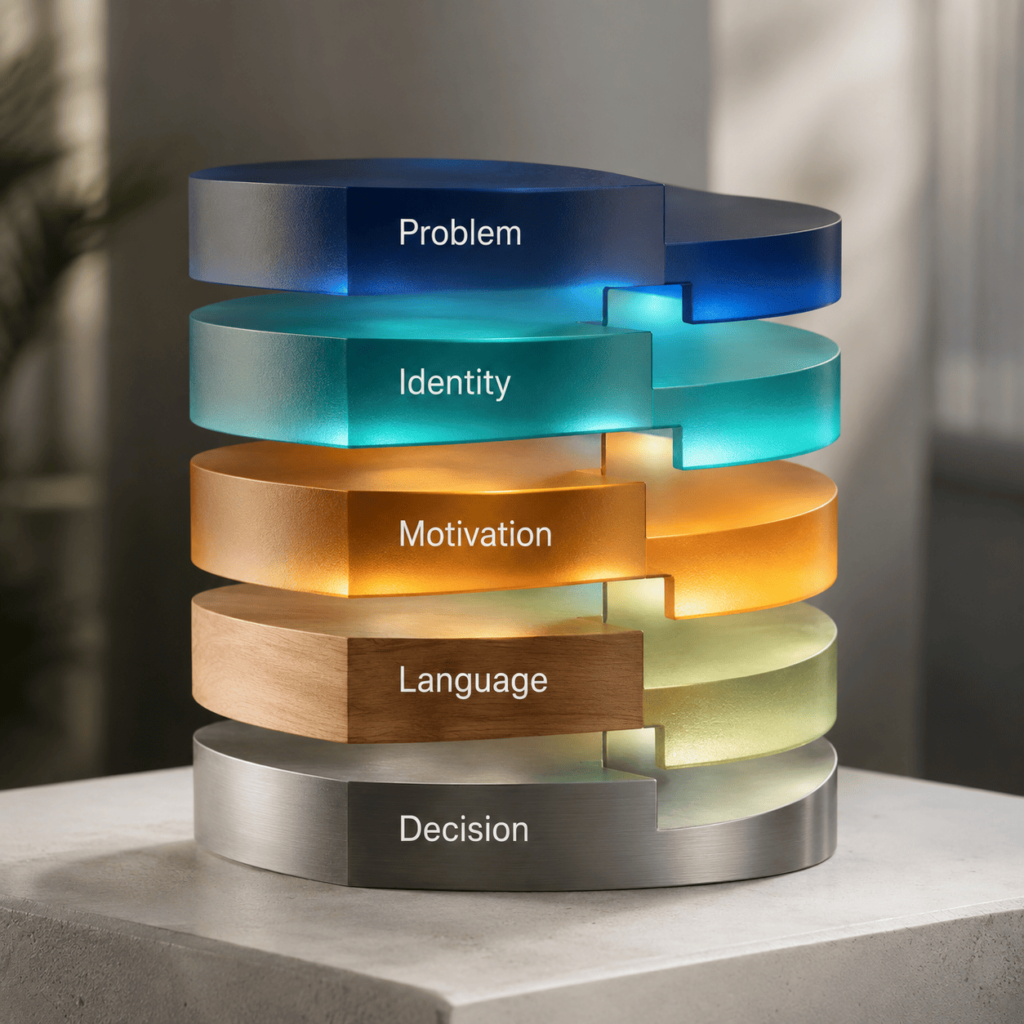
The MS Audience Research Framework organizes audience research into five layers. Each layer answers a different question, and each depends on the evidence gathered in the layer before it. Personas and ICPs are not separate layers — they are outputs assembled from the first four layers and validated in the fifth.
| Layer | Core Question | Primary Output |
| 1. Problem Layer | What problem is driving this buyer to look for a solution? | Documented pain points, triggers, and consequences of inaction |
| 2. Identity Layer | Who experiences this problem, and how do they group naturally? | Segmentation model (firmographic, behavioral, psychographic) |
| 3. Motivation Layer | What is the buyer actually trying to accomplish? | Jobs To Be Done (functional, emotional, social) |
| 4. Language Layer | How does the buyer describe the problem in their own words? | Voice of Customer (VoC) library |
| 5. Decision Layer | How does the buyer evaluate options and decide? | Decision criteria, objections, buying committee map |
Layer 1 — Problem Layer
This layer identifies the specific event, frustration, or business consequence that pushes someone from “not looking” to “actively looking.” Every buyer has a trigger — a missed target, a failed process, a competitor move, a new hire who flags an issue that’s been ignored. Without identifying the trigger, messaging tends to describe features instead of relevance.
What to capture:
- The problem in the buyer’s own terms, not the vendor’s category language
- What the buyer was doing before the problem became urgent
- What happens if the problem stays unsolved (the cost of inaction)
- Who else in the organization feels the consequence of the problem
Layer 2 — Identity Layer
This layer groups buyers into meaningful segments — not by arbitrary demographic buckets, but by shared problems, shared buying behavior, and shared decision patterns, drawing directly on the core principles of customer segmentation.
Useful segmentation dimensions include:
- Firmographic — company size, industry, growth stage, tech stack
- Behavioral — how they currently solve the problem, how they research, how they buy
- Psychographic — risk tolerance, decision speed, internal culture around new tools
A segment is only useful if it changes how the business should message, target, or sell. If two segments would receive the same content and the same pitch, they aren’t functionally different segments — merge them.
Layer 3 — Motivation Layer
This layer applies Jobs To Be Done (JTBD) thinking: people don’t buy products, they hire them to make progress on a specific job. JTBD analysis separates that job into three dimensions:
- Functional job — the practical task being accomplished (“consolidate reporting across five tools”)
- Emotional job — how the buyer wants to feel during and after the process (“confident the decision won’t be second-guessed”)
- Social job — how the buyer wants to be perceived by others (“seen as the person who fixed this”)
Most messaging only addresses the functional job. Differentiation frequently comes from correctly addressing the emotional and social jobs competitors ignore.
Layer 4 — Language Layer
This layer captures Voice of Customer (VoC) — the exact phrases, complaints, and questions real buyers use. VoC is collected, not invented. Reliable sources include sales call transcripts, support tickets, live chat logs, review site comments, and direct interview quotes.
The output is a living VoC library organized by theme (problem descriptions, objections, feature requests, praise) that copywriters, SEO teams, and sales enablement can pull from directly. This is also where genuine long-tail search phrasing tends to surface — buyers often search using the same words they use to describe the problem out loud.
Layer 5 — Decision Layer
This layer documents how the buyer actually evaluates and chooses a solution:
- Decision criteria — the specific factors used to compare options (price, integration effort, support quality, implementation time)
- Objections — the concerns that stall or kill a deal
- Buying committee — who else is involved, and what each person cares about
- Decision timeline — how long the process typically takes and what triggers each stage
This layer is what turns audience research into something sales and content teams can act on immediately, because it maps directly to how objections should be handled and where trust signals need to appear in the customer journey.
📥 Take the Framework With You
Want to implement this audience research process with your team? Access our comprehensive resource library to get the complete Download the MS Audience Research Framework template and start gathering actionable customer insights today.
Buyer Persona vs. ICP vs. Segmentation
These three terms get used interchangeably, but they answer different questions and serve different purposes.
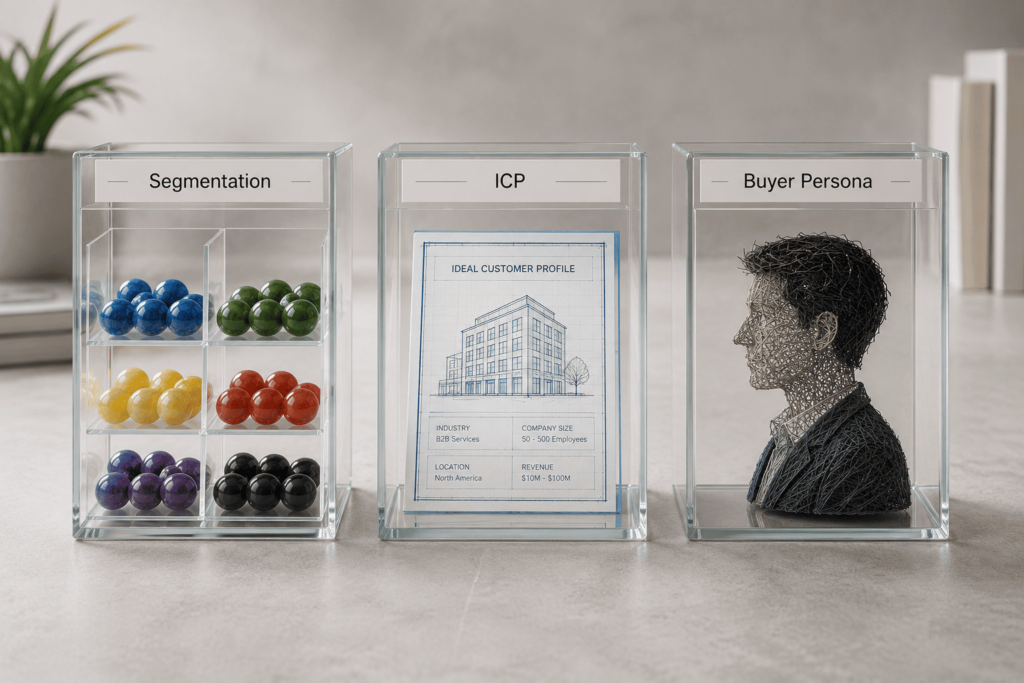
| Concept | Question It Answers | Scope | Primary Use |
| Segmentation | How does the audience naturally divide? | Groups of accounts or people | Targeting and prioritization |
| Ideal Customer Profile (ICP) | Which accounts are worth pursuing? | Company-level (B2B) | Sales targeting, account prioritization |
| Buyer Persona | Who is the individual decision-maker, and how do they think? | Individual-level | Messaging, content, sales conversations |
A useful way to hold these together: segmentation defines the groups, the ICP defines which groups are worth pursuing, and personas describe the individuals inside the ICP who actually make or influence the decision. Skipping straight to persona creation without segmentation or ICP work underneath it is why so many personas feel generic — they were never anchored to a specific, prioritized group in the first place.
Applying the Framework: A Practical Scenario
Consider a mid-market B2B software company that sells project management software to marketing agencies. Running the five layers might surface something like this:
- Problem Layer — Agencies aren’t struggling with “task management” in the abstract. The real trigger is client-facing reporting breaking down when a project spans multiple tools, which surfaces during a client escalation.
- Identity Layer — Two segments emerge: agencies under 20 people managing everything manually, and agencies over 20 people who’ve outgrown a spreadsheet-based system. These segments need different messaging entirely — one needs a case for structure, the other needs a case for consolidation.
- Motivation Layer — The functional job is “give clients a clear status update in one place.” The emotional job is “stop feeling behind in client meetings.” The social job is “be seen internally as the person who fixed the reporting problem.”
- Language Layer — Interviews and support tickets reveal buyers rarely say “project management software.” They say “client visibility” and “status reporting” far more often — language that should show up in headlines, not buried in body copy.
- Decision Layer — The dominant objection isn’t price; it’s migration effort from the current tool. That single insight should shape the entire onboarding narrative on the commercial page.
None of this emerges from a persona template filled out in a conference room. It comes from the raw evidence layers underneath it.
Choosing a Research Method: A Simple Decision Framework
| If you need… | Use this method |
| Deep understanding of a single buyer’s reasoning | 1:1 customer interviews |
| Quantifiable patterns across a large audience | Structured surveys |
| Unfiltered, in-the-moment language | Support tickets, live chat logs, review sites |
| Insight into what almost stopped a purchase | Win/loss interviews |
| Understanding of what convinces a buyer to say yes | Sales call recordings and transcripts |
| A pulse on emerging pain points at scale | Community forums and social listening |
No single method covers all five layers. A minimum-viable audience research effort combines at least one direct-conversation method (interviews or sales calls) with one passive-language method (support tickets or reviews), because buyers say different things in each context.
Implementation Checklist
Use this checklist before treating an audience research effort as complete:
Common Mistakes in Audience Research
Starting with the persona template instead of the evidence. This produces a document that looks finished but was never grounded in real conversations.
Treating one interview as representative. Patterns require repetition across multiple sources before they’re reliable enough to act on.
Confusing firmographic segmentation with meaningful segmentation. Company size alone rarely explains why two buyers make different decisions.
Skipping the language layer. Teams write copy in their own internal vocabulary instead of the vocabulary the market actually uses, which quietly suppresses both conversion and organic visibility.
Never revisiting the research. Buyer language and priorities shift as the market matures; audience research has a shelf life and needs periodic revalidation.
Building personas that read like a stock photo caption. A persona with a name, a stock photo, and generic hobbies but no documented pain point, trigger, or objection isn’t useful to anyone downstream.
Best Practices
- Anchor every claim in the audience research to a specific source (an interview, a ticket, a call) rather than a general impression.
- Prioritize recency — buyer language shifts, especially in fast-moving categories.
- Keep the VoC library accessible to content, SEO, and sales teams, not locked inside a single research document.
- Revalidate personas and ICP definitions at least once or twice a year, or immediately after a significant shift in the market.
- Treat every layer as evidence for the next one — resist the urge to jump straight to persona-writing.
Frequently Asked Questions
What is the difference between audience research and market research?
Audience research focuses on individual buyer behavior, language, and decision-making. Market research focuses on the broader competitive and demand landscape. They inform each other but answer different questions — see the Market Research Framework for the market-level process.
How is a buyer persona different from an Ideal Customer Profile (ICP)?
A persona describes an individual decision-maker’s mindset, motivations, and language. An ICP describes the type of account or company most likely to become a successful, profitable customer. Personas typically live inside an ICP, not the other way around.
How often should audience research be updated?
At minimum annually, and immediately after any major shift — a new competitor, a pricing change, a product pivot, or a noticeable change in the language prospects use during sales calls.
Can audience research be done without customer interviews?
Partially. Support tickets, reviews, and sales call transcripts provide real signal, but they tend to be less complete than direct interviews, which allow follow-up questions that surface the “why” behind a stated preference.
Does Jobs To Be Done replace buyer personas?
No. JTBD explains what the buyer is trying to accomplish; personas describe who is trying to accomplish it and how they think. They’re complementary layers in the same framework, not competing methods.
What’s the biggest sign that a persona was built without real research?
It reads as a demographic sketch — name, title, hobbies — with no documented pain point, no direct quote, and no specific objection attached to it.
Next Step
Audience research is the input layer for nearly everything else in a growth system — messaging, content planning, SEO strategy, and content marketing all depend on it being accurate. Once the five layers are documented, the next step is usually translating them into market-level context through the Market Research Framework, or applying them directly to a service engagement.