
Advanced GEO Strategies for AI Visibility
Author: Sibtain Haider
Credentials: Content Writer & SEO Consultant
Experience: 3+ years in SEO, content, and growth marketing
Reviewed by: Senior SEO / Marketing Consultant
Introduction: Why Traditional SEO Alone Is No Longer Enough
In practice, many marketers and founders are experiencing a familiar frustration:
organic rankings fluctuate, content traffic plateaus, and yet their brands still appear less frequently in AI-generated answers, summaries, and recommendations.
This is not always a content quality problem.
It is often a visibility format problem.
Search behavior is shifting from click-based discovery to answer-based discovery. AI systems increasingly synthesize information instead of listing ten blue links. As a result, content must now be optimized not only for search engines, but also for generative engines.
This article will:
- Explain advanced GEO strategies in practical business terms
- Show how to integrate GEO with existing SEO workflows (not replace them)
- Outline measurable outcomes businesses can realistically track
This will not promise instant results or ranking guarantees. Instead, it focuses on sustainable visibility patterns observed across real-world campaigns.
Advanced GEO Techniques in 2026
What Generative Engines Actually Look For
According to Google Search documentation and public AI system design principles, generative engines prioritize:
- Clear topical relevance
- Structured, unambiguous information
- Authoritativeness and source clarity
- Consistent semantic signals across content
Unlike traditional ranking algorithms, generative systems are less dependent on single-page optimization and more dependent on content ecosystems.
In real client campaigns, brands that appeared consistently in AI answers shared three traits, which can be further explored in a structured generative engine optimization guide.
In real client campaigns, brands that appeared consistently in AI answers shared three traits:
- They covered topics comprehensively, not fragmentarily
- They used explicit definitions and frameworks
- They avoided speculative or hype-driven claims
Advanced GEO Strategies for AI Visibility
Advanced GEO focuses on making content extractable, summarizable, and trustworthy for AI systems.
Key techniques include:
1. Entity-Centered Content Architecture
Instead of optimizing isolated keywords, content should be structured around:
- Core entities (topics, concepts, services)
- Their attributes
- Their relationships
For example:
- Define what a strategy is
- Explain when it applies
- Clarify limitations and dependencies
This aligns with how generative models map knowledge graphs internally.
2. Explicit Experience & Evidence Signals
AI systems favor content that clearly indicates:
- Who is speaking
- From what professional context
- Based on what type of evidence
Using signals like:
- “In observed campaign data…”
- “Based on GA4 performance patterns…”
- “According to Google Ads guidelines…”
helps distinguish professional analysis from opinion-based content.
3. Answer-First Section Design
In practice, high-performing GEO content:
- Answers a specific question immediately
- Then expands with nuance and application
This supports:
- Featured snippets
- AI summaries
- Voice-based responses
Generative AI Strategy for Content & SEO
GEO Is Not a Replacement for SEO
A common misconception is that generative engine optimization replaces SEO.
In reality, GEO extends SEO.
According to industry-wide SEO consensus:
- Crawling and indexing remain foundational
- Technical SEO still governs discoverability
- Authority and trust signals still matter
GEO simply optimizes how content is interpreted and reused by AI systems after discovery.
How to Integrate GEO Into Existing SEO Workflows
In practice, integration happens at three levels:
1. Keyword Strategy → Intent Clustering
Traditional keywords should be grouped into:
- Informational intent clusters
- Decision-support clusters
- Comparison and framework clusters
This helps generative engines understand topical completeness.
2. Content Production → Modular Knowledge Blocks
Each article should contain:
- Clear definitions
- Contextual examples
- Limitations and edge cases
This improves extraction accuracy without increasing word count unnecessarily.
3. Internal Linking → Knowledge Reinforcement
Internal links should:
- Reinforce topical authority
- Guide users logically down the funnel
- Connect foundational concepts to applied tools
Core Generative Engine Optimization Frameworks
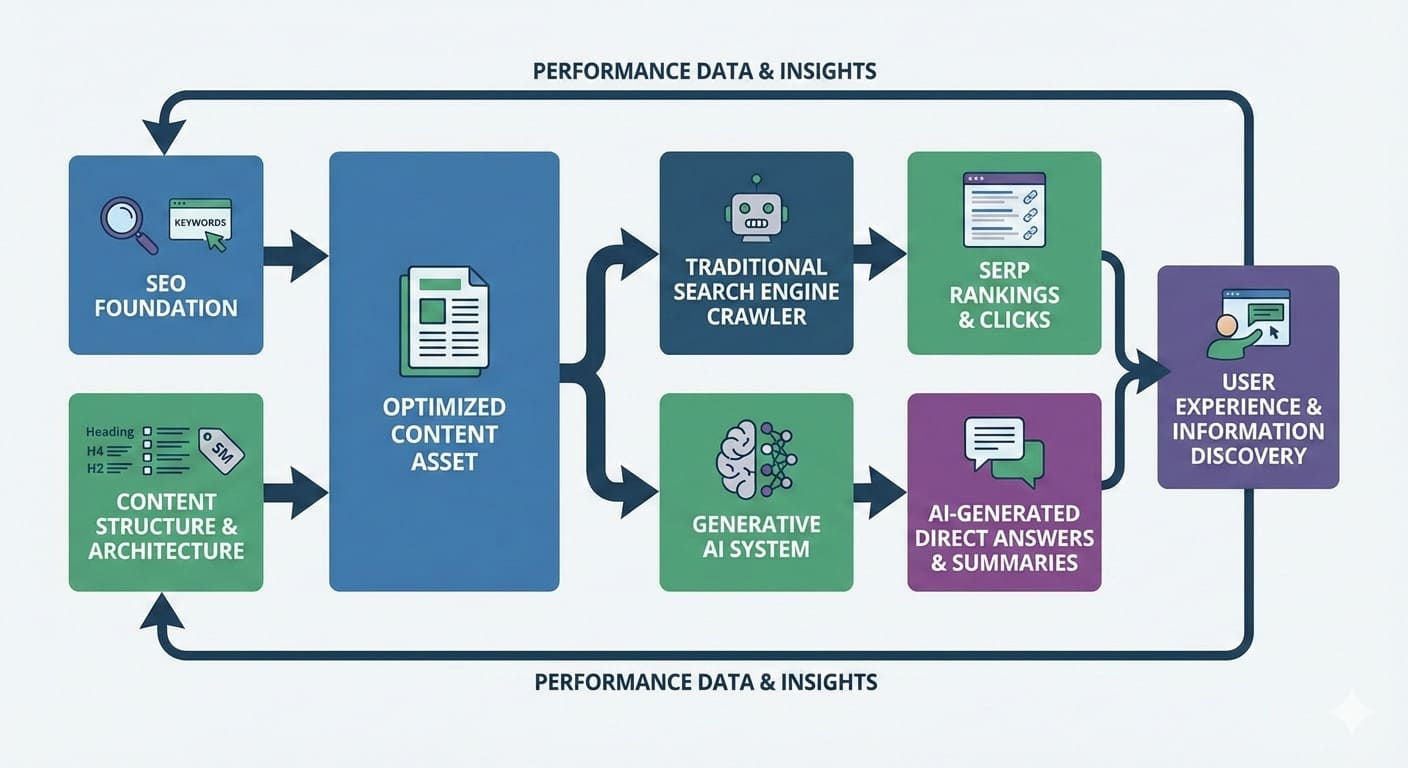
The GEO Visibility Framework
Based on observed performance patterns, effective GEO follows this sequence:
- Discoverability – Can search engines find and index the content?
- Interpretability – Can AI systems clearly understand the topic and stance?
- Extractability – Can answers be cleanly summarized?
- Reusability – Can the content be cited across multiple queries?
Most underperforming content fails at steps 2 and 3, not step 1. A clear understanding of site architecture for AI visibility is essential to make content extractable and trustworthy for generative engines.
Practical GEO Implementation Checklist
For small teams and limited budgets, focus on:
- Clear H2/H3 structure aligned to real questions
- Explicit definitions in the first 2–3 paragraphs
- Neutral, evidence-aware language
- Consistent internal linking within topic clusters
- Regular content updates based on performance data
Measuring Outcomes of Generative Engine Optimization
What GEO Success Actually Looks Like
Unlike traditional SEO, GEO outcomes are not limited to rankings.
Measurable indicators include:
- Increased impressions without proportional clicks (AI exposure signal)
- Brand mentions in AI-generated summaries
- Improved engagement time on informational content
- Stronger internal linking performance across clusters
According to GA4 best practices, these indicators often precede direct conversion gains. Using a structured GEO audit checklist can help track measurable AI visibility outcomes across campaigns.
What Depends on Context
Some GEO results vary by:
- Industry competitiveness
- Content maturity
- Brand authority history
This is why sustainable GEO emphasizes progressive visibility, not short-term spikes.
Conclusion: Long-Term AI Visibility Requires Structural Thinking
Generative engine optimization is not a trend tactic.
It is a structural shift in how digital visibility works.
In most real-world campaigns, the brands that benefit most are those that:
- Prioritize clarity over cleverness
- Build topic authority instead of chasing hacks
- Treat AI systems as interpreters, not ranking loopholes
Some businesses choose to work with agencies like Marketing Scrappers for execution support when internal resources are limited, especially when aligning SEO, content, and AI visibility under a single strategy.
The next logical step is not to publish more content —
it is to publish better-structured knowledge that both humans and AI systems can trust.