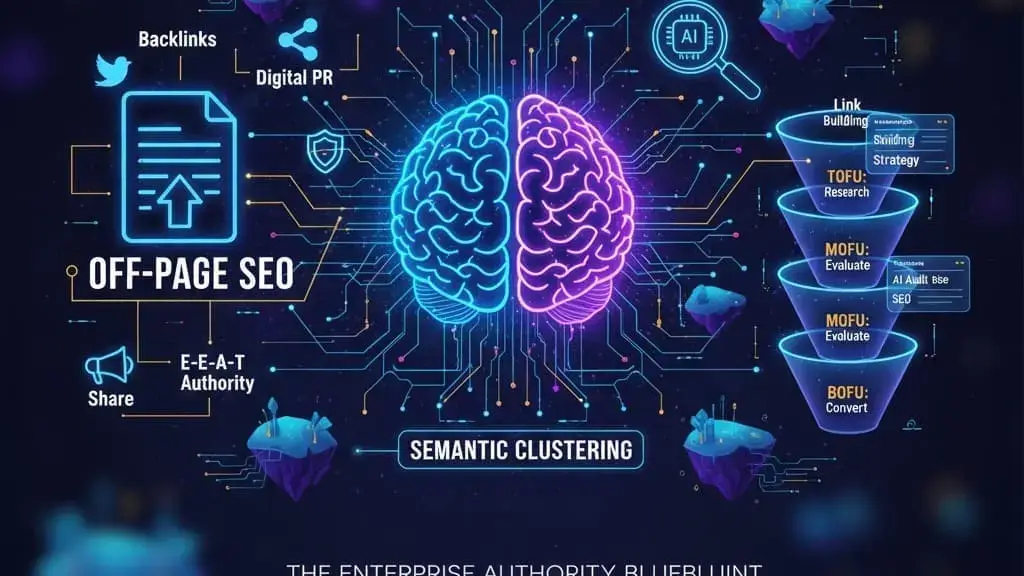

How Semantic Off-Page SEO Builds AI-Ready Brand Trust
Discover how semantic Off-Page SEO transforms your enterprise into an AI-ready authority. In this blueprint, we decode Microsoft-aligned strategies to build trust, accelerate link acquisition, and dominate modern search rankings. I. Strategic Imperatives: Off-Page SEO, Enterprise Authority & the AI Era 1.1 Why Semantic Off-Page SEO Is the Foundation of Enterprise Authority Off-Page SEO embodies external validation—it’s how your domain builds trust, signals authority, and acquires measurable ranking strength beyond internal content optimization. While On-Page SEO optimizes internal structure, content, UX, and keyword usage, Off-Page SEO is about what others say about you: backlinks, brand mentions, social references, influencer signals, and third-party endorsements. Backlinks remain one of Google’s strongest ranking signals. Neglecting link acquisition makes it nearly impossible to compete for high-difficulty keywords in competitive industries. While On-Page SEO can yield early improvements within weeks, meaningful impact from Off-Page SEO generally takes 2 to 6+ months of consistent execution. In the era of E-E-A-T (Experience, Expertise, Authoritativeness, Trustworthiness), Off-Page SEO is the external “proof” mechanism. High-quality backlinks, authoritative citations, and brand mentions substantiate your domain’s E-E-A-T posture. If you’re looking to build enterprise-level authority through a structured Off-Page SEO strategy, our Off-Page SEO Services help your brand earn authoritative links and citations that drive long-term rankings. Because search engines increasingly treat E-E-A-T as a signal for quality, your strategy must evolve beyond keyword optimization. Your content must be capable of attracting external validation — expert author bios, original data, and compelling case studies lend credibility and linkability. 1.2 Aligning with Microsoft’s AI Structured Data & Trust Signals When building enterprise-scale SEO, alignment with AI-first search paradigms is essential. Microsoft’s recent advice underscores this: Structure content carefully (clear headings, self-contained passages) so AI systems can “lift” meaningful answers. Use schema markup, FAQ blocks, and conversational formatting to help AI systems parse and understand your content. In a controlled test, only the page with robust schema implementation appeared in an AI Overview and achieved top ranking. Thus, to perform in both classic search and in AI-powered answer engines, your content must be deeply structured, semantically coherent, and trust-anchored. A semantic clustering approach (versus isolated keyword targeting) enables better alignment with LLM-driven systems that prize context and entity relationships. Further, thought leadership and Digital PR are not optional — they serve as the bridge between content and external authority, making your high-risk, competitive keywords tractable. II. Foundational Methodology: Intent Mapping, Semantic Clusters & Priority Scoring 2.1 Mapping Search Intent: The “Why” Behind Each Keyword Keyword research should start with intent — what is the user trying to accomplish? Semantic clustering groups keywords by shared meaning and intent, not merely lexical similarity. ClickRank+1 Intent is classically divided into three core types (which align with the funnel): Intent Searcher Goal Funnel Phase Content Type Off-Page Focus Informational Learn or define a concept (e.g. “what is off-page SEO”) TOFU Guides, checklists, content hubs Earn brand mentions, social shares Commercial Investigation Explore methods, tools, and comparisons MOFU Deep case studies, workflows, comparative guides Secure expert citations, niche backlinks Transactional Ready to act — services, tools, procurement BOFU Service pages, ROI calculators, testimonials Acquire high-authority links to conversion pages This alignment ensures your content both serves the user and is optimized for external authority-building. Want to ensure your On-Page SEO aligns perfectly with user intent and AI search systems? Explore our On-Page SEO Optimization Service to build semantic depth and an AI-ready content structure. 2.2 Strategic Metrics: Volume, Difficulty & Prioritization To structure content investments, you’ll track: Search Volume (SV) — potential traffic opportunity Keyword Difficulty (KD) — estimated ranking competitiveness Strategic Priority Score — a custom score (1–5) combining intent, difficulty, and revenue alignment Example benchmark ranges (for enterprise-level sites): KD 0–29: Low competition — suitable for quick wins KD 30–49: Mid competition — requires additional off-page support KD 50–69: Hard — needs strong domain authority & link strategy KD >70: Highly competitive — reserved for established domains Keywords with commercial or transactional intent often get a higher priority score even if difficulty is high, as their revenue potential justifies investment. 2.3 Semantic Clustering + Intent Mapping Framework Clusters group keywords by topical intent rather than mere lexical match. Each cluster addresses a cohesive subtopic of your core theme, with attention to the funnel stage and off-page needs. Intent Type Primary Goal Funnel Stage Format Off-Page Focus Informational Understand the core concept TOFU Ultimate guides, checklists Shareability, mentions Commercial Investigation Learn methods & workflows MOFU Detailed case studies, tool comparisons Expert mentions niche backlinks Transactional Acquire service/tool BOFU Service pages, ROI tools High-authority links to money pages This framework ensures every piece of content maintains a clear role and link-building objective. III. Keyword Strategy: Data-Driven Clusters & Content Themes Below is a refined cluster model you can adapt (with keyword research tools for your niche): 3.1 Cluster 1 — Off-Page Fundamentals & Awareness (TOFU / early MOFU) Keywords: off-page SEO checklist, what is off-page SEO, how off-page SEO helps rankingIntent: Informational → early awarenessKD target: 20–35Goal: Rapid domain topical coverage and traffic acquisition 3.2 Cluster 2 — Tactical Link Acquisition Methods (MOFU) Keywords: broken link building 2025, turn unlinked mentions into links, competitor backlink gap strategyIntent: Commercial investigationKD target: 30–45Goal: Attract mid-funnel readers and nurture them into deeper assets Need hands-on help with white-hat link acquisition or guest posting outreach? Our Guest Posting Services connect your brand with top-tier publishers and niche-relevant platforms to accelerate your Off-Page SEO growth. 3.3 Cluster 3 — Digital PR, E-E-A-T & Brand Authority (High-Value MOFU) Keywords: enterprise digital PR strategies, applying E-E-A-T to off-page SEO, brand mention link buildingIntent: Thought leadership / credibility-buildingKD target: 45–55Goal: Earn high-value citations and establish authority 3.4 Cluster 4 — Backlink Audits & Outsourcing (BOFU) Keywords: best B2B backlink audit tools, outsource link building services, backlink ROI calculatorIntent: TransactionalKD target: 50–65Goal: Convert qualified leads with service pages & conversion signals 3.5 Cluster 5 — Hyper-Specific & Long-Tail (TOFU / MOFU) Keywords: AI tools for link-building outreach, best backlink checker 2025, off-page SEO audit checklist PDFIntent: Niche