

Why Generative Engine Optimization Tools Matter for AI Search
-
Search visibility is no longer limited to rankings and clicks — AI systems now summarize, select, and cite sources directly in answers.
-
Traditional SEO tools are built to measure positions, traffic, and backlinks, not how content is interpreted by generative models.
-
In AI-driven search, content must be:
-
Clearly structured
-
Contextually complete
-
Entity-aligned
-
Easy for AI systems to extract and trust
-
-
Generative engine optimization tools help teams evaluate:
-
Whether content is likely to be used or cited in AI-generated answers
-
How well entities, topics, and relationships are defined
-
Where gaps exist between human-readable content and AI-readable structure
-
-
As AI search reduces direct clicks, these tools support visibility and attribution, not just rankings — a shift conventional SEO platforms were not designed to address.
Best Generative Engine Optimization Tools for AI Search (2026)
Author: Hassan Shroff – Founder, Marketing Scrappers
Credentials: SEO Strategist & Digital Marketing Consultant
Experience: 4+ years in SEO, content strategy, and growth marketing
Reviewed by: Senior SEO & AI Search Consultant
Introduction: Why Many SEO Teams Feel Unprepared for AI Search
Across industries, marketing teams are noticing a consistent shift: content that once performed well in traditional search is no longer surfacing as expected in AI-generated answers, conversational search results, or zero-click environments.
In practice, this creates several frustrations:
- Rankings improve, but traffic does not grow proportionally
- Content is indexed but not cited by AI answer engines
- Visibility shifts from pages to summarized responses
- Attribution becomes unclear
This guide is not a shortcut to “winning” AI search, nor does it promise guaranteed visibility. Instead, it provides a clear, structured overview of the best generative engine optimization tools, what role they play, and how businesses evaluate them responsibly in 2026.
What this guide will do
- Explain where GEO tools fit in modern search ecosystems
- Compare tool categories at a strategic level
- Help decision-makers assess suitability by use case
What this guide will not do
- Provide tool-specific tutorials
- Rank vendors by hype or speculation
- Replace foundational SEO or content quality work
Generative Engine Optimization Tools at a Glance
Before comparing features or use cases, most decision-makers want to confirm one thing quickly:
What generative engine optimization tools actually exist today, and how are they categorized?
Below is a high-level snapshot of the current GEO tool landscape, grouped by primary function.
This is not a ranking or endorsement — it is a visibility map.
AI Search Visibility & Citation Analysis Tools
Tools in this category are designed to assess whether and how content appears in AI-generated answers, summaries, and conversational search results.
Commonly referenced platforms include:
- Perplexity Pages / Source Monitoring Tools
- Brand or Citation Monitoring Platforms with AI SERP Tracking
- Custom LLM query testing tools used by SEO teams
Primary purpose:
- Detect AI answer inclusion
- Monitor citation frequency
- Evaluate attribution visibility
Semantic & Entity Optimization Platforms
These tools focus on how search engines and AI systems understand topics, entities, and relationships within content.
Commonly used platforms include:
- InLinks
- WordLift
- Schema-focused entity optimization tools
- Knowledge graph alignment platforms
Primary purpose:
- Strengthen entity clarity
- Improve topical completeness
- Support AI and semantic search interpretation
AI Content Evaluation & LLM Alignment Tools
These platforms analyze how large language models interpret, summarize, or transform content — without acting as publishing tools themselves.
Examples in this category include:
- LLM content evaluation frameworks
- AI content quality scoring tools
- Prompt-based content interpretation testers
Primary purpose:
- Assess AI readability and summarization behavior
- Identify factual ambiguity risks
- Validate answer-format compatibility
Hybrid SEO Platforms Adding GEO Capabilities
Some established SEO platforms are gradually introducing GEO-adjacent features, such as AI SERP monitoring or entity analysis.
These tools are typically:
- SEO-first platforms
- Augmented with AI visibility or semantic modules
- Not purpose-built GEO tools, but often used alongside them
Primary purpose:
- Bridge traditional SEO with AI search signals
- Support transition workflows for SEO teams
What this snapshot tells you:
GEO is not a single-tool market. In practice, teams combine analysis, semantic structuring, and AI interpretation tools rather than relying on one platform.
Section 1: Generative Engine Optimization — Context & Positioning
What Generative Engine Optimization Tools Are Designed to Support
Generative Engine Optimization (GEO) refers to optimizing content so it can be understood, selected, and cited by AI-powered search and answer engines.
According to Google’s Search documentation and public guidance on AI-generated results, systems increasingly prioritize:
- Clear topical structure
- Entity clarity and relationships
- Authoritativeness and source signals
- Factual consistency across the web
GEO tools do not replace SEO platforms. Instead, they extend analysis into areas such as:
- AI citation likelihood
- Semantic coverage
- Entity completeness
- Answer-format compatibility
- For a foundational explanation, see:
- What Is Generative Engine Optimization and Why It Matters for AI Search
- Generative Engine Optimization vs Traditional SEO
Section 2: Best Generative Engine Optimization Tools — Category Overview
Rather than listing individual vendors, it is more accurate to group generative engine optimization tools by capability type. In real-world evaluations, businesses typically use multiple tools across categories, not a single platform.
1. AI Search Visibility & Citation Analysis Tools
These tools assess whether content appears in:
- AI summaries
- Answer engines
- Conversational search outputs
They focus on:
- Citation frequency
- Prompt-based visibility testing
- Source attribution signals
Often used by:
- SEO strategists
- Content leads
- Editorial teams
2. Semantic & Entity Optimization Platforms
These tools help structure content around:
- Named entities
- Contextual relevance
- Topical completeness
Based on industry-wide SEO consensus and Google’s entity-based indexing approach, these platforms support:
- Knowledge graph alignment
- Disambiguation
- Topic authority modeling
3. AI Content Evaluation & Alignment Tools
These platforms analyze how content is interpreted by large language models:
- Answer accuracy
- Context retention
- Hallucination risk indicators
They are commonly used as pre-publication validation layers, not content generators.
For tool-specific breakdowns, see:
-
Best Generative Engine Optimization Tools: Features, Pricing & Pros/Cons
Section 3: Tools Comparison Snapshot (Decision Logic)
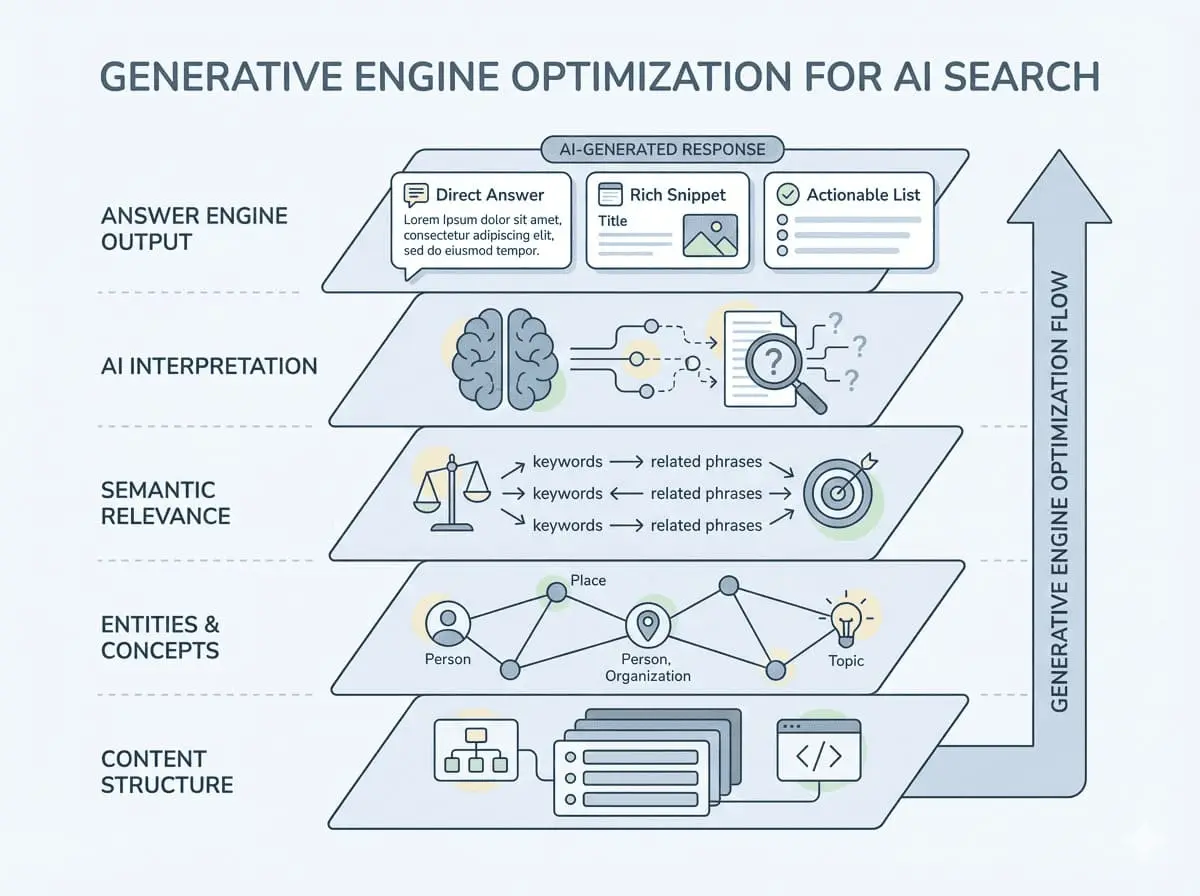
Rather than comparing tools by feature checklists, most teams evaluate them using three practical dimensions.
Capability Fit
- Does the tool focus on AI search, semantic SEO, or evaluation?
- Is it designed for analysis or execution support?
Integration Reality
- Can it complement existing SEO platforms?
- Does it align with GA4, Search Console, or editorial workflows?
Pricing Alignment
When assessing best generative engine optimization tools pricing, common patterns include:
- Credit-based AI queries
- Tiered access by feature depth
- Enterprise-only citation monitoring
Cost effectiveness depends on usage maturity, not company size.
For structured comparisons, see:
- Best Tools for Generative Engine Optimization
- Best GEO Tools Ranked by Performance
Section 4: GEO Tools by Use Case (High-Level Routing)
Agencies & Enterprises
Typically prioritize:
- Citation monitoring at scale
- Multi-domain analysis
- Governance and reporting
→ Best GEO Tools for Agencies and Enterprises
Startups & Small Businesses
Often need:
- Cost-controlled visibility insights
- Clear recommendations, not raw data
- Learning-oriented interfaces
→ Best GEO Tools for Startups & SMBs
E-commerce Brands
Focus on:
- Product entity clarity
- AI shopping and recommendation surfaces
- Structured data compatibility
→ Best GEO Tools for E-commerce
Publishers & Blogs
Common priorities include:
- Source attribution
- Editorial authority signals
- Answer engine compatibility
→ Best GEO Tools for Blogs & Publishers
Section 5: GEO Tools for AI Search & Answer Engines
As AI search expands, best generative engine optimization tools for AI search increasingly address:
- Answer engine inclusion
- Conversational query handling
- Voice and assistant responses
According to platform guidelines and observed SERP behavior:
- Clear authorship and review signals matter
- Consistent factual framing improves citation stability
- Over-optimized content is often ignored
For deeper exploration:
- Best GEO Tools for AI Search Results
- Best GEO Tools for Answer Engines
- Best GEO Tools for Voice & Conversational Search
Section 6: How to Choose the Right GEO Tool
In practice, businesses struggle most with tool overload, not tool scarcity.
Selection Criteria That Hold Up Long-Term
- Purpose clarity – analysis, validation, or monitoring
- Data transparency – explainable outputs, not black boxes
- Workflow fit – editorial and SEO alignment
- Evidence grounding – alignment with platform documentation
Avoid selecting tools based solely on:
- AI buzz
- Automated “scores” without context
- Promises of guaranteed AI visibility
For structured guidance:
-
How to Choose the Best Generative Engine Optimization Tools
Section 7: Pricing, Free Trials & Access Models
Most GEO platforms fall into one of three access models:
- Limited free testing environments
- Time-bound trials with capped AI queries
- Paid tiers based on usage depth
When comparing best generative engine optimization tools pricing, consider:
- Query volume realism
- Team access needs
- Reporting requirements
Useful resources:
- Best Free vs Paid Generative Engine Optimization Tools
- GEO Platforms with Free Trials
- Where to Compare GEO Tool Pricing
Section 8: Frequently Asked Questions (High-Level)
Are GEO tools worth it in 2026?
For teams targeting AI search visibility, GEO tools are increasingly useful as decision-support systems, not ranking guarantees.
Which GEO tools work best for AI search?
Effectiveness depends on whether the tool aligns with:
- AI citation tracking
- Semantic coverage analysis
- Content evaluation needs
Are GEO tools different from SEO tools?
Yes. SEO tools focus on rankings and traffic; GEO tools focus on interpretation, citation, and answer inclusion.
Conclusion: Sustainable Visibility Requires Strategic Clarity
Generative engine optimization tools represent an evolution in how content performance is evaluated—not a replacement for sound SEO, quality content, or business fundamentals.
Teams that benefit most from these tools:
- Understand their role within a broader strategy
- Use them to inform decisions, not automate authority
- Anchor execution in platform guidelines and evidence
Clarity, not acceleration, remains the defining advantage in AI-driven search environments.
About the Author
Hassan Shroff is the Founder of Marketing Scrappers and a digital marketing consultant with over a decade of experience across SEO, content strategy, and growth marketing. His work focuses on sustainable search visibility, AI-safe content frameworks, and long-term authority building for businesses across multiple industries.
Some organizations choose to work with agencies like Marketing Scrappers for execution support when navigating SEO, GEO, and AI search strategy alignment.