
Short Definition
Video SEO is the practice of optimizing video content so search engines and AI-powered search systems can accurately understand, index, and surface it for relevant queries. It combines clear metadata, structured information, semantic relevance, and user-focused content to improve visibility across search results, video platforms, and AI-generated answers.
Expanded Definition
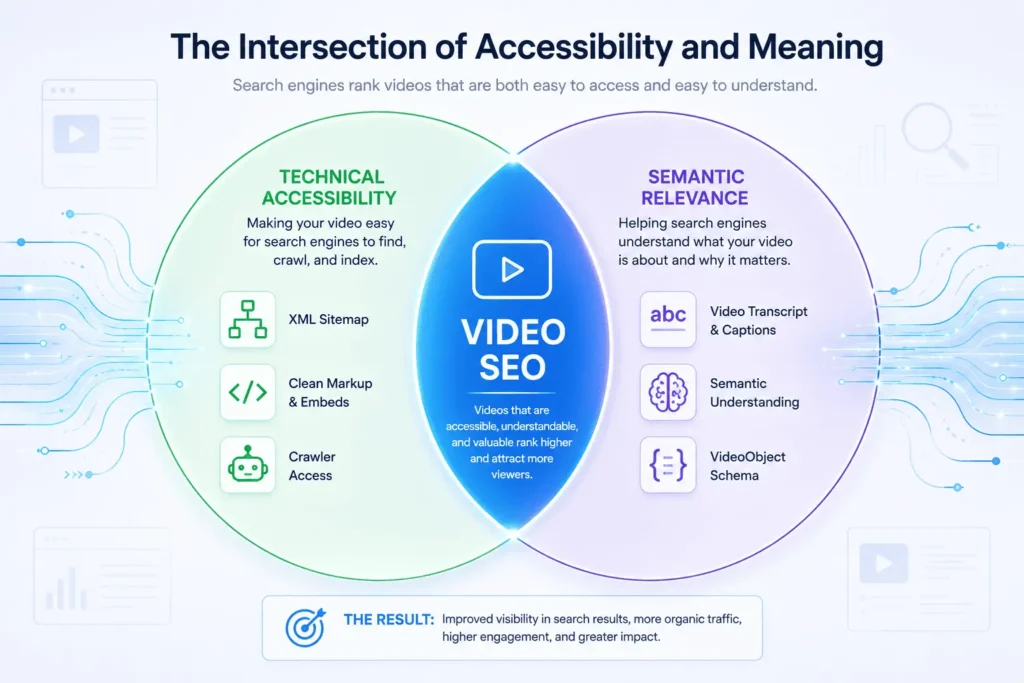
Video SEO sits at the intersection of technical SEO and content marketing. It governs whether search engines and AI systems can discover, interpret, and rank a piece of video content — regardless of whether that video is hosted natively on a website, embedded from a platform like YouTube or Vimeo, or distributed across several channels at once.
Two layers determine discoverability:
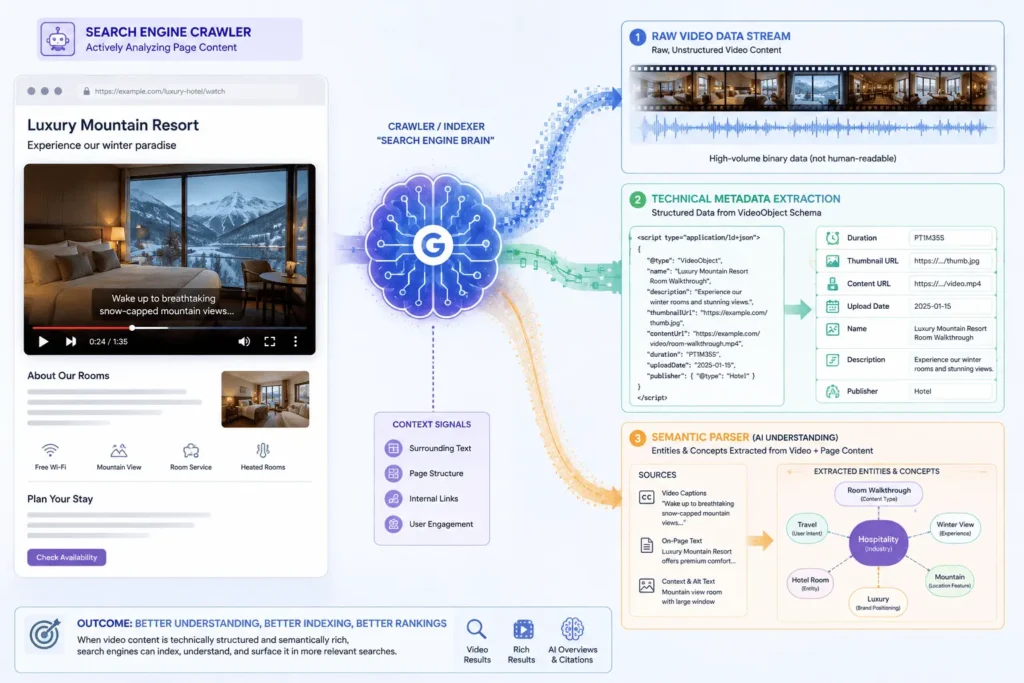
Technical layer. The video needs a dedicated watch page that can be crawled, standard embedding elements (or a well-supported embed method), and — where the site is video-heavy — a video sitemap following Google's Video SEO Best Practices that helps search engines locate it.”
Semantic layer. The title, description, transcript, captions, and structured data (typically VideoObject schema) give search engines and AI systems the textual context needed to understand what the video contains. AI-driven search systems are gradually developing the ability to interpret video and audio directly, but at present, text-based signals remain the primary mechanism by which both traditional search engines and AI answer systems understand video content — this is a developing area, not a settled one.
Video SEO does not operate in isolation. Its effectiveness depends on the search intent of the surrounding page, the broader topical authority of the site, and — for AI-generated answers — the credibility signals the hosting source carries. A technically perfect video with no supporting context rarely gets surfaced consistently.
Why It Matters
- It reaches search demand that text alone misses. How-to, demonstration, comparison, and “what does X look like” queries increasingly surface video resultsaccording to recent
content marketing statistics and research - AI-generated answers are starting to cite video sources. For instructional and demonstrative intent, a business absent from video search is increasingly absent from AI-mediated discovery for the same queries.
- Video shortens the distance to trust. In visually driven categories — hospitality, real estate, professional services, product manufacturing — a well-indexed video often communicates credibility faster than a page of text, which directly supports Experience and Trust signals under E-E-A-T.
- One asset, multiple uses. A single interview, walkthrough, or demonstration can support a blog article, a case study, and a video search listing without duplicating production effort.
- It rewards structure over budget. Because video SEO depends more on technical accessibility and clear context than on production spend, it’s a channel where a small team can compete on clarity rather than scale.
Key Characteristics
- Owns the discoverability layer of video content — not the production, storytelling, or distribution layer.
- Applies to both self-hosted video (on a dedicated watch page) and third-party-hosted video, most commonly YouTube.
- Depends more on structured data and surrounding text (titles, descriptions, transcripts) than on the video file itself.
- Requires a baseline of technical accessibility: crawlable URLs, standard embedding elements, and a video sitemap where relevant.
- Increasingly evaluated by AI-driven search systems that combine metadata signals with still-developing multimodal understanding.
- Distinct from “video marketing,” which covers strategy, creative quality, and distribution — video SEO is specifically the discoverability and indexing function.
Practical Example
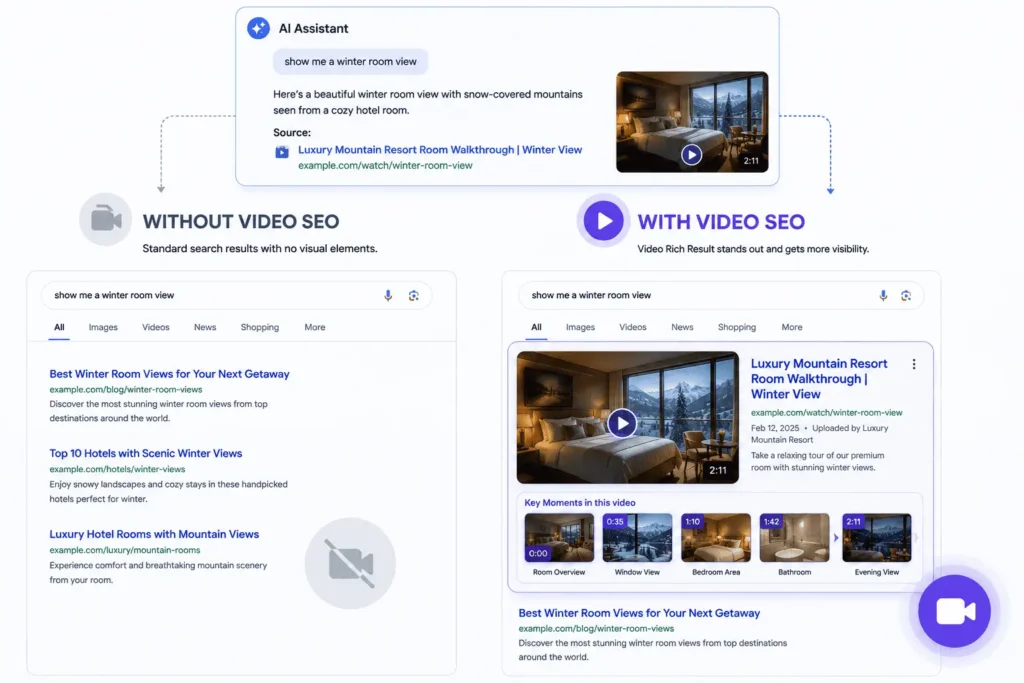
Consider a hypothetical content marketing case: a hospitality business publishes a two-minute video answering a specific traveler question — what a mountain-view room actually looks like in winter. Published correctly, the video lives on its own watch page rather than inside a generic gallery, carries a title and description that reflect the exact question being answered, includes a transcript, and carries VideoObject structured data specifying its duration, thumbnail, and upload date.
Structured this way, the video becomes eligible to appear in Google’s Video tab, in Key Moments within a longer video, and as a supporting source when an AI system answers a related travel question. The same footage, published without a dedicated page, transcript, or structured data, remains functionally invisible to search engines and AI systems — regardless of how good the video itself is.
Common Misconceptions
- “Uploading to YouTube is enough.” Platform hosting helps, but discoverability still depends on metadata quality, transcript accuracy, and how the video is embedded and contextualized wherever it’s shown.
- “Video SEO and video marketing are the same thing.” Video marketing covers strategy, storytelling, and distribution. Video SEO covers the specific technical and semantic requirements that make a video discoverable and indexable.
- “Captions are only an accessibility feature.” They double as the primary textual signal search engines and AI systems use to understand what a video actually contains.
- “Only YouTube videos can rank.” Self-hosted and third-party-hosted video can appear in Google’s video features when technical and structured data requirements are met. YouTube’s advantage is default optimization, not exclusivity.
- “Adding VideoObject schema guarantees a rich result.” Structured data makes a video eligible for enhanced display under
VideoObject structured data specifications. Search engines still decide independently whether and how to surface it.
Related Entities
Content Marketing (parent) · Video Content · YouTube SEO · Video Search Optimization · Video Metadata · Video Schema Markup (VideoObject) · Video Indexing · Structured Data · Search Intent · AI Search · Semantic SEO · Entity SEO.
Related Terms
- Content Marketing
- YouTube SEO
- Video Schema Markup
- Structured Data
- Search Intent
- Semantic SEO
- Entity SEO
- Video Indexing
- AI Search Optimization
FAQ
What is Video SEO in simple terms? It’s the set of technical and content practices that make a video discoverable, understandable, and rankable by search engines and AI systems — separate from how well the video is filmed or edited.
Is Video SEO the same as YouTube SEO? No. YouTube SEO is a subset focused on ranking inside YouTube’s own platform. Video SEO is broader — it covers any hosting environment, including self-hosted video and Google’s wider search surfaces.
Do I need to host videos on my own website for Video SEO to work? No. Self-hosted video and platform-hosted video (YouTube, Vimeo) can both be optimized. What matters is the watch page, the metadata, and the structured data around the video, not where the file lives.
Can AI systems like ChatGPT or Google’s AI Overviews reference video content directly? Increasingly, yes — for demonstrative and instructional queries — though this capability is still developing. Currently, they rely heavily on the transcript, title, description, and structured data surrounding a video rather than interpreting the raw footage alone.
Is schema markup required for Video SEO? It isn’t strictly required, but VideoObject structured data is the clearest way to tell search engines what a video contains, and it’s a prerequisite for several enhanced video features in Google Search.
For a step-by-step implementation guide, download our Content Marketing Checklist
Summary
Video SEO is the discoverability layer of video content — the practices that let search engines and AI systems find, understand, and surface a video for relevant queries. It depends less on production budget than on technical accessibility (a dedicated, crawlable watch page) and semantic clarity (titles, transcripts, and structured data). Within the Marketing Scrappers ecosystem, it functions as a supporting entity of Content Marketing: the concept that governs whether a video can be found, ahead of any question of how to optimize it.
Take the Next Step in Your Content Strategy
Video SEO is one component of a broader content marketing system. See how it fits into the full approach: