
Generative Engine Optimization (GEO): Definition, Examples & Why It Matters in 2026
Written by Hassan Sulaimani, Founder, Marketing Scrappers · Reviewed: July 2026
Generative Engine Optimization (GEO) is the practice of structuring, writing, and publishing content so that generative AI systems — including ChatGPT, Google AI Overviews and AI Mode, Perplexity, and Microsoft Copilot — can retrieve, understand, and cite it when generating answers, rather than optimizing solely for a ranked list of links.
Expanded Definition
Where traditional SEO focuses on earning a position on a search engine results page, GEO focuses on earning inclusion inside the answer itself. Generative AI systems respond to questions directly, often synthesizing several sources into a single conversational reply instead of returning ten blue links.
GEO covers the practices that make content easier for these systems to find, interpret correctly, and reuse with attribution: clear entity definitions, well-structured passages, credible sourcing, and consistent terminology. The term traces back to a 2023 academic study from Princeton University researchers, who first framed “Generative Engine Optimization” as a distinct research problem. It has since become standard vocabulary in digital marketing as platforms such as ChatGPT, Perplexity, and Google’s AI Overviews and AI Mode have scaled to serve well over two billion users across more than 200 countries.
GEO does not replace SEO. It extends it. Businesses succeeding at GEO in 2026 are generally the same businesses with strong technical SEO, entity SEO, and content authority foundations already in place.
Why GEO Matters
Search behavior has shifted. A growing share of queries — particularly informational ones — now resolve inside an AI-generated answer before a user ever reaches a website. Google’s AI Overviews and AI Mode, now merged into a single search experience, reach billions of users worldwide. ChatGPT, Perplexity, and Copilot add further AI-native surfaces where people research, compare, and decide.
This changes what “visibility” means for a business. Ranking further down a results page is decreasingly valuable if an AI system has already answered the question above it. Being the source an AI system names, quotes, or recommends — even without a click — still builds brand recognition, trust, and consideration.
GEO matters because it determines whether a business’s expertise, data, and positioning are part of that AI-generated answer, or absent from it entirely.
How Generative AI Search Works (High Level)
Most generative AI search systems rely on a process called retrieval-augmented generation (RAG). When a user submits a query, the system retrieves a set of relevant passages from an index of web content — sometimes its own search index, sometimes a live crawl — rather than answering purely from what it memorized during training.

The system then synthesizes those retrieved passages into a single response, selecting which sources to cite, quote, or link based on relevance, clarity, and perceived credibility. Content that states its subject clearly, defines terms explicitly, and separates ideas into self-contained sections is easier for this retrieval step to extract and easier for the generation step to summarize accurately.
This is why GEO treats structure and clarity as ranking factors in their own right, not simply formatting preferences.
GEO vs. SEO vs. AEO
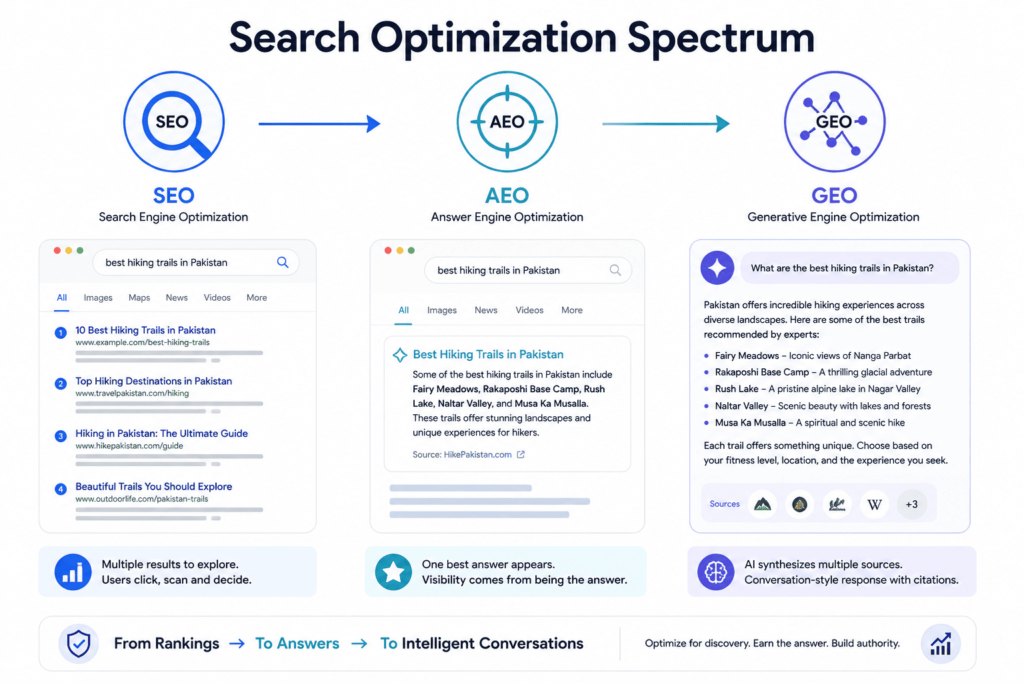
GEO overlaps with two related disciplines. The distinction matters for deciding where each activity belongs in a marketing plan.
| Discipline | Primary Goal | Success Signal |
| SEO | Rank within search engine results pages | Rankings, organic clicks, traffic |
| AEO | Structure content to directly answer a specific question — originally built around voice search and featured snippets | Featured snippet wins, direct-answer placements |
| GEO | Get retrieved, cited, or recommended inside AI-generated answers across multiple platforms | Citation frequency, AI-referred traffic, brand mentions in AI answers |
In practice, the three disciplines share the same foundation — clear entities, credible content, technical accessibility — and increasingly overlap, since content built for direct-answer formats often performs well in generative answers too. Marketing Scrappers treats GEO as the broader, umbrella discipline for AI-era visibility, with AEO as one contributing input rather than a separate strategy.
Key Characteristics
- Optimizes for inclusion inside an AI-generated answer, not just a ranking position on a results page
- Depends on retrieval mechanisms — commonly RAG — that pull from indexed or live web content, not solely from a model’s training data
- Spans multiple platforms (Google AI Overviews and AI Mode, ChatGPT, Perplexity, Microsoft Copilot, Gemini) rather than one search engine
- Rewards clear entity definitions, structured data, and self-contained, quotable passages
- Builds on existing SEO, entity SEO, and content authority foundations rather than replacing them
- Measured through citation frequency and AI-referred visibility rather than rankings or click-through rate alone
Practical Example
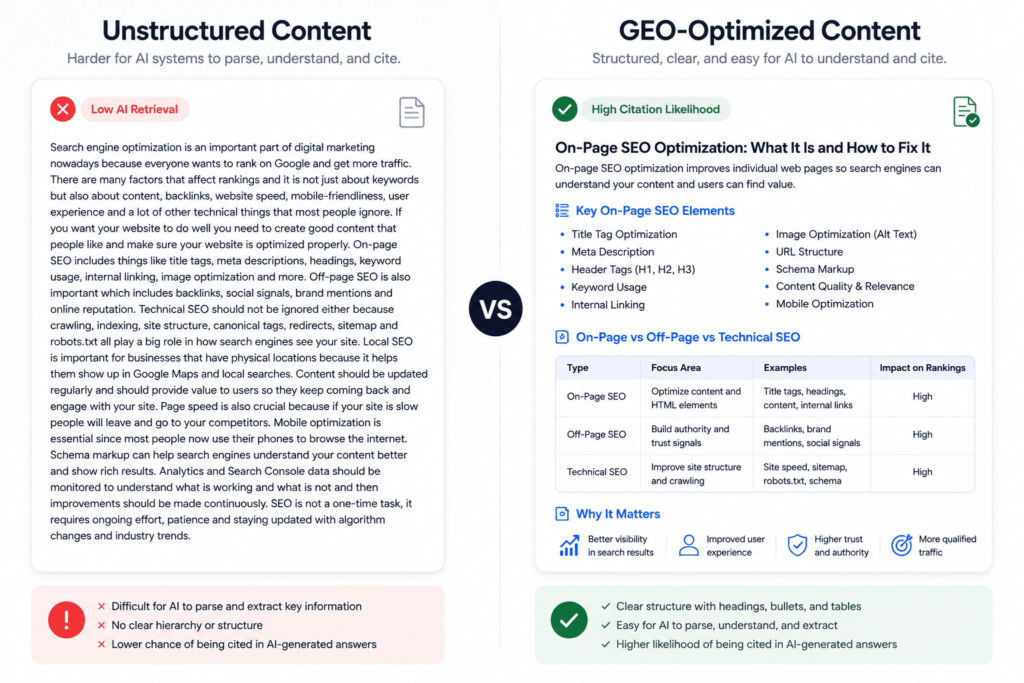
A business owner asking an AI assistant “what’s the best CRM for a small boutique hotel?” will typically receive a direct, synthesized answer naming two or three specific tools, each with a short reason attached. If a hospitality-technology publisher has already published a clearly structured comparison — a plain-language definition of what a hotel CRM does, a comparison table of leading tools, and explicit criteria for “best for small properties” — that content is a strong candidate for the AI system to retrieve and cite by name. A generic, unstructured overview of CRMs is far less likely to be selected, even if it ranks reasonably well in traditional search.
Common Misconceptions
- “GEO replaces SEO.” It doesn’t. GEO adds a citation-and-retrieval layer on top of the same entity, content, and technical foundations SEO already requires.
- “GEO and AEO are the same thing.” They overlap, but AEO originated around structuring direct answers for voice search and featured snippets, while GEO covers the broader set of behaviors — retrieval, synthesis, citation, recommendation — across all generative AI platforms.
- “GEO means gaming AI systems.” It doesn’t. AI systems select sources based on clarity, structure, and credibility signals that are difficult to fake and legitimate to strengthen.
- “One optimized page guarantees a citation.” No single tactic guarantees inclusion in an AI-generated answer. Citation depends on a platform’s retrieval behavior for that specific query, and that behavior varies by system and changes over time.
Related Entities
GEO does not exist as an isolated concept. It sits inside a defined network of related entities within the Marketing Scrappers knowledge graph:
- Parent discipline: AI Search Optimization (a branch of Search Engine Optimization)
- Closely related disciplines: Answer Engine Optimization (AEO), Entity SEO, Semantic SEO
- Underlying mechanisms: Large Language Models (LLMs), Retrieval-Augmented Generation (RAG), Knowledge Graph, Structured Data
- Platforms: Google AI Overviews, Google AI Mode, ChatGPT, Perplexity AI, Microsoft Copilot, Google Search
- Outcome concepts: AI Citations, Brand Entity
Frequently Asked Questions
What is Generative Engine Optimization (GEO)? GEO is the practice of structuring content so that generative AI systems — such as ChatGPT, Google AI Overviews and AI Mode, Perplexity, and Copilot — can retrieve, understand, and cite it in the answers they generate.
Is GEO the same as SEO? No. SEO optimizes for ranking position in search results; GEO optimizes for being retrieved, cited, or recommended inside an AI-generated answer. The two are complementary, not competing, disciplines.
How is GEO different from AEO? AEO originated as the practice of structuring content to directly answer a specific question, largely for voice search and featured snippets. GEO is the broader discipline covering how generative AI systems retrieve, synthesize, and cite content across all AI-generated answers, of which direct-answer formatting is one contributing factor.
Which platforms does GEO apply to? GEO applies across generative AI systems that answer queries directly, including Google AI Overviews and AI Mode, ChatGPT, Perplexity, Microsoft Copilot, and Google Gemini.
Does a business need to abandon traditional SEO to focus on GEO? No. GEO builds on the same entity clarity, technical accessibility, and content credibility that SEO already requires; it does not replace that foundation.
Why does GEO matter now? Because a growing share of search queries — especially informational ones — are being answered directly inside AI-generated responses, changing what “search visibility” means for a business’s brand and expertise.
Summary
Generative Engine Optimization (GEO) is the discipline of making content retrievable, understandable, and citable by generative AI systems such as ChatGPT, Google AI Overviews and AI Mode, Perplexity, and Microsoft Copilot. It extends — rather than replaces — traditional SEO, adding a layer focused on how AI systems select, synthesize, and attribute information inside their answers. As AI-generated answers account for a growing share of how people research and decide, GEO determines whether a business’s expertise is part of that answer, or missing from it.
GEO is one entity inside Marketing Scrappers’ AI Search Optimization discipline, which covers the full implementation approach — including our GEO Citation Stack™, Marketing Scrappers’ framework for discoverability, retrieval, citation, and recommendation across AI-powered search ecosystems.
Explore the AI Search Optimization Service → /services/seo/ai-search-optimization/ Read the Complete Generative Engine Optimization Guide → /guides/generative-engine-optimization/ (in development)
Ready to Implement GEO?
Learn how Marketing Scrappers helps your business get retrieved, cited, and recommended across major AI engines.