
Answer Engine Optimization (AEO)
Answer Engine Optimization (AEO) is the practice of structuring content so AI-powered platforms — including Google AI Overviews, AI Mode, ChatGPT, Perplexity, and Microsoft Copilot — can extract it, trust it, and cite it as a direct answer to a user’s question. AEO shifts the goal from ranking for a click to becoming the source an answer engine quotes or summarizes.
What Is Answer Engine Optimization?
For two decades, search optimization had one job: earn a ranking position that a human would click. AEO exists because that job description no longer covers what actually happens on a growing share of searches. When someone asks a question inside Google AI Mode, ChatGPT, or Perplexity, the platform doesn’t hand back ten links — it generates a synthesized answer and names (or doesn’t name) the sources behind it.
AEO is the discipline of making sure your content is one of the sources named. That means writing definitions, comparisons, and explanations in a way that a language model can locate, understand, and quote with confidence — without ambiguity, without three paragraphs of preamble, and without requiring the reader (or the model) to infer the answer from context.
AEO is not a separate content channel from SEO. It is what SEO looks like when the audience reading your page includes both humans and retrieval systems.
Why Answer Engine Optimization Matters
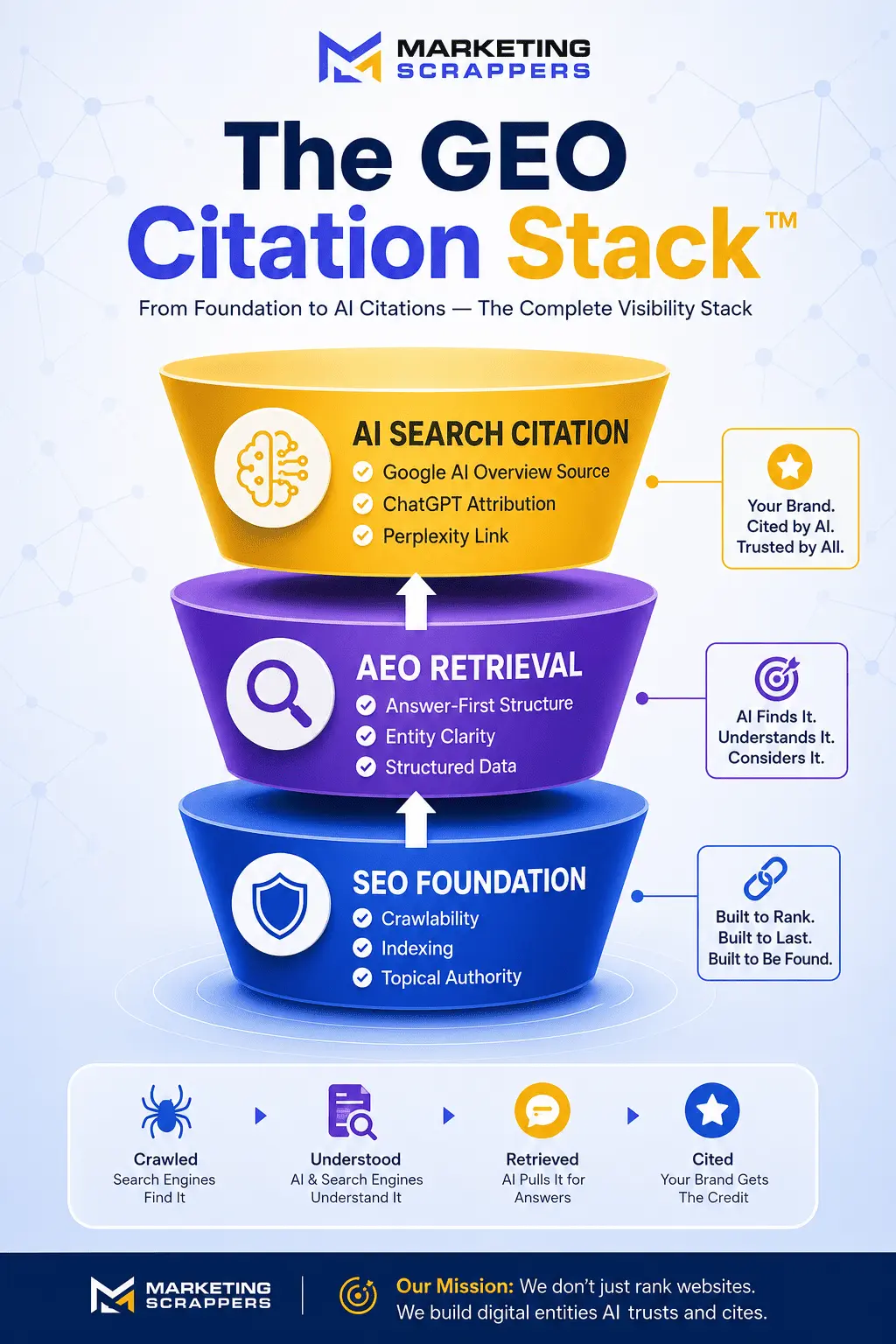
The commercial risk of ignoring AEO is straightforward: if an answer engine never cites your page, you don’t lose a ranking — you lose the interaction entirely. The user gets their answer, forms an impression of the space, and may never see a list of links at all.
Two shifts make this a business issue rather than a technical curiosity:
- Zero-click behavior is growing. A meaningful and rising share of Google queries now resolve inside an AI Overview, a featured snippet, or a People Also Ask card, with no click required. Independent trackers disagree on the exact percentage — estimates for AI Overview prevalence alone range from roughly the mid-teens to over half of queries, depending on query type and market — but the direction is consistent across every source: answers are increasingly delivered on the results page itself, not on yours.
- Citation is becoming a discovery channel in its own right. Buyers are starting research inside ChatGPT, Perplexity, and Copilot before they ever open Google. Whichever brand gets named in that first answer enters the consideration set. Whichever doesn’t is invisible at that stage, regardless of how strong its traditional rankings are.
Marketing Scrappers tracks this specific outcome — being named as a source inside AI-generated answers — through an internal framework we call the GEO Citation Stack™. The full methodology lives on the AI Search Optimization service page; this glossary entry exists to make sure the underlying term is unambiguous first.
How Answer Engines Work (High Level)
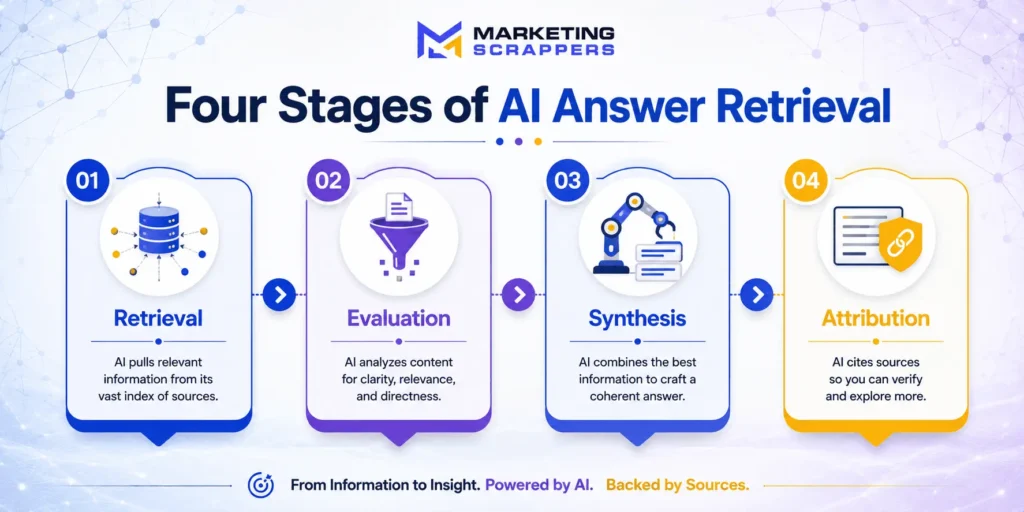
Every answer engine follows a similar shape, even though the underlying models differ:
- Retrieval — the system pulls candidate content from a search index, live web crawl, or grounding source relevant to the question.
- Evaluation — it assesses which candidates most directly, clearly, and credibly answer the specific question asked.
- Synthesis — it generates a natural-language answer, often drawing from multiple sources at once.
- Attribution — it selects which sources (if any) to name or link as support for that answer.
The practical implication is that clarity and structure compete directly with model reasoning at the evaluation stage. A page that states its answer in the first sentence gives a model less work to do than a page that arrives at the answer after several paragraphs of narrative build-up.
Answer Engine Optimization vs. SEO vs. GEO
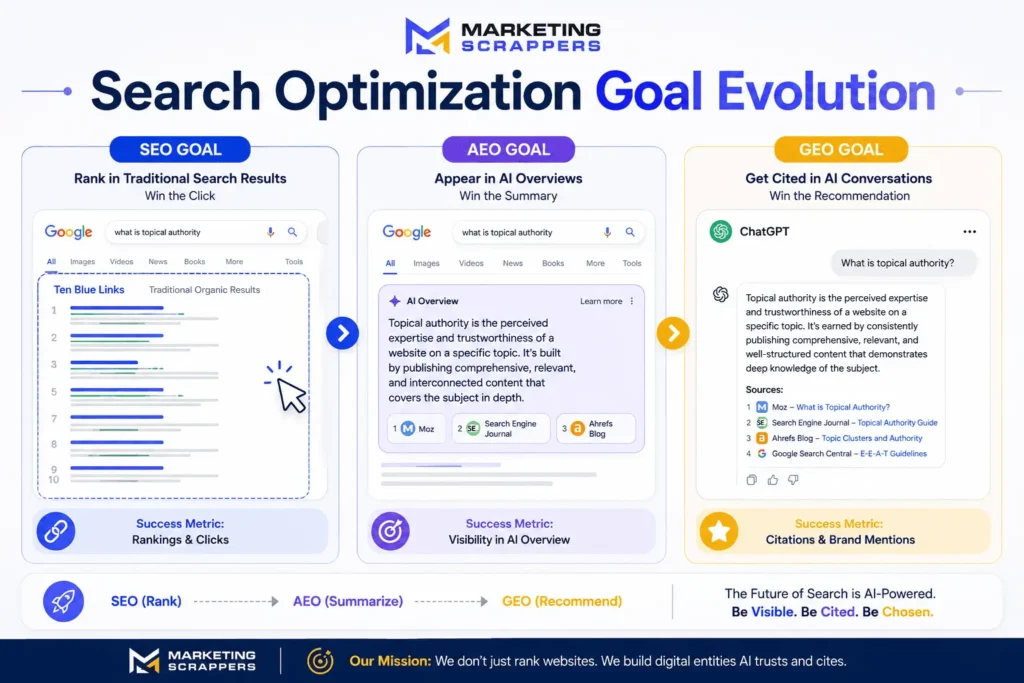
The three terms overlap, and the industry hasn’t fully standardized their boundaries. The distinction that holds up best in practice:
| Discipline | Primary Goal | Success Metric | Surfaces |
| SEO (Search Engine Optimization) | Rank on a results page | Position, impressions, clicks | Google, Bing organic results |
| AEO (Answer Engine Optimization) | Be cited as the direct answer | Citation, inclusion in the generated answer | AI Overviews, AI Mode, featured snippets, voice assistants |
| GEO (Generative Engine Optimization) | Be understood and referenced across generative AI systems broadly | Share of model, presence across AI platforms | ChatGPT, Gemini, Claude, Perplexity, Copilot |
Most practitioners now treat AEO as the answer-retrieval layer inside the broader GEO discipline: GEO covers optimization across generative AI platforms generally, while AEO focuses specifically on winning the moment a system needs a source for a factual claim, definition, or recommendation. SEO remains the foundation underneath both — a page that isn’t crawlable or indexed doesn’t get the chance to be evaluated for citation in the first place.
Key Characteristics of AEO-Ready Content
- Answer-first structure — the direct answer appears in the first sentence or paragraph, not buried after context-setting.
- Question-shaped framing — content is organized around the specific questions a person (or a model, on their behalf) would ask.
- Extractable formatting — definitions, lists, and tables that can be lifted out of the page and still make sense on their own.
- Entity clarity — concepts, brands, and terms are named explicitly and consistently, rather than implied through pronouns or vague references.
- Verifiable specificity — claims are concrete enough to be checked, not generic enough to apply to any competitor’s page.
- Standalone coherence — each section can be understood without requiring the reader to have read the sections before it.
A Practical Example
Two pages define the same term. Page A opens with a company history, a client testimonial, and a promotional paragraph before finally defining the term in its sixth paragraph. Page B states a precise, self-contained definition in its first sentence, then expands on it.
When a user asks an AI Mode or ChatGPT query for that definition, the model evaluating both pages has a clear, quotable answer available immediately from Page B and has to do interpretive work to extract one from Page A. All else being comparable in authority and trust signals, Page B is far more likely to be the one named in the generated answer. This is the entire logic of AEO in miniature: structure removes friction between what your page says and what the model needs to say back to the user.
Search engines are shifting from links to direct answers. See how our structured methodology helps brands build authority and earn source attribution across Google AI Overviews, Perplexity, and ChatGPT.
Explore the AI Search Optimization Service →
Common Misconceptions About AEO
- “AEO replaces SEO.” It doesn’t. Google’s own Search Central documentation states plainly that there are no special technical requirements to appear in AI Overviews or AI Mode beyond standard SEO fundamentals, as outlined in their guide to generative AI features on Google Search — crawlability, indexability, and helpful, people-first content. AEO adds structure and clarity on top of that foundation; it doesn’t substitute for it
- “AEO only applies to ChatGPT.” ChatGPT is one of several answer engines. Google AI Overviews, AI Mode, Perplexity, and Microsoft Copilot each apply their own retrieval and citation logic, and a page can be well-cited in one and absent from another.
- “AEO and GEO are the same thing.” They’re closely related but not identical. AEO is generally treated as the answer-retrieval subset of the broader GEO discipline, though usage across the industry is still inconsistent.
- “Adding FAQ schema is AEO.” Structured data can help engines parse a page, but schema markup that describes content the page doesn’t actually and clearly say does nothing for citation. The underlying prose still has to carry the answer.
- “Ranking #1 in Google guarantees AI citation.” Ranking well is usually a prerequisite for appearing in Google’s own AI Overviews, but it has little bearing on whether the same page gets cited in Perplexity, ChatGPT, or Copilot, since each draws on different retrieval sources and citation criteria.
Related Entities & Terms
AEO sits inside a wider cluster of AI-search concepts that Marketing Scrappers treats as one interconnected knowledge system rather than isolated definitions:
- Generative Engine Optimization (GEO) — the broader discipline AEO operates within.
- AI Search Optimization — the MS service area encompassing AEO, GEO, and related AI-visibility work.
- Entity SEO — the practice of structuring content around clearly defined entities, which underpins how answer engines identify what a page is actually about.
- Knowledge Graph — the structured data layer search systems use to understand entities and their relationships.
- Structured Data — machine-readable markup that supports (but doesn’t replace) content clarity.
- AI Overviews — Google’s AI-generated summary feature, one of several answer engine surfaces AEO targets.
- Large Language Models (LLMs) — the underlying technology that powers modern answer engines’ evaluation and synthesis steps.
- Zero-Click Search — the broader search behavior pattern that makes AEO commercially relevant.
Summary
Answer Engine Optimization is the discipline of structuring content so AI-powered platforms can extract, trust, and cite it as a direct answer — a shift in objective from “rank for a click” to “become the source the answer names.” It builds on SEO fundamentals rather than replacing them, and it sits inside the broader Generative Engine Optimization discipline. For the frameworks Marketing Scrappers uses to implement AEO at the service level — including the GEO Citation Stack™ — see the AI Search Optimization service page
Frequently Asked Questions
What does AEO stand for? AEO stands for Answer Engine Optimization — optimizing content to be selected and cited as a direct answer by AI-powered search and chat platforms.
Is AEO different from SEO? Yes, though they’re connected. SEO aims for ranking position on a results page. AEO aims for citation inside a generated answer. Strong SEO fundamentals — crawlability, indexing, topical authority — remain a prerequisite for AEO success.
Is AEO the same as GEO? Not exactly. AEO is typically considered the answer-retrieval-focused part of the broader Generative Engine Optimization (GEO) discipline, which covers optimization across generative AI platforms more generally. Industry usage of both terms is still settling.
Which platforms does AEO apply to? Google AI Overviews and AI Mode, ChatGPT, Perplexity, and Microsoft Copilot are the main current answer engine surfaces, though each has its own retrieval and citation behavior.
Do I still need traditional SEO if I’m doing AEO? Yes. Answer engines still depend on crawlable, indexable, well-structured content as their raw material. AEO is additive structure and clarity layered on top of SEO fundamentals, not a substitute for them.