
E-E-A-T: Definition, Examples & Why It Matters for SEO and AI Search in 2026
E-E-A-T is Google’s framework — Experience, Expertise, Authoritativeness, and Trustworthiness — for judging whether content deserves to rank well and appear in AI-generated answers. It is not a direct ranking factor. Human quality raters use it to score page quality, and those scores help train Google’s ranking and AI systems.
Expanded Definition
E-E-A-T comes from : Google Search Quality Rater Guidelines (PDF), the public document Google gives to the human evaluators who assess search result quality. It breaks down into four components:
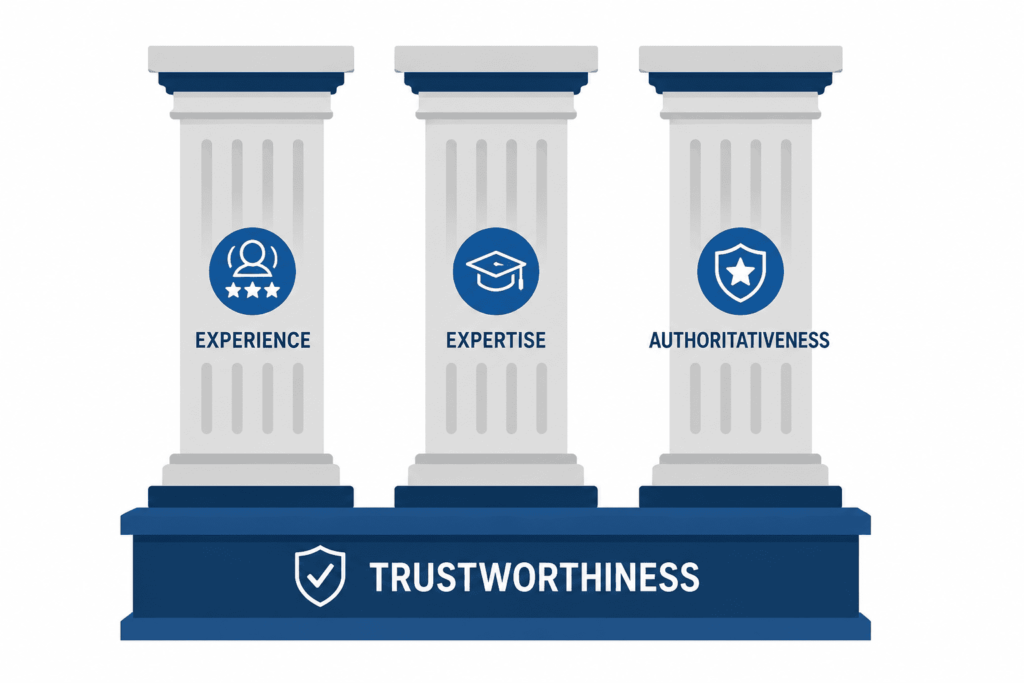
- Experience — first-hand, lived involvement with the topic (having actually used the product, visited the place, or done the task)
- Expertise — the knowledge or skill needed to speak credibly on the subject
- Authoritativeness — recognition, by others, as a go-to source on the topic
- Trustworthiness — accuracy, honesty, safety, and transparency of the content and the site publishing it
Google added the “Experience” component in December 2022, expanding the original E-A-T model that had existed since 2014. Trustworthiness sits at the center of the framework: content can demonstrate experience, expertise, and authority, but if it isn’t trustworthy, the other three carry little weight.
It’s important to be precise about what E-E-A-T is not. There is no numerical “E-E-A-T score,” and it isn’t a variable in Google’s ranking algorithm the way page speed or a backlink is. Instead, it’s an evaluation lens — human raters apply it when scoring search results, and those judgments are used to refine and train the automated systems that do rank content. Google updates the guidelines periodically; recent versions have added guidance on evaluating AI-generated answers, which extends E-E-A-T’s relevance beyond traditional search into how AI systems select and cite sources.
Why It Matters
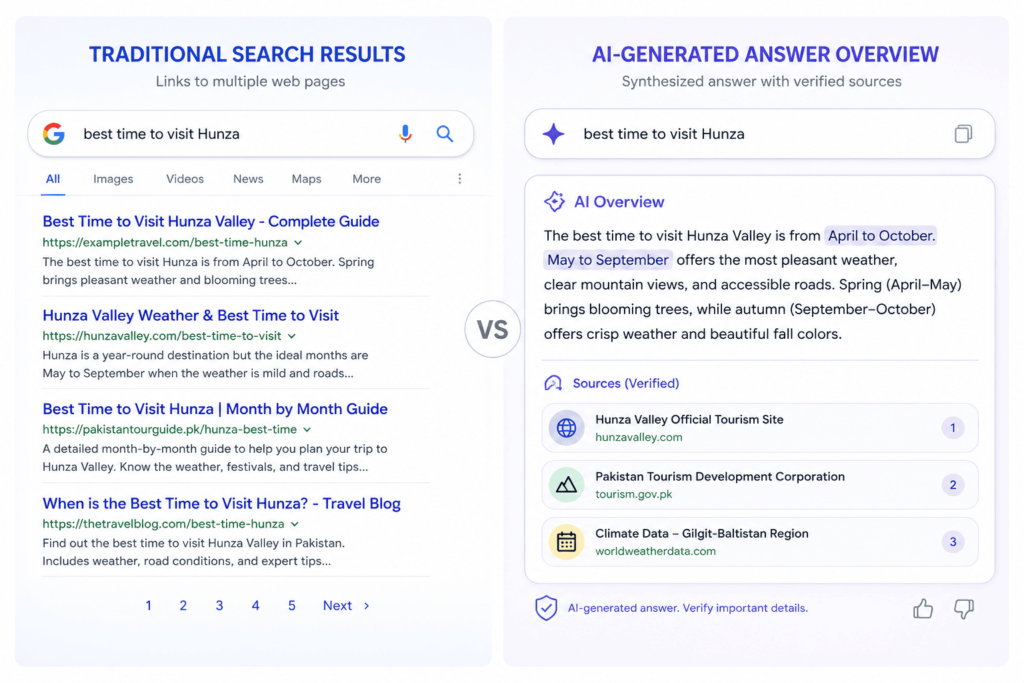
E-E-A-T matters because it describes the qualities that both search engines and AI systems are designed to reward. As more discovery happens through AI Overviews, chat-based assistants, and answer engines rather than a list of blue links, the practical stakes have shifted: content with weak experience or trust signals isn’t just at risk of ranking lower — it’s at risk of never being surfaced or cited at all.
This applies unevenly by topic. Google weights E-E-A-T most heavily for YMYL (“Your Money or Your Life”) subjects — health, finance, safety, and civic topics — where inaccurate information can cause real harm. But the underlying logic extends to any business publishing content to earn attention: a boutique hotel writing about local travel, a clinic explaining a procedure, or an agency explaining SEO all compete on the same basic question a reader (or an AI system) is implicitly asking: can this source be trusted on this subject?
For businesses, this reframes content from a traffic-generation activity into a credibility-building one. Publishing more content doesn’t help if it lacks demonstrable experience, clear authorship, and verifiable accuracy — those are the specific signals E-E-A-T is built around.
Key Characteristics
- Four interdependent components, not four separate checkboxes — they reinforce each other
- Trustworthiness functions as the foundation; the other three pillars support it
- Not an algorithmic ranking factor and not a numerical score — a human rater evaluation framework that informs algorithm training
- Weighted more heavily for YMYL topics, but relevant to all content competing for visibility
- Increasingly relevant to how AI systems (Google AI Overviews, ChatGPT, Gemini, Perplexity) decide which sources to summarize or cite
- Applies to AI-assisted content too — Google’s guidance evaluates the “who, how, and why” behind content regardless of whether AI was used to help produce it, provided real experience, oversight, and transparency are present
Practical Example

Consider two articles on “best hiking trails near a mountain town.” One is an unattributed, generic listicle with no author, no original detail, and no sourcing. The other is written by a hotel’s own concierge staff who have personally guided those hikes, includes original photos and specific seasonal notes, and is reviewed by a named local expert. Both may contain similar facts, but the second demonstrates Experience (first-hand guiding), Expertise (local knowledge), Authoritativeness (a named, credentialed reviewer), and Trustworthiness (transparent authorship) — the combination Google’s raters are trained to recognize, and the kind AI systems are more likely to draw from when constructing an answer.
Common Misconceptions
- “E-E-A-T is a ranking factor.” It isn’t applied directly by the algorithm. It’s a framework human raters use to score quality, and those scores help train the systems that do rank content.
- “E-E-A-T only matters for health and finance content.” It’s weighted most heavily there, but the same trust logic applies to any content competing for visibility or AI citation.
- “Adding an author bio fixes E-E-A-T.” An author bio is one signal among many. E-E-A-T reflects the substance of the content and the site’s overall reputation, not a single element.
- “AI-written content automatically fails E-E-A-T.” Creating Helpful, Reliable, People-First Content Documentation, how it was made (including AI involvement), and why it exists — not whether AI was used at all. Transparency and human oversight matter more than authorship method.
Related Entities
Experience · Expertise · Authoritativeness · Trustworthiness · Google Search Quality Rater Guidelines · Helpful Content System · Topical Authority · Entity SEO · Brand Authority · Author Entity · AI Search Optimization
Related Terms
- YMYL (Your Money or Your Life): The category of topics — health, finance, safety, civic life — where Google applies E-E-A-T most strictly.
- Helpful Content: Google’s broader standard for people-first content; E-E-A-T is one lens used to evaluate it.
- Content Signals: The observable indicators (authorship, sourcing, freshness, depth) that support an E-E-A-T assessment.
- AI Search Optimization: The practice of structuring content so AI systems can understand, extract, and cite it — a discipline where E-E-A-T signals increasingly influence which sources get selected.
FAQ
What does E-E-A-T stand for? Experience, Expertise, Authoritativeness, and Trustworthiness — the four components Google’s Search Quality Rater Guidelines use to evaluate content quality.
Is E-E-A-T a Google ranking factor? Not directly. It’s a framework used by human quality raters to score search results; those scores help train Google’s ranking and AI systems rather than acting as a ranking input themselves.
When was “Experience” added to E-A-T? Google added Experience in December 2022, expanding the original E-A-T model that had been part of the guidelines since 2014.
Does E-E-A-T apply to AI-generated content? Yes. Google’s guidance focuses on who created the content, how it was made, and why — AI involvement isn’t disqualifying on its own, but the content still needs to demonstrate genuine experience, accuracy, and transparency.
Which E-E-A-T component matters most? Trustworthiness is generally treated as the foundation. Content can show experience, expertise, and authority, but if it isn’t accurate and transparent, those signals carry less weight.
How does E-E-A-T relate to AI Overviews and answer engines? AI systems tend to draw from and cite sources that display strong credibility signals. Recent updates to Google’s rater guidelines specifically address evaluating AI-generated answers, extending E-E-A-T’s relevance beyond traditional search results. Google Search Central Blog Article.
Summary
E-E-A-T — Experience, Expertise, Authoritativeness, and Trustworthiness — is the framework Google’s human quality raters use to judge content quality, with Trustworthiness as its foundation. It isn’t a ranking factor or a score, but the signals it describes correlate strongly with visibility in both search results and AI-generated answers. As discovery increasingly happens through AI Overviews and answer engines, demonstrating real E-E-A-T has become a practical requirement for any business that wants its content to be trusted, surfaced, and cited.
Building durable E-E-A-T signals across a website — author identity, sourcing, freshness, and reputation — is core to Marketing Scrappers’ Content Marketing methodology. Explore the Content Marketing Service →
Want a working checklist? Download the Content Quality & E-E-A-T Checklist or read the Complete Content Strategy Guide.
Explore our Content Marketing Service to learn how we build these signals into your organic strategy.
Take Action: Audit Your Content Quality
Put these guidelines into practice with our step-by-step framework.