
Knowledge Graph SEO: Definition, Examples & 2026 Strategy
Reviewed by Hassan Sulaimani, Founder, Marketing Scrappers ·Glossary · Last updated July 2026
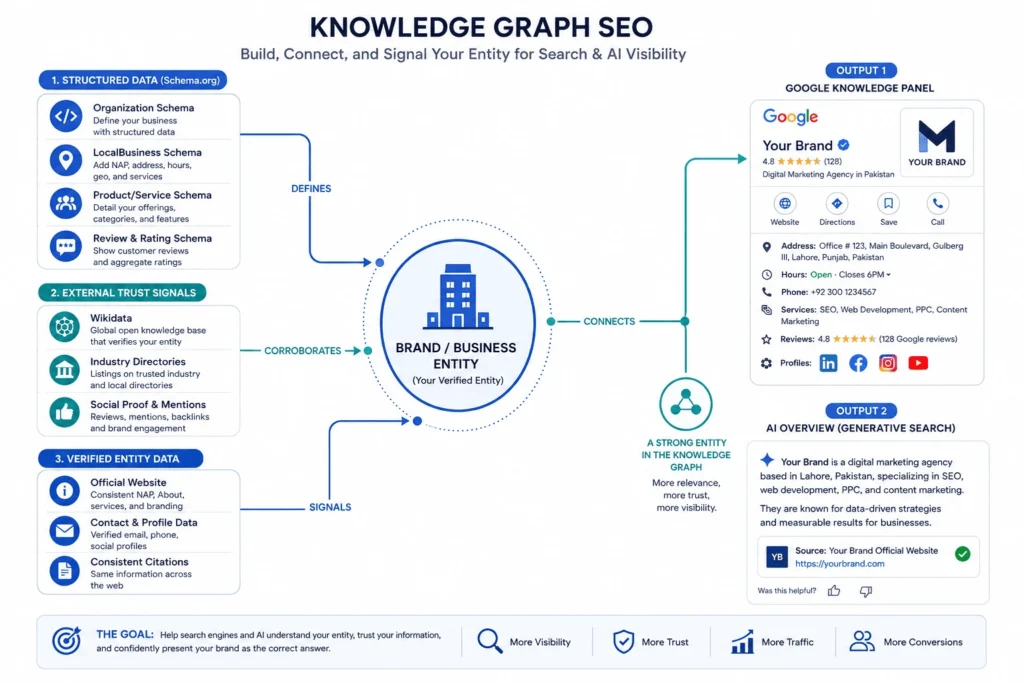
Knowledge Graph SEO is the practice of structuring a brand’s entities, relationships, and data so that search engines and AI systems can map that brand accurately inside a knowledge graph — a network of connected entities. It relies on structured data, consistent identity signals, and clear relationships rather than keyword density alone.
What Knowledge Graph SEO Actually Means
Most explanations of Knowledge Graph SEO collapse two distinct ideas into one, which is why the term feels confusing even to experienced marketers.
The first idea is Google’s Knowledge Graph: a proprietary database Google uses to store entities — people, places, organizations, products, concepts — and the relationships between them. When your brand shows up in a knowledge panel with the correct logo, description, and links, that’s Google’s Knowledge Graph recognizing you as a defined entity.
The second idea is your own content’s knowledge graph: the implicit network of entities and relationships that search engines and AI systems construct simply by reading what you publish. Every page you write, every internal link, every mention of a product or person adds nodes and edges to that graph — whether you plan it or not.
Knowledge Graph SEO covers both. It’s the discipline of making sure the graph search engines and AI systems build from your content is accurate, complete, and consistent with the entity you actually are — and, where possible, earning a place inside Google’s own Knowledge Graph too.
This distinction matters because most guides treat “Knowledge Graph SEO” as a single tactic — usually “add schema markup.” It isn’t. Schema markup is one signal that feeds the graph. It is not the graph itself.
Why Knowledge Graph SEO Matters in 2026
Search stopped being a keyword-matching exercise years ago. Both traditional search engines and the large language models behind AI Overviews, ChatGPT, Gemini, and Perplexity work on entities and relationships, not strings of text. A page can rank for the right words and still fail to be recognized as about the right entity — and that gap is increasingly the difference between showing up and getting cited.
In practice, this shows up in three ways:
- Knowledge panels and rich results depend on search engines correctly identifying your brand as an entity, not just matching your name to a query.
- AI Overviews and generative answers favor sources with clear, resolvable entity signals, because it’s more reliable for the system to cite something it can confidently identify than something it has to infer — a trend highlighted in our AI Search Visibility Report 2026.
- Brand disambiguation — if you share a name with another business, product, or concept, weak entity signals mean search engines and AI systems may attribute the wrong information to you, or none at all.
None of this replaces the fundamentals of good SEO. It sits on top of them. A page still needs to satisfy search intent and provide real value — Knowledge Graph SEO is what determines whether search engines and AI systems correctly understand what that value belongs to.
How Knowledge Graph SEO Works
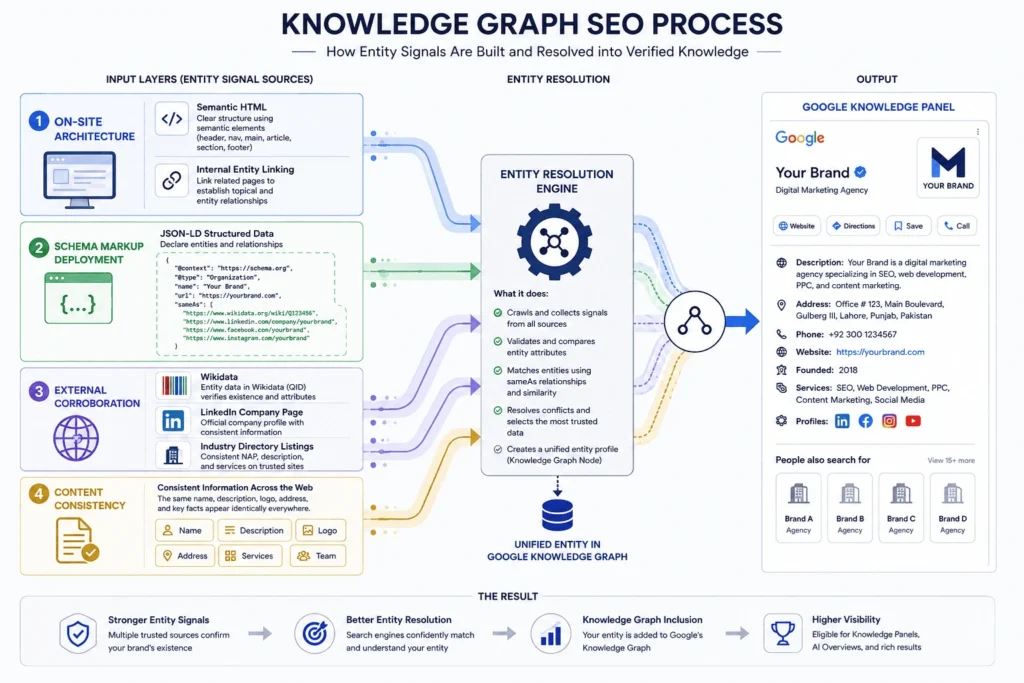
A knowledge graph is built from nodes (entities) and edges (relationships). In practice, several types of signals feed it:
- Structured data — schema.org markup, particularly Organization, Person, and the sameAs property (per Google Search Central guidelines on structured data), which explicitly tells search engines what an entity is and how it connects to other known entities.
- — references to your brand or its people in sources search engines already trust, structured around the Wikidata entity data model or industry directorie, or established publications.
- Consistency — the same name, description, and relationships repeated accurately across your site and the external web, rather than conflicting versions of “who you are.”
- Content relationships — how your own pages link to and reference one another, which shows search engines and AI systems which entities in your content are related, and how.
The full methodology for building and strengthening these signals — schema architecture, entity disambiguation, and citation building — belongs to Entity SEO strategy and implementation, not to this definition. That work is covered in the Entity SEO service and its related implementation guide.
Knowledge Graph SEO vs. Entity SEO
These terms are often used interchangeably, but they describe different layers of the same discipline.
Ready to Position Your Brand for AI Search?
Turn your brand’s entity relationships into measurable visibility across Google AI Overviews, ChatGPT, Gemini, and Perplexity.
Explore the AI Search Optimization Service →| Knowledge Graph SEO | Entity SEO | |
| What it is | The outcome: how accurately your brand is represented as an entity inside knowledge graphs | The strategy: the deliberate work of building and strengthening that entity representation |
| Scope | The graph itself — nodes, edges, and how systems read them | The tactics — schema, sameAs links, disambiguation, citation building |
| Question it answers | “Is this brand correctly mapped as an entity?” | “How do we make sure it is? |
In short: Entity SEO is what you do. Knowledge Graph SEO is what you’re trying to get right as a result. For the full strategic framework, see the Entity SEO service and the AI Search Optimization service,, where entity work and generative-search visibility come together under what we call the GEO Citation Stack™ — Marketing Scrappers’ approach to strengthening entity relationships across both traditional search engines and AI systems.
A Simple Example
A boutique hotel adds markup based on the Schema.org Organization specification to its homepage, including a sameAs property linking to its verified Wikidata entry, its official social profiles, and a trusted local tourism directory listing. Search engines can now connect the hotel’s website to an entity that other trusted sources already describe consistently.
Over time, this can result in a knowledge panel showing the correct name, category, and links when someone searches the hotel by name — and it makes the hotel a more citable source when an AI assistant answers a question like “boutique hotels in Skardu.”
Nothing about this example involves ranking for a specific keyword. It’s entirely about whether the entity — the hotel itself — is understood correctly.
Common Misconceptions About Knowledge Graph SEO
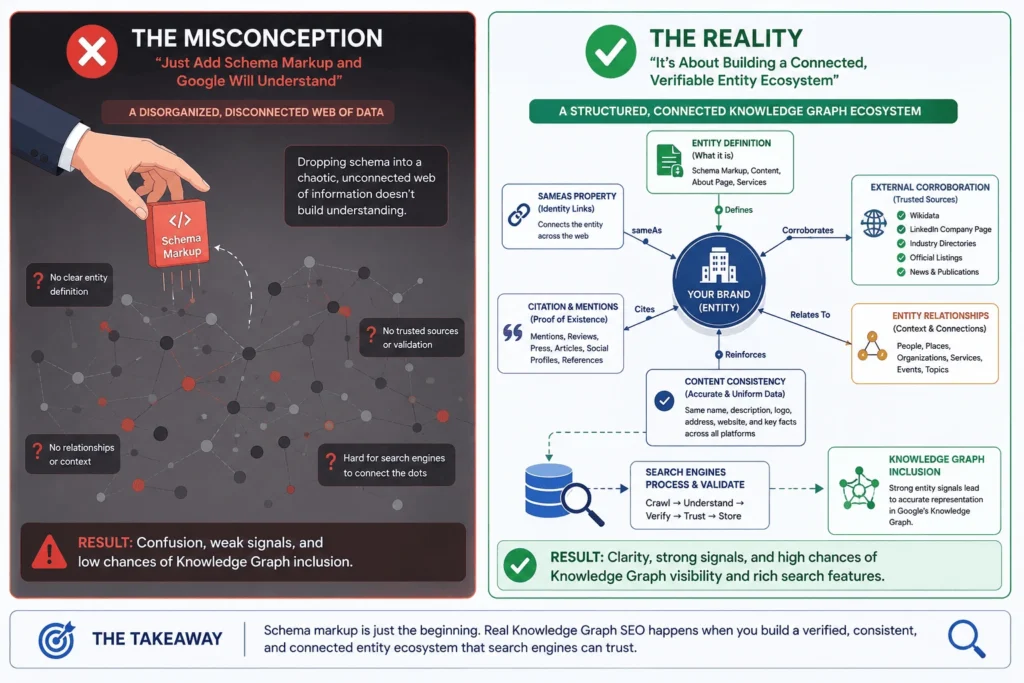
- “It just means adding schema markup.” Schema is one input. The graph also depends on external corroboration and content relationships that markup alone can’t create.
- “Only large or well-known brands benefit.” Any brand with a legitimate, verifiable identity can improve its entity signals — the payoff is often highest for smaller brands currently indistinguishable from similarly named businesses.
- “It replaces traditional on-page SEO.” It doesn’t. Knowledge Graph SEO determines how well an entity is understood; it doesn’t substitute for content that satisfies search intent.
- “Google’s Knowledge Graph and an AI system’s understanding of your brand are the same thing.” They’re related but separate systems. Earning a Google knowledge panel doesn’t automatically mean an AI assistant will cite you correctly, and vice versa.
Frequently Asked Questions
What is Knowledge Graph SEO in simple terms? It’s the practice of making sure search engines and AI systems correctly understand your brand as a distinct, well-defined entity — rather than just matching your name to keywords.
Is Knowledge Graph SEO the same as Entity SEO? No. Entity SEO is the set of tactics — schema, sameAs links, citations — used to build entity recognition. Knowledge Graph SEO describes the resulting graph and how accurately it represents your brand.
Do I need a Google Knowledge Panel to benefit from Knowledge Graph SEO? No. A knowledge panel is one visible outcome, but entity clarity also affects how AI Overviews, ChatGPT, Gemini, and Perplexity interpret and cite your content — with or without a panel.
How do I know if my brand has a defined entity in Google’s Knowledge Graph? Search your brand name directly. If a knowledge panel appears with accurate information, your brand has been mapped to an entity. If it’s missing or incorrect, that’s worth investigating.
Does Knowledge Graph SEO help with AI Overviews and generative search? Yes. The systems behind AI Overviews and AI assistants rely on clear entity signals to decide what to cite, which is why entity clarity has become part of Generative Engine Optimization and Answer Engine Optimization work.
Related Terms
- Entity SEO — the strategic discipline of building entity recognition
- Knowledge Graph — the underlying data structure of entities and relationships
- Semantic SEO — optimizing for meaning and context rather than keywords alone
- Schema Markup — structured data used to declare entities and relationships
- Structured Data — the broader category schema markup belongs to
- Wikidata — an open knowledge base commonly used to corroborate entities
- Generative Engine Optimization (GEO) — optimizing content for AI-generated answers
- Answer Engine Optimization (AEO) — optimizing content to be selected as a direct answer
What This Means for Your Business
If your brand isn’t clearly mapped as an entity, you’re relying entirely on keyword matching in a search landscape that increasingly runs on entity recognition. That gap tends to show up quietly — passed over in AI Overviews, misattributed in AI assistant answers, confused with a similarly named competitor — long before it shows up in a traffic report.
Take the Next Step with Entity SEO
Whether you need an execution partner or deeper technical knowledge, we’ve got you covered.