
Entity SEO: Definition, How It Works & Why It Matters
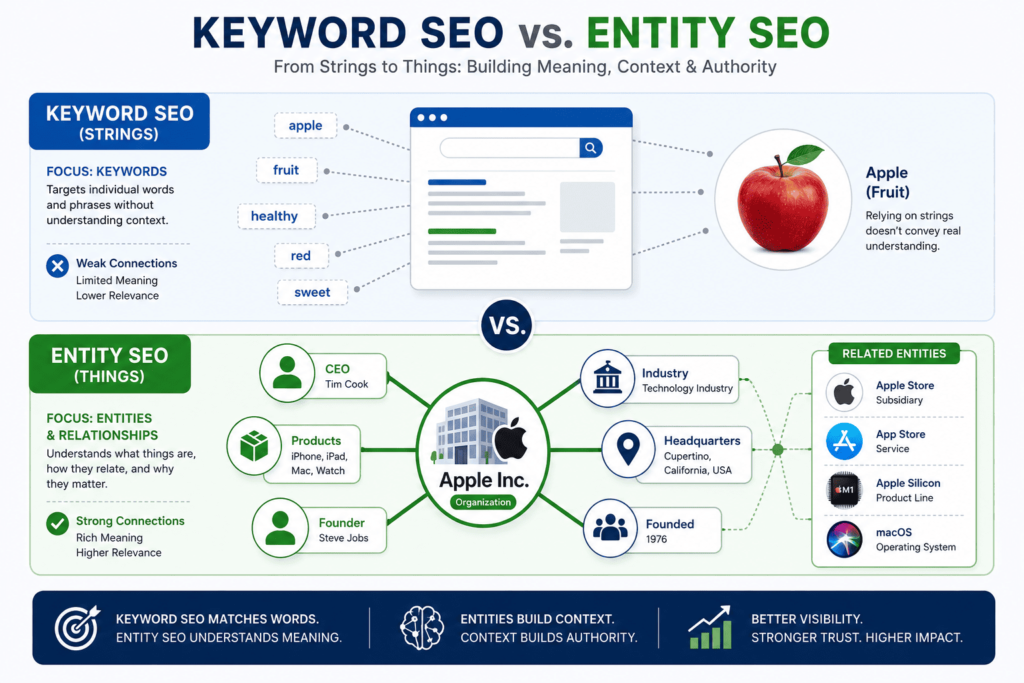
Entity SEO is the practice of optimizing a website, brand, or person so that search engines and AI systems can recognize it as a distinct, well-understood entity — a real thing with a stable identity, defined attributes, and verifiable relationships to other entities — rather than as a collection of keyword-matched pages.
What Is Entity SEO?
Traditional SEO optimized for strings. Entity SEO optimizes for things.
An entity is any distinct, singular, well-defined concept that can exist independently: a company, a person, a product, a place, an event, or an abstract idea. Search engines maintain structured databases of these entities — most visibly Google’s Knowledge Graph — and use them to understand meaning rather than merely match text.
The practical difference is this. A keyword-based system asked about “Apple” must guess from surrounding text whether the query concerns fruit or a technology company. An entity-based system does not guess. It resolves the query to a specific node in its knowledge base, retrieves that entity’s known attributes and relationships, and answers accordingly.
Entity SEO is the discipline of making sure your brand, your people, and your subject-matter coverage are represented as clearly resolvable entities inside those systems.
The 3 Core Pillars of Entity SEO (Entity Establishment, Disambiguation, & Association)
That involves three distinct jobs, which are frequently conflated:
- Entity establishment — ensuring the entity exists and is recognized at all. A business that appears nowhere in structured, corroborated form may simply not exist as an entity from the search engine’s perspective.
- Entity disambiguation — ensuring the entity is distinguishable from similarly named entities. This is where consistent naming and explicit identity references matter most.
- Entity association — ensuring the entity is connected to the topics, people, and concepts it should be known for. This is where entity work overlaps with topical authority.
Most published advice on Entity SEO addresses only the second job, usually by recommending schema markup, and treats the other two as if they were automatic. They are not.
Why Entity SEO Matters
Entity SEO moved from a specialist concern to a mainstream one for a specific structural reason: AI-assisted search retrieves and synthesizes information about things, not about pages.
When an AI system answers a question about a category — “who does technical SEO for enterprise B2B companies” — it is not simply ranking documents. It is drawing on an internal representation of which organizations are associated with that domain, then citing sources that corroborate it. A brand with no clear entity representation has no meaningful way into that answer, regardless of how well-optimized its individual pages are.
The Impact of Entity Recognition on Brand & AI Visibility
The business implications follow directly:
Visibility in AI-generated answers depends on entity recognition. If a system cannot resolve who you are and what you do, it cannot include you in a synthesized response.
Brand queries behave differently than category queries. Recognized entities tend to receive richer, more stable treatment in search results — branded panels, accurate descriptions, correct attribution of products and people. Unrecognized entities are represented by whatever the system can infer, which is often incomplete or wrong.
Entity confusion has direct commercial cost. When a business shares a name with a larger or better-established entity, or has inconsistent identity signals across the web, search systems routinely surface the wrong information — outdated addresses, a competitor’s details, a defunct social profile.
Topical association determines category consideration. Being recognized as an entity is necessary but not sufficient. The entity also has to be connected to the topics you want to be found for.
Expert Box — What we observe in practice: The most common entity problem we encounter is not missing schema markup. It is inconsistency. A business describes itself one way on its homepage, differently in its schema, differently again on LinkedIn, and differently in its directory listings. Each source is individually reasonable; collectively they give search systems no stable signal to converge on. Fixing consistency almost always produces more movement than adding markup to an already-inconsistent foundation.
How Entity SEO Works: The MS-EOM Framework
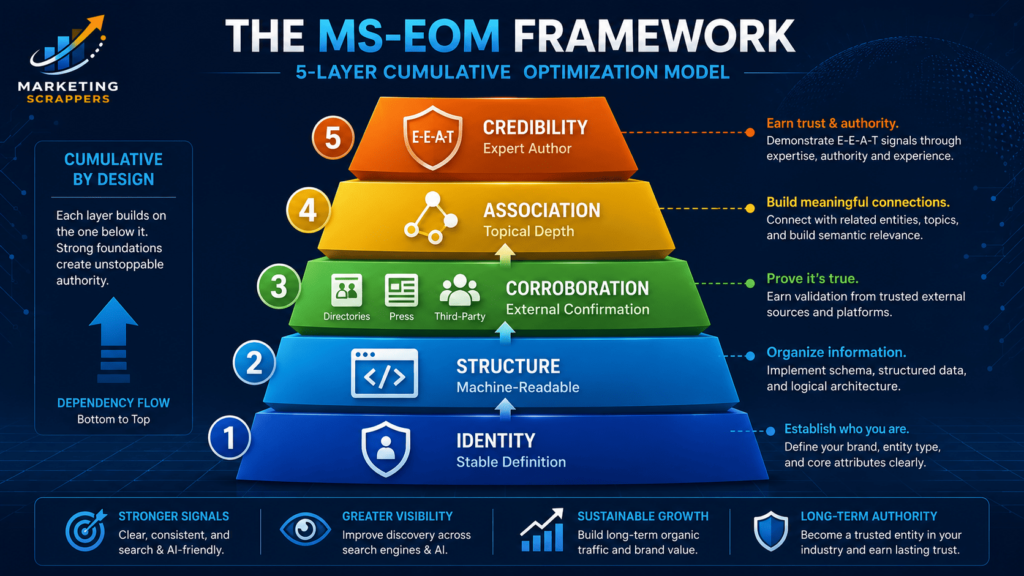
Entity SEO works by supplying search engines and AI systems with corroborated, machine-readable signals about identity, attributes, and relationships — and then reinforcing those signals consistently everywhere the entity appears.
Marketing Scrappers organizes this work through the MS Entity Optimization Model (MS-EOM), which describes five layers that must operate together. The model exists because entity work fails most often not from a missing tactic but from a missing layer — teams implement structured data without establishing corroboration, or build topical depth without a resolvable entity to attach it to.
The 5 Layers of Entity Optimization
| Layer | What It Establishes | Primary Mechanisms |
| 1. Identity | That the entity exists and has a stable, singular definition | Consistent naming, canonical descriptions, a definitive “about” source |
| 2. Structure | That machines can read the identity without inference | Organization and Person schema, sameAs properties, structured data validation |
| 3. Corroboration | That the identity is confirmed by sources other than the entity itself | Wikidata and authoritative databases, industry directories, press coverage, consistent third-party profiles |
| 4. Association | That the entity is connected to the topics it should be known for | Topical depth, internal linking architecture, named frameworks and original concepts, author attribution |
| 5. Credibility | That the entity is trustworthy enough to cite | Experience signals, original research, transparent authorship, demonstrable expertise (E-E-A-T) |
The layers are cumulative and ordered. Structured data (Layer 2) describing an identity that is inconsistent (Layer 1) encodes the inconsistency. Corroboration (Layer 3) without topical association (Layer 4) produces a recognized entity with no category relevance. Association without credibility (Layer 5) produces topical presence that AI systems have no reason to cite.
A note on how entity recognition is confirmed. Google exposes a Knowledge Graph Search API, though Google’s own documentation notes it returns individual matching entities rather than connected graphs, is not intended as a production-critical service, and is being migrated toward its Cloud Enterprise Knowledge Graph product. In practice, entity recognition is best assessed through a combination of signals — brand panel presence, how search systems describe the business in generated answers, and consistency of attributes across third-party sources — rather than through any single API lookup. Anyone claiming a precise “entity score” is offering a proxy, not a measurement.
Related Entities
Entity SEO does not exist in isolation. Understanding it requires understanding its immediate semantic neighbors and how each one relates.
| Related Entity | Relationship to Entity SEO |
| Entity | The foundational unit. Entity SEO is the optimization discipline built around it. |
| Knowledge Graph | The structured database where entities and their relationships are stored and resolved. |
| Schema Markup | The primary implementation mechanism for communicating entity data to machines. |
| Wikidata | An open, structured knowledge base widely used as a corroborating source for entity identity. |
| Organization Schema | The specific schema type used to define a business as an entity. |
| sameAs | A structured data property that links an entity to its authoritative profiles elsewhere, aiding disambiguation. |
| Semantic SEO | The broader discipline of optimizing for meaning and context; Entity SEO is one component of it. |
| Topical Authority | The depth and breadth of an entity’s demonstrated coverage of a subject area. |
| E-E-A-T | The credibility framework that determines whether a recognized entity is treated as trustworthy. |
Entity SEO vs. Semantic SEO vs. Schema Markup
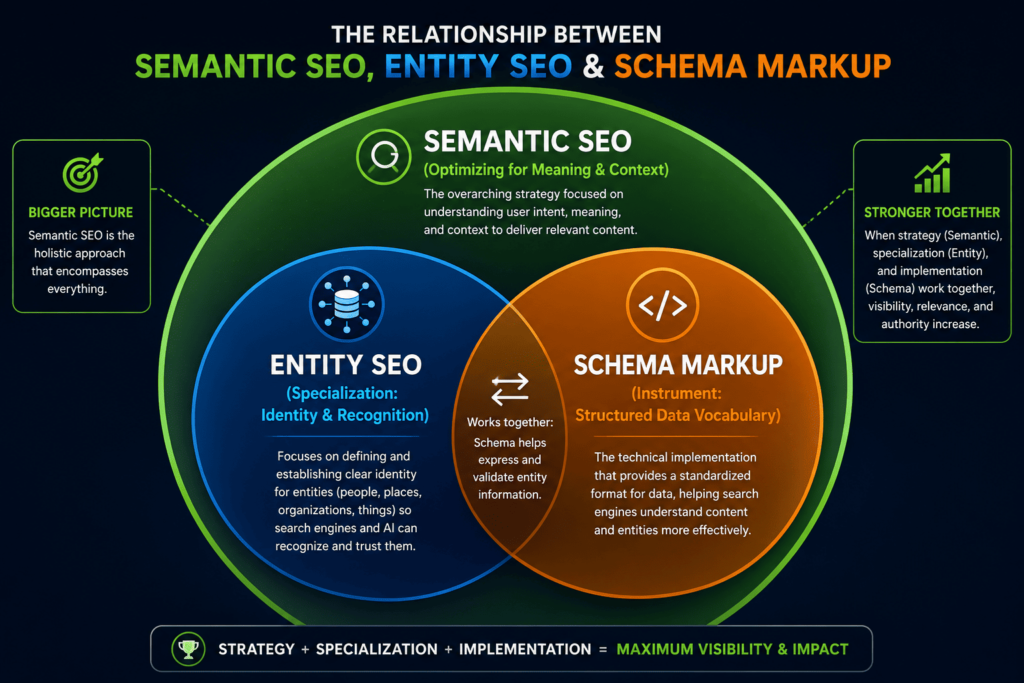
These three terms are used interchangeably across most published SEO content. They are not interchangeable, and confusing them leads to predictable implementation errors — most commonly, treating schema markup as though it were an entity strategy.
Key Differences & Structural Hierarchy
| Entity SEO | Semantic SEO | Schema Markup | |
| What it is | A discipline focused on entity identity and recognition | A broader discipline focused on meaning, context, and topical relationships | A technical vocabulary and implementation method |
| Core question | “Does the system know what and who we are?” | “Does the system understand what this content means?” | “Is this information machine-readable?” |
| Scope | Brand, people, products, and their relationships | Content, topics, queries, and conceptual coverage | Individual pages and data objects |
| Primary output | A recognized, correctly described, well-connected entity | Comprehensive, contextually complete topical coverage | Valid structured data in a machine-readable format |
| Relationship | A subset of Semantic SEO, focused on identity | The parent discipline containing Entity SEO | A tool used by both |
The clearest way to hold the distinction: Semantic SEO is the field. Entity SEO is a specialization within it. Schema markup is an instrument both use. You can implement schema markup perfectly and have no entity strategy. You can have a strong entity presence built largely on corroboration and consistency with relatively modest markup.
Practical Examples
Organization entity — a B2B services firm. The business is described identically across its homepage, Organization schema, LinkedIn, and industry directories. sameAs properties link the schema to those profiles. Its founder is defined as a Person entity connected to the organization. The result is an unambiguous identity that search systems can resolve and describe accurately.
Person entity — a founder or subject-matter expert. Author attribution on published content connects the Person entity to specific topics. Speaking engagements, published research, and third-party citations corroborate expertise independently. Over time, the person becomes associated with the subject area rather than merely appearing on pages about it.
Product entity — a named methodology or software product. A distinctly named product with a consistent definition, a canonical page, and consistent external references becomes a resolvable entity in its own right. This is why naming proprietary frameworks matters strategically — an unnamed process cannot become an entity.
Local business entity. Name, address, and phone consistency across the business’s own site, its Business Profile, and directory listings is the entire foundation. Local entity problems are almost always consistency problems, not markup problems.
Ambiguous brand entity — the hard case. A company sharing a name with a larger, better-known entity faces a disambiguation problem that markup alone rarely solves. Resolution typically requires distinctive corroborated signals across multiple independent sources, plus strong topical association in a category the competing entity does not occupy.
Common Mistakes
- Treating schema markup as an entity strategy. Markup describes an identity; it does not establish or corroborate one.
- Inconsistent naming and descriptions across the site, structured data, and external profiles — the single most common and most damaging error.
- Omitting sameAs properties, leaving search systems to infer connections between the site and its external profiles.
- Building topical content without a resolvable entity behind it, producing coverage with no attributable source.
- Publishing unattributed content, which forfeits the ability to build Person entities and weakens credibility signals.
- Chasing a Knowledge Panel as the goal. A panel is a visible symptom of entity recognition, not the objective, and not a reliable measure of it.
- Creating multiple competing definitions of a proprietary concept, which fragments rather than concentrates entity association.
Related Services & Resources
If you are working through Entity SEO practically rather than conceptually, these resources go deeper:
- What Is Entity SEO? Complete Guide — the full implementation guide, including auditing current entity recognition and building corroboration.
- Schema Markup Guide and Organization Schema Guide — the structural layer in detail.
- Brand Entity Building and Wikidata SEO — the corroboration layer.
- AI Search Optimization Guide — how entity recognition translates into visibility in AI-generated answers.
- AI Search Visibility Report — MS research on how brands surface in AI-assisted search.
For businesses that need entity work executed rather than explained, the Entity SEO Service applies the MS-EOM across all five layers, and the AI Search Optimization Service extends it toward visibility in generative search environments.
Frequently Asked Questions
What is Entity SEO?
Entity SEO is the practice of optimizing a brand, person, product, or concept so search engines and AI systems recognize it as a distinct entity with a defined identity, attributes, and relationships — rather than as text to be keyword-matched.
What is an entity in SEO?
An entity is a distinct, singular, well-defined thing that can exist independently — a company, person, place, product, event, or concept. Search engines store entities and their relationships in structured knowledge bases such as Google’s Knowledge Graph.
What is the difference between Entity SEO and Semantic SEO?
Semantic SEO is the broader discipline of optimizing for meaning, context, and topical relationships. Entity SEO is a specialization within it focused specifically on the identity and recognition of entities. Entity SEO is a subset of Semantic SEO.
Is Entity SEO the same as schema markup?
No. Schema markup is a structured data vocabulary — one implementation mechanism among several. Entity SEO is a strategic discipline that uses schema markup alongside naming consistency, external corroboration, topical association, and credibility signals.
How do I know if my business is recognized as an entity?
There is no single definitive test. Useful indicators include whether a brand panel appears for branded queries, whether AI systems describe your business accurately when asked about it, and whether your attributes are consistent across third-party sources. Google’s Knowledge Graph Search API can be consulted, but Google notes it is not intended as a production-critical service and returns individual entities rather than relationships.
Does Entity SEO help with AI search visibility?
Yes, and it is arguably its most direct application. AI systems synthesize answers about things rather than ranking documents. A brand that cannot be resolved as an entity has limited pathways into those synthesized answers.
Do I need a Wikipedia or Wikidata page for Entity SEO?
Neither is required, and Wikipedia has independent notability standards that most businesses will not meet. Corroboration can come from many sources — industry directories, press coverage, consistent professional profiles, and authoritative databases. Wikidata is more accessible than Wikipedia but should be one signal among several, not the strategy.
How long does Entity SEO take to show results?
Entity recognition builds gradually because it depends on corroboration across independent sources accumulating over time. Consistency fixes can register relatively quickly; establishing a previously unrecognized entity, or resolving disambiguation against a stronger competing entity, is typically a multi-quarter effort. Any specific timeline promised without knowing the entity’s starting position should be treated skeptically.
Does Entity SEO replace keyword research?
No. Keywords remain how demand is expressed and measured. Entity SEO changes what you optimize toward — recognized concepts and relationships rather than string matches — but understanding what people search for remains foundational.
Key Takeaways
- Entity SEO optimizes for things, not strings — the concepts search engines and AI systems recognize and store.
- It involves three distinct jobs: establishment, disambiguation, and association. Most published advice covers only the second.
- The MS Entity Optimization Model (MS-EOM) organizes the work into five cumulative layers: Identity, Structure, Corroboration, Association, and Credibility.
- Entity SEO is a subset of Semantic SEO. Schema markup is a tool, not a strategy.
- Its commercial relevance has increased sharply because AI-assisted search retrieves and synthesizes information about entities rather than ranking documents.
- The most common failure is inconsistency, not missing markup.
Need Help Structuring Your Brand Entities?
Ensure AI search systems and Knowledge Graphs clearly recognize, disambiguate, and validate your organization.
Explore the Entity SEO Service