
Short Definition
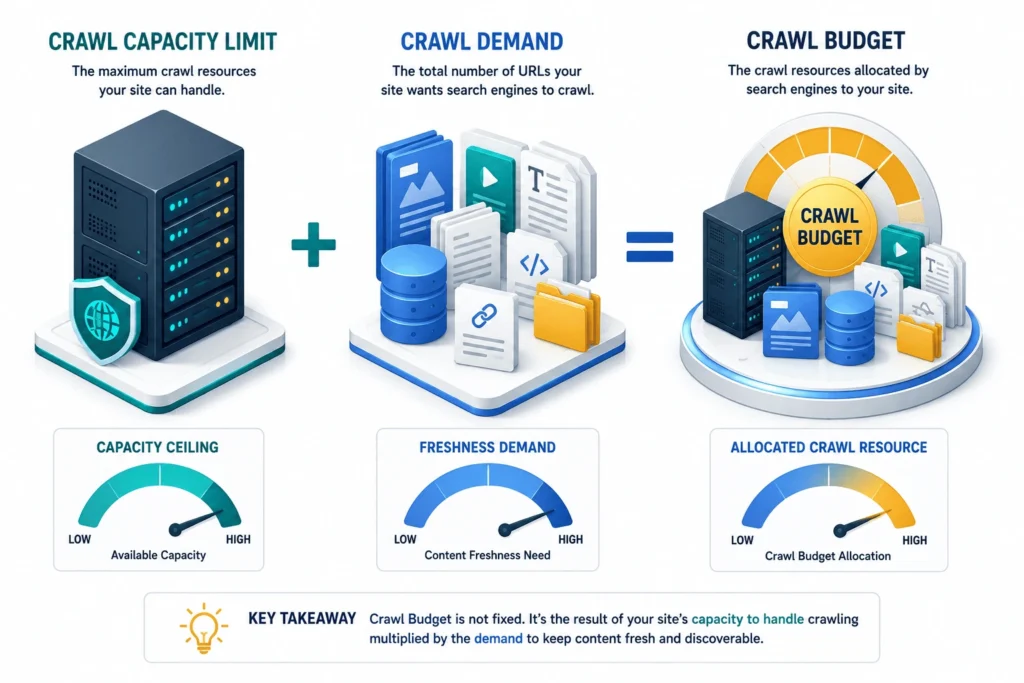
Crawl budget is the number of pages a search engine’s crawler will fetch on a website within a given timeframe. It’s shaped by crawl capacity (how much crawling a server can handle) and crawl demand (how much the crawler wants to revisit and discover pages), together determining how quickly new or updated content gets indexed.
Expanded Definition
Google formalized the concept in a 2017 Search Central blog post, What Crawl Budget Means for Googlebot
, defining it as the combination of crawl capacity and crawl demand. define a site’s crawl budget as the set of URLs Googlebot can and wants to crawl. “Can” refers to server-side capacity — Google originally called this the crawl rate limit, though current documentation increasingly uses crawl capacity limit for the same idea. “Wants” refers to crawl demand — how much value, freshness, or popularity a search engine assigns to revisiting a given set of URLs. Ighenatt
The concept is specific to how Googlebot operates, but the underlying logic — a finite allocation of crawling attention across a domain — applies conceptually to any web crawler, including Bing’s crawler and the AI crawlers (GPTBot, ClaudeBot, PerplexityBot) that increasingly index sites for generative-answer engines. Crawl budget is not something most businesses manage directly; it’s the outcome of a calculation Google runs continuously, not a setting a site owner controls.
Why It Matters
Crawl budget determines speed of discovery, not quality of ranking. Google has been explicit that an increased crawl rate will not necessarily lead to better positions in Search results — crawling is necessary for appearing in results, but it is not itself a ranking signal. The business impact is timing: if Googlebot spends its available budget on low-value URLs, genuinely new or updated pages take longer to be discovered, crawled, and become eligible for indexing.
Google aims to check and index pages in a reasonably timely manner — for most sites this is three days or more, and same-day indexing shouldn’t be expected as the norm. That baseline lag is exactly what widens when crawl budget is poorly allocated. Ighenatt
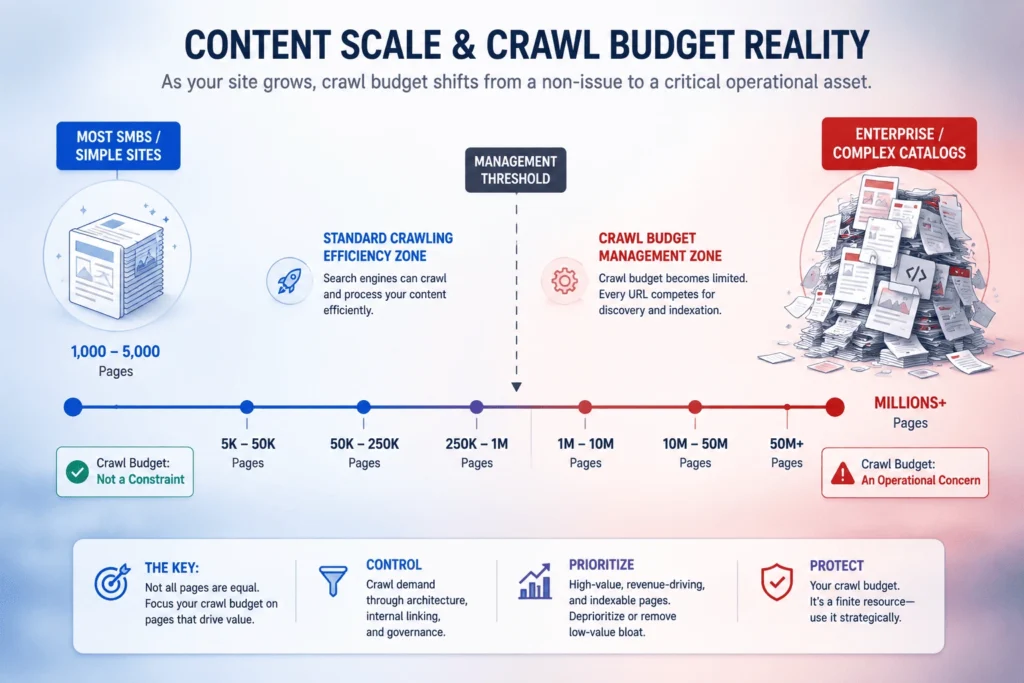
In practice, crawl budget is a scale problem: sites with fewer than a few thousand URLs are typically crawled efficiently without any special management. Industry reporting on Google’s own guidance frames it as a practical concern mainly once a site exceeds roughly a million pages updated weekly, or ten thousand-plus pages that change daily For detailed recommendations on managing enterprise-level sites, refer to Google’s official documentation on Crawl Budget Management for Large Sites. Most small and mid-sized business sites will never bump against this ceiling; the value of understanding the term is being able to recognize when it becomes relevant rather than assuming it always is. It’s also a growing consideration on the GEO/AEO side of things: AI crawlers draw on the same underlying server capacity as traditional search crawlers, so a site that’s slow or duplicate-heavy risks being under-visited by both.
To learn how AI search crawlers impact visibility, explore our State of SEO 2026 report.
Key Characteristics
- Two components, not one — crawl capacity (server-side ceiling) and crawl demand (content-side pull) combine to produce the effective budget.
- Dynamic, not fixed — site-wide events such as a migration can temporarily increase crawl demand as Google works to reindex content under new URLs; budget recalculates continuously rather than resetting on a schedule. Ighenatt
- Not a ranking factor — it’s a discovery-speed mechanism, sitting upstream of ranking, not part of it.
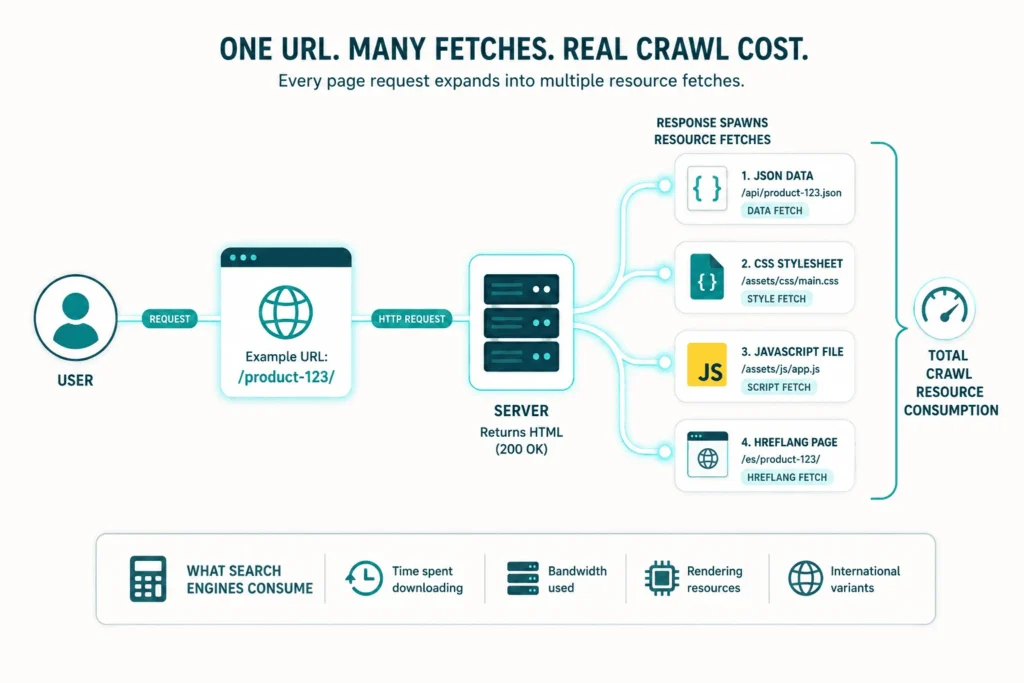
- Universally consumed — any URL Googlebot fetches counts toward the budget, including embedded CSS, JavaScript, AJAX calls, and alternate versions like AMP or hreflang pages.As Google explains in Inside Googlebot: demystifying crawling, fetching, and the bytes we process, every script and stylesheet fetched during rendering has its own limits and consumes crawler bandwidth.
- Scale-dependent relevance — it’s a meaningful operational concern almost exclusively for large or structurally complex sites, not a universal SEO checklist item.
Practical Example
A furniture retailer publishes 40–50 new product pages a month but also generates thousands of near-duplicate URLs from color, size, and sort-order filters on its catalog pages. If Googlebot spends most of its available crawl budget cycling through filter-combination URLs, the genuinely new product pages can sit undiscovered for days or weeks — delaying their eligibility to appear in search results during exactly the window when they’d otherwise be competing for seasonal or launch-driven demand.
Common Misconceptions
- “A bigger crawl budget means better rankings.” Crawling is a prerequisite for ranking, not a ranking signal itself — a site can be crawled heavily and still rank poorly, or crawled lightly and rank well, based on the hundreds of other signals Google weighs.
- “Every website has a crawl budget problem.” For the overwhelming majority of small and mid-sized sites, Google crawls efficiently without any special management being necessary.
- “Crawl budget and indexing are the same thing.” Crawling is discovery and fetching; indexing is a separate downstream process of analyzing and storing a page. A URL can be crawled and still never indexed.
- “You can request Google to give you more crawl budget.” Search Console lets you set an upper limit on crawl rate in specific cases, but you can’t manually raise your allocation — it’s the outcome of Google’s own capacity-and-demand calculation.
- “Crawl budget is a permanent number.” It shifts with server performance, content freshness, site events like migrations, and overall site value signals.
Related Entities
Semantic position: Technical SEO (parent) → Crawl Budget (this entity) → Crawl Rate Limit / Crawl Demand (components) → Googlebot, Indexing, XML Sitemap, Robots.txt, Canonical Tags, Internal Linking, Crawlability (adjacent entities).
- Googlebot — the crawler whose behavior and resource allocation this entity describes.
- Web Crawling — the broader process crawl budget governs the scale and pace of.
- Crawl Rate Limit (Crawl Capacity Limit) — the server-capacity component of crawl budget.
- Crawl Demand — the content-value component of crawl budget.
- Indexing — the downstream cataloging step that can only occur after a URL has been crawled.
- XML Sitemap — a discovery aid that helps direct crawl attention toward priority URLs.
- Robots.txt — the access-control layer that keeps low-value URLs from consuming crawl budget.
- Canonical Tags — a duplicate-content signal that reduces crawl waste across near-identical URLs.
- Internal Linking — the architecture that shapes which URLs get discovered, and how often they’re revisited.
- Crawlability — the broader precondition (can a page be reached at all) that crawl budget assumes is already satisfied.
- Technical SEO — the parent discipline this entity belongs to.
Related Terms
- Crawl Rate — informal shorthand often used interchangeably with crawl capacity limit.
- Crawl Capacity Limit — Google’s current terminology for what was originally introduced as “crawl rate limit.”
- Crawl Efficiency — a qualitative description of how well available crawl budget is being spent, not a metric Google publishes directly.
- Index Budget — a common but technically inaccurate term that conflates crawl budget with the separate process of indexing.
FAQ
What is crawl budget in simple terms?
It’s the number of pages a search engine’s crawler is willing and able to fetch on your site within a given period, based on your server’s capacity and how much the crawler values revisiting your content.
Is crawl budget a Google ranking factor?
No. Crawling is required to appear in search results, but Google has stated directly that crawl rate itself doesn’t influence ranking position.
Does every website need to worry about crawl budget?
No. It’s mainly relevant for large or structurally complex sites — think large catalogs, marketplaces, or sites generating many URLs via parameters. Most small and mid-sized business sites are crawled efficiently without any special management.
What’s the difference between crawl budget and indexing?
Crawl budget governs discovery and fetching. Indexing is the separate step where a fetched page is analyzed and added to Google’s index. A page can be crawled without ever being indexed.
How do I know if crawl budget is limiting my site?
Common signals include important pages not showing up in Search Console’s coverage reports well after publishing, or crawl request volume in the Crawl Stats report not moving even as you add content. Confirming and fixing this requires a proper technical audit — that diagnostic work is covered under Technical SEO.
For a complete walkthrough on optimizing crawlability, check out our Technical SEO Guide.
Summary
Crawl budget is the finite allocation of crawling attention — shaped by server capacity and content demand — that determines how quickly a search engine discovers and revisits pages on a site. It isn’t a ranking factor, and for most small and mid-sized sites it isn’t a practical constraint at all. It becomes operationally relevant once a site’s scale or structure (large catalogs, faceted navigation, frequent large-scale updates) creates enough low-value URLs to compete with genuinely important pages for the same limited crawling attention.
If your site has thousands of URLs or frequent large-scale updates, a Technical SEO audit can show whether crawl budget is actually limiting your indexing speed.
Explore the Technical SEO Service →Download our Technical SEO Checklist to audit your site’s crawl efficiency.