
Short Definition
Semantic SEO is the practice of optimizing content around meaning, context, entities, and user intent rather than relying solely on exact-match keywords. It helps search engines and AI systems understand relationships between topics, improving content relevance, discoverability, and authority across modern search experiences.
Expanded Definition
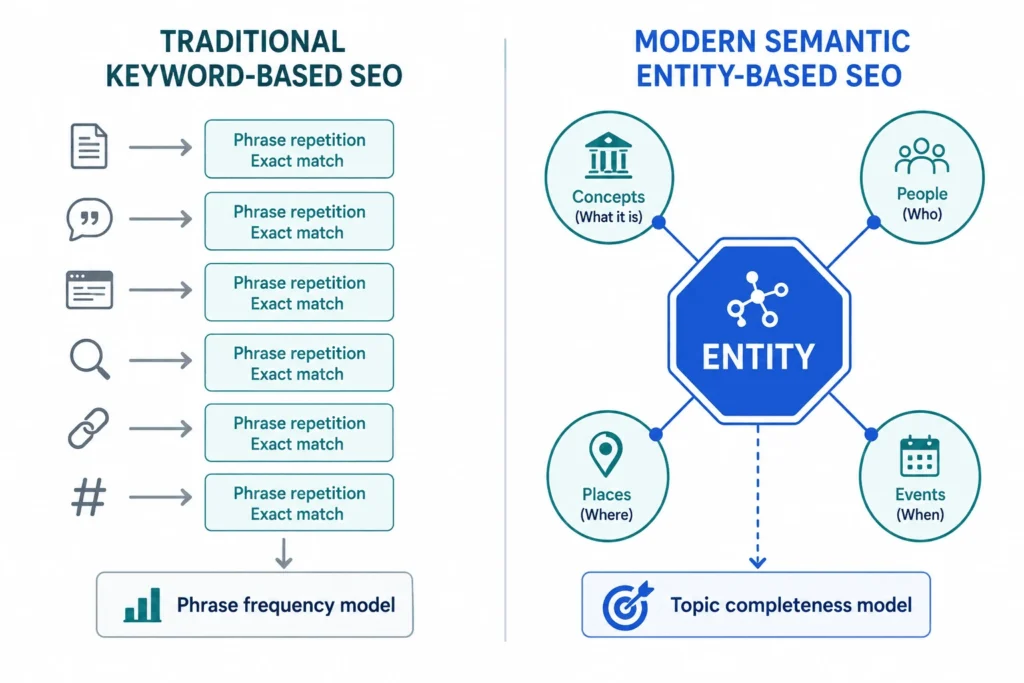
Traditional SEO treated a page largely as a container for keywords — rankings tracked closely with how often and where a phrase appeared. Semantic SEO treats a page as a set of ideas: entities (people, places, products, concepts) and the relationships between them.
That shift isn’t new, but it has become unavoidable Official documentation on how Google Search interprets meaning and entities tracks how Google’s Knowledge Graph (2012) and the Hummingbird update (2013) moved ranking systems from literal phrase-matching toward meaning-based retrieval. BERT (2019) extended this by parsing the context surrounding a word rather than the word in isolation. By 2026, the same underlying logic determines how AI systems — Google’s AI Overviews, ChatGPT, Gemini, and Perplexity — read a page: they extract entities and the relationships between them to construct an answer, rather than counting keyword occurrences.
In practice, semantic SEO means writing content that directly answers the question behind a search, uses the vocabulary and related concepts a topic naturally involves, and keeps entity relationships consistent across a site — so, for example, “quartz countertop” is clearly and consistently connected to “engineered stone,” “kitchen renovation,” and “countertop fabricator.” It does not replace keyword research; keywords still indicate which entities and intents matter to an audience. It changes what gets optimized — from the phrase to the concept.
Why It Matters
Google’s core ranking systems have rewarded meaning over literal keyword matches since Hummingbird and BERT — content built only around exact-match phrases already under-performs in classic search, and that gap widens in AI-generated answers, which are constructed from entity relationships rather than keyword frequency.
The business stakes are rising because the “result” itself is changing. As AI Overviews and chat-based answer engines summarize and cite sources directly, understanding how AI systems extract entity relationships to cite answers is becoming a distinct competitive advantage. That depends on how clearly a site’s content represents entities and their relationships, which is exactly what semantic SEO governs.
For businesses competing against commoditized, template-driven competitors, semantic clarity is also one of the few differentiators most incumbents haven’t touched — a website with genuinely well-structured entity relationships is legible to Google and AI systems in a way a keyword-stuffed competitor’s site is not.
Key Characteristics
- Entity-centric, not keyword-centric — content is organized around the things it discusses and how they relate, not phrase frequency.
- Context-aware — the same word can map to different entities depending on surrounding meaning (e.g., “tile” the flooring material vs. a browser tab); semantic SEO disambiguates through context.
- Intent-aligned — content is shaped around what someone is trying to accomplish (compare, buy, learn, fix), not just the words they typed.
- Not dependent on repetition — relevance comes from topical completeness and relationship clarity, not keyword density.
- Reinforced by structured data — markup adhering to the Schema.org DefinedTerm specification makes entity relationships explicit to machines rather than implicit in prose alone.
- Strengthened by internal linking — links between related concepts reinforce the same relationships search engines and AI systems infer from the text itself.
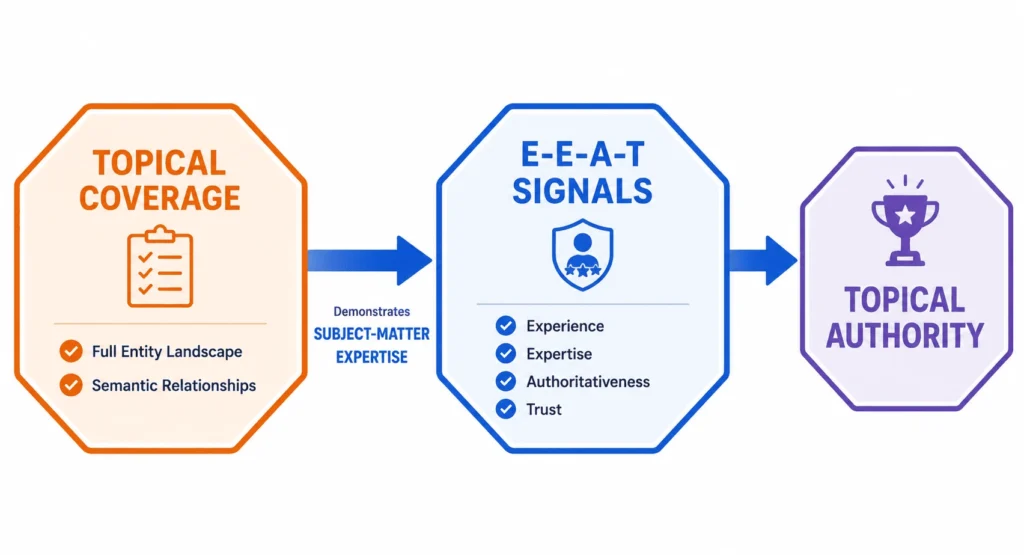
- Foundational to topical authority — a site that consistently covers a subject’s full entity landscape, not one keyword, reads as more authoritative to both Google and AI systems.
- Machine-readable by design — clear, answer-first definitions and explicit relationships make content easier for AI systems to extract and cite accurately.
Practical Example
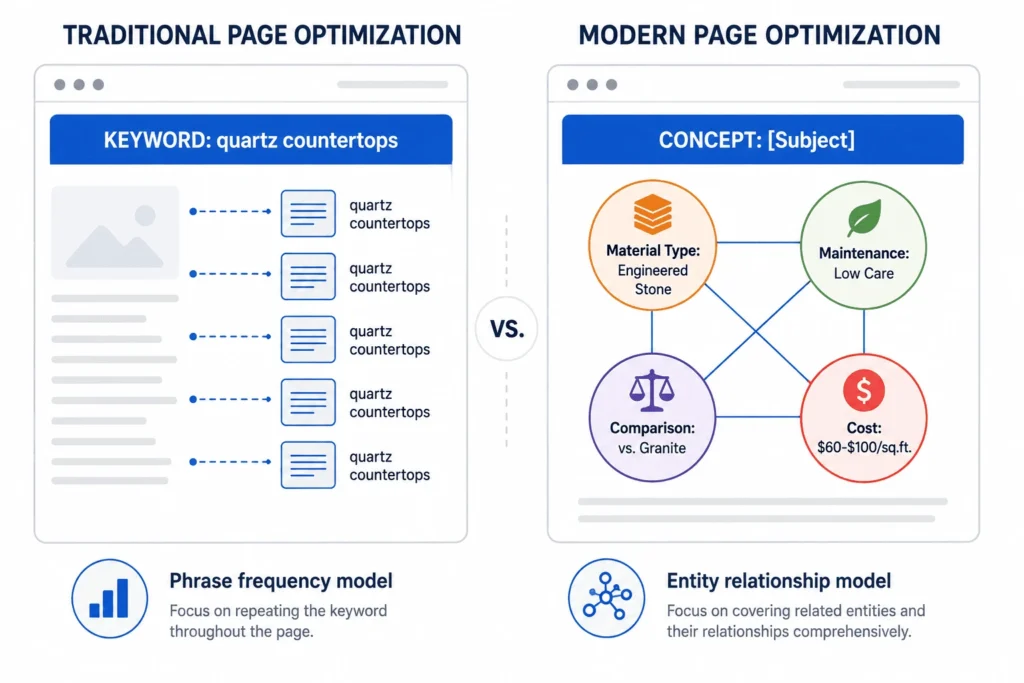
Consider two versions of a page targeting “quartz countertops [city]”:
- Keyword-first version: repeats the target phrase as often as feels natural, lists services, offers minimal supporting context.
- Semantic version: covers the same topic but explicitly connects the entity “quartz countertop” to its related entities — material composition (engineered stone vs. natural stone), comparison to granite and marble, maintenance requirements, typical cost range, and the installation process — answering the buyer’s underlying questions rather than repeating one phrase.
The semantic version ranks for the original query and for the dozens of related searches a buyer actually runs (“quartz vs. granite,” “how much do quartz countertops cost”), and it’s structured so an AI system can accurately summarize or cite it if someone asks for a countertop-material comparison.
Common Misconceptions
- “It just means using synonyms.” Synonyms reduce repetition, but semantic SEO is about mapping entity relationships and intent — not word substitution.
- “It’s the same as LSI (Latent Semantic Indexing) keywords.” LSI is an older, largely discredited keyword-tool concept. Modern semantic SEO is grounded in entities and knowledge graphs, not a hidden co-occurrence word list.
- “It replaces keyword research.” Keyword research still identifies which entities and intents matter to an audience; semantic SEO changes how that research gets applied, not whether it happens.
- “It only matters for AI search.” It also directly affects classic Google rankings — Google’s core algorithms have used entity and context understanding since Hummingbird and BERT.
- “It’s a one-time technical fix.” Entity relationships have to stay consistent as content, schema, and internal links evolve. It’s an ongoing editorial and architectural discipline, not a single audit.
Related Entities
- SEO (parent entity) — Semantic SEO is one discipline within SEO, alongside technical SEO, on-page SEO, and local SEO.
- Entity SEO (closely related) — focuses on how individual entities (people, brands, products) are identified and connected across the web; semantic SEO applies that entity thinking to content itself.
- Search Intent (core input) — meaning is judged partly by what the searcher is trying to accomplish, which semantic SEO uses as a primary signal.
- Topic Clusters (structural implementation) — one of the main ways semantic relationships get built into a site’s architecture, via pillar and supporting pages.
- Topical Authority (outcome) — consistent semantic coverage of a subject is what produces topical authority over time.
- Knowledge Graph (underlying system) — Google’s database of entities and relationships that semantically optimized content is ultimately trying to align with.
- Structured Data (technical layer) — schema markup makes entity relationships explicit to machines, reinforcing signals already present in the content.
- Natural Language Processing (NLP) (enabling technology) — the technology search engines and AI systems use to extract meaning and entities from content.
- Internal Linking (reinforcement mechanism) — links between related concepts strengthen the same relationships semantic SEO establishes in the text.
- E-E-A-T (trust layer) — semantically coherent, well-connected content demonstrates genuine subject-matter understanding rather than fragmented keyword targeting.
- Google Search (application context) — the primary environment semantic SEO is built for, alongside AI answer engines.
Related Terms
- Semantic Search — the search engine’s side of this relationship: how a query’s meaning gets interpreted. Semantic SEO is the content-side practice of aligning with it.
- Entity-Based SEO — a near-synonym often used interchangeably with entity SEO, emphasizing entities as the unit of optimization.
- Natural Language / Conversational Search — the longer, more conversational query behavior that semantically structured content is well-suited to answer.
- Latent Semantic Indexing (LSI) — an outdated keyword-tool concept frequently confused with semantic SEO; not its technical basis (see Common Misconceptions).
FAQ
What is semantic SEO in simple terms? It’s writing and structuring content around what a topic actually means and how its parts relate, so search engines and AI systems understand it accurately — instead of relying on repeating an exact phrase.
How is semantic SEO different from traditional keyword-based SEO? Traditional SEO optimizes for a specific phrase and how often it appears. Semantic SEO optimizes for the full set of entities, relationships, and intents behind that phrase, which is why it naturally captures many related searches at once.
Does semantic SEO mean I no longer need keyword research? No. Keyword research still identifies which entities and intents matter to your audience. Semantic SEO changes how that research gets applied — toward comprehensive, relationship-aware content rather than phrase repetition.
How does semantic SEO relate to AI search visibility (GEO/AEO)? AI systems build answers by identifying entities and their relationships in source content. Content with clear semantic structure is easier for these systems to extract, summarize, and cite — which is why semantic SEO underpins both Generative Engine Optimization (GEO) and Answer Engine Optimization (AEO).
Is semantic SEO the same as semantic search? No. Semantic search describes how a search engine interprets the meaning of a query. Semantic SEO is the content practice of aligning with that interpretation.
Summary
Semantic SEO shifts optimization from exact-match keywords to meaning, entities, and relationships — the same shift Google’s own ranking systems made with Hummingbird and BERT, and the same logic AI answer engines use to read and cite content today. It doesn’t replace keyword research, technical SEO, or content strategy; it’s the layer that makes all three legible to both search engines and AI systems. Implementation — entity mapping, topic clusters, structured data, and content architecture — belongs to Marketing Scrappers’ SEO service and supporting guides; this page defines the concept those disciplines build on.
Apply Semantic SEO Across Your Search Strategy
Semantic SEO is one of several core disciplines inside our SEO service. See how we apply entity mapping, topic clusters, and structured content architecture to build long-term organic authority.