
Topical Authority
Short Definition
Topical authority is the level of expertise and trust a website demonstrates by publishing comprehensive, well-connected content around a specific subject. It is built through complete topic coverage, semantic relationships, and clear internal linking, helping search engines and AI systems recognize the site as a reliable source on that topic.
Expanded Definition
Topical authority describes how completely a website covers a subject, rather than how many keywords a single page targets. A site earns it not by publishing one strong article, but by building a connected body of content that addresses the full range of questions, subtopics, and related concepts a subject involves — and by demonstrating, through that coverage, that the site actually understands the subject.
It’s worth being precise about what this term is and isn’t. “Topical authority” did not originate as an official Google ranking factor name — it’s a term the SEO industry coined to describe the combined effect of several signals that are real. <cite index=”18-8″>Google’s search advocate John Mueller has described the term as essentially a rebranding of relevancy
, a concept that has long been part of how search ranks content. At the same time, a 2024 leak of Google’s internal API documentation reportedly surfaced attributes such as siteFocusScore and siteRadius — measures of how tightly a site’s content concentrates around a central theme and how far individual pages drift from it. The honest summary: there is no single dial called “topical authority” inside Google’s algorithm, but the underlying idea — that coverage, cohesion, and consistency around a subject are rewarded — is well supported.
How it’s evaluated, at a high level:
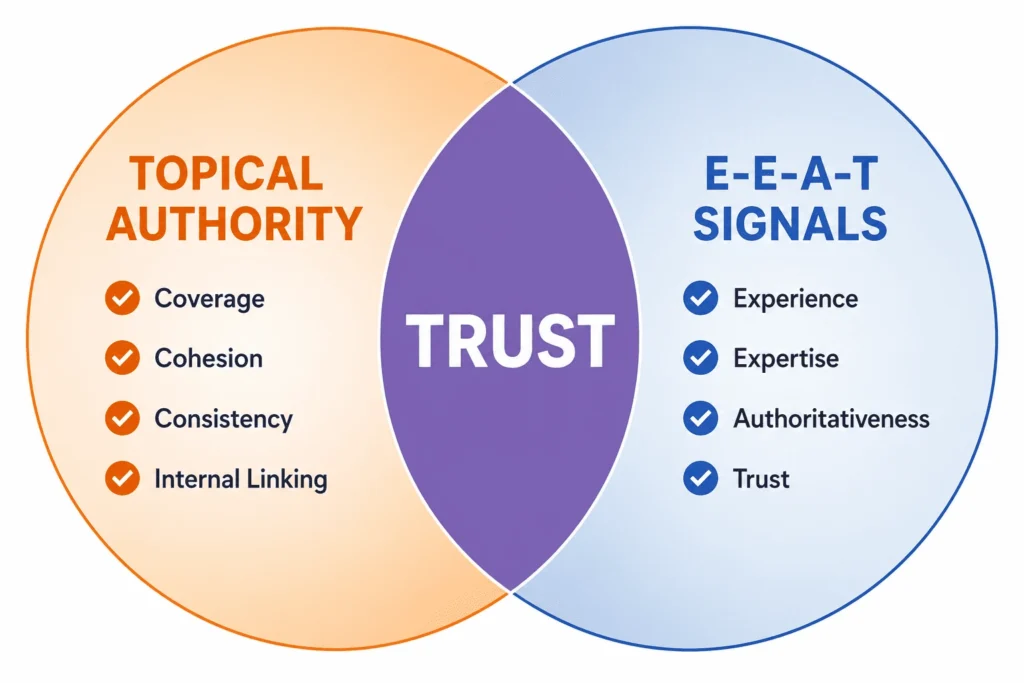
- Coverage — does the site address the subject’s core questions and subtopics, not just one entry point into it?
- Cohesion — do the pages on that subject relate to each other in a way that reflects genuine subject-matter structure, rather than sitting as disconnected posts?
- Consistency — has that coverage been maintained and extended over time, rather than published once and left static?
- Demonstrated expertise — does the content show first-hand knowledge and sound reasoning (the qualities Google’s own guidance on people-first content asks creators to evaluate for), rather than reading as compiled or generic?
This page defines the concept and its relationships. It does not walk through how to plan, cluster, or build topical authority — that implementation guidance belongs to the Content Marketing service and its supporting pillar guide.
This page defines the concept and its relationships. It does not walk through how to plan, cluster, or build topical authority — that implementation guidance belongs to the Content Marketing service and its supporting pillar guide.
Why It Matters
Search behavior has changed the value of this concept. As AI Overviews and AI-generated answers absorb a growing share of informational queries, systems increasingly need to select a small number of trusted sources to cite rather than surfacing ten blue links. A site that has established topical authority — genuine, connected coverage of a subject — is in a stronger position to be one of those cited sources, both in traditional search and in AI-generated answers.
For a business, this translates into a practical distinction: content built as isolated, one-off articles competes on individual keywords and has a shrinking ceiling as click-through rates on informational queries decline. Content built as a connected body of coverage competes on subject ownership, which is harder for competitors to replicate and more durable as search interfaces continue to change.
Businesses should care about this when:
- Individual blog posts rank briefly but don’t compound into lasting visibility.
- Competitors with narrower content libraries are outranking a site with more total pages.
- The goal shifts from “get traffic to a page” to “become the reference a market turns to.”
- A brand wants to be recognized — by search engines, AI systems, and buyers — as a credible source on its core subject, not just a vendor of it.
Key Characteristics
- Subject-wide coverage — addresses the breadth of a topic, not a single keyword or angle within it.
- Structural cohesion — pages relate to each other through deliberate internal linking that mirrors real conceptual relationships.
- Sustained depth over time — reinforced through ongoing publishing and updates, not achieved in a single push.
- Entity-level, not page-level — the recognition accrues to the site or brand as a whole, not to one high-performing page.
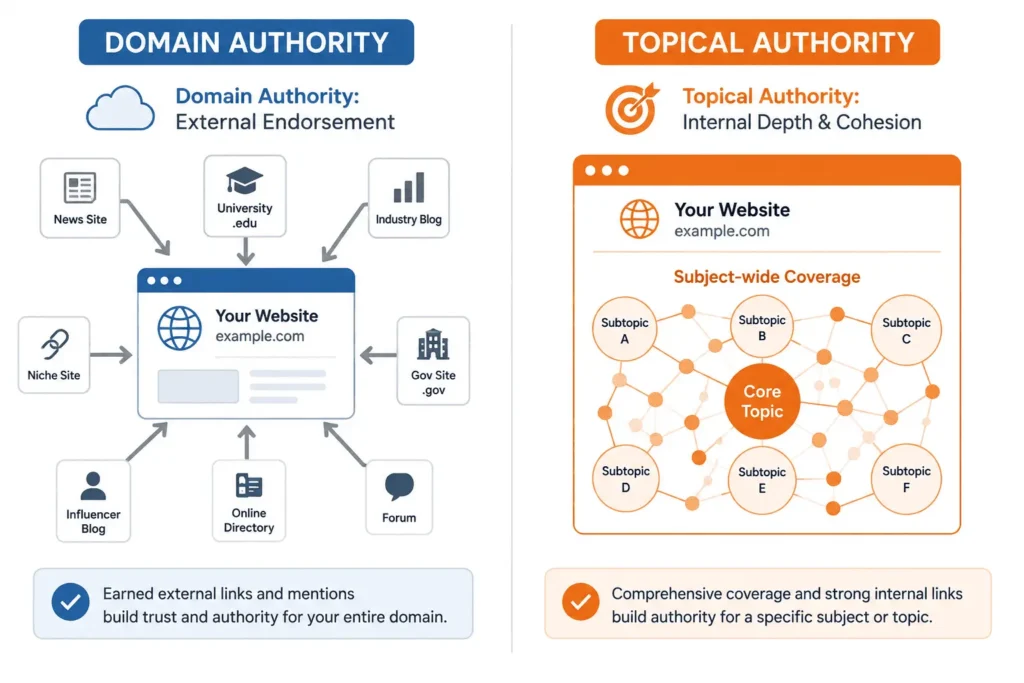
- Distinct from link-based authority — domain authority and backlink profiles measure external endorsement; topical authority measures internal coverage and coherence. The two are related but not the same signal.
Practical Example
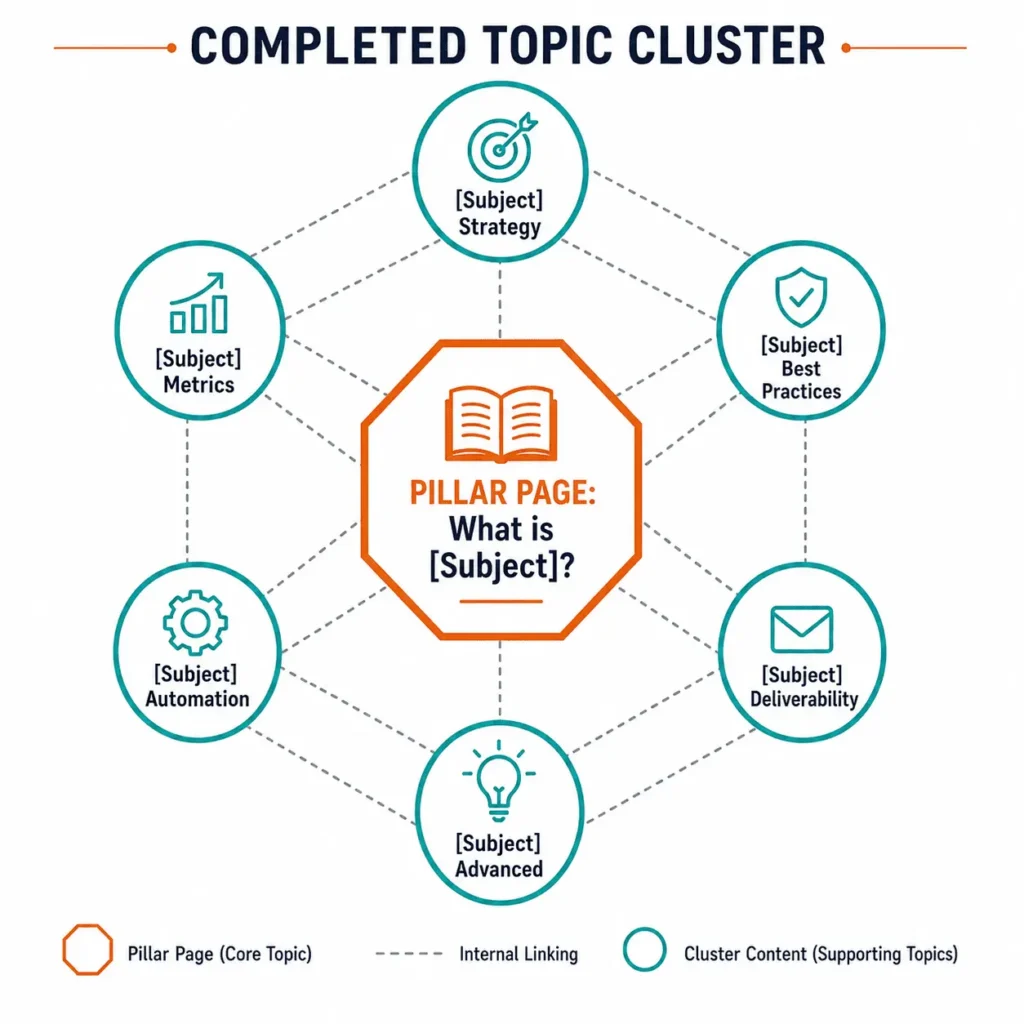
A single article titled “What Is Email Marketing?” does not, by itself, build topical authority — even if it ranks well. A site that instead publishes and interlinks a connected set of content — covering email marketing strategy, segmentation, automation platforms, deliverability, and compliance, each piece written with genuine depth and cross-referenced where the topics overlap — signals to search engines and AI systems that it understands email marketing as a complete subject, not just one entry point into it. Over time, that connected coverage is what earns the site recognition as a trusted source on the topic as a whole.
Common Misconceptions
- “Publishing more content automatically builds topical authority.” Volume without coherence — articles that don’t connect to a structured subject — does not build it. Coverage has to be organized, not just accumulated.
- “Topical authority is a named Google ranking factor.” It’s an industry term for the combined effect of real signals (coverage, internal linking, content quality), not a single measurable score Google has confirmed using.
- “One strong pillar page is enough.” A pillar page defines the subject; the supporting cluster around it is what demonstrates coverage. Authority comes from both together.
- “Once achieved, it’s permanent.” Coverage that goes stale, or that competitors surpass with deeper content, can lose relative authority. It requires maintenance.
Related Entities
- Content Marketing — the discipline this concept sits inside; topical authority is one of the outcomes content marketing is built to produce.
- Topic Clusters — the structural pattern (pillar plus supporting articles) most commonly used to build topical authority.
- Semantic SEO — the broader discipline of organizing content around meaning and entities rather than isolated keywords; topical authority is one of its outcomes.
- Entity SEO — concerned with how search engines and AI systems recognize a brand or organization as a real-world entity; strong topical authority strengthens that entity profile.
- Internal Linking — the mechanism that signals the relationships between pages within a topic.
- Search Intent — each page within a topic’s coverage needs to satisfy a distinct intent; without that, coverage duplicates rather than expands.
- E-E-A-T — the quality signals (experience, expertise, authoritativeness, trust) that content within a topic needs to demonstrate for coverage to translate into authority.
- Knowledge Graph — the structure in which entity relationships are stored; well-established topical authority helps a site’s entities appear correctly connected within it.
Related Terms
- Content Marketing
- Topic Clusters
- Semantic SEO
- Entity SEO
- Internal Linking
- Search Intent
- E-E-A-T
- Knowledge Graph SEO
- Content Hub
- AI Search Optimization
FAQ
What is topical authority in SEO? Topical authority is the trust and expertise a website builds by comprehensively covering a subject through connected, high-quality content — rather than ranking one page for one keyword.
Is topical authority an official Google ranking factor? Not by that name. It’s an industry term describing the combined effect of real signals — content coverage, internal linking, and quality — that Google’s systems do evaluate, even though “topical authority” itself isn’t a confirmed, named metric.
How is topical authority different from domain authority? Domain authority (a third-party metric) estimates a site’s strength based largely on backlinks. Topical authority describes how completely and coherently a site covers a specific subject, independent of external links.
Does topical authority affect visibility in AI Overviews and AI search? Yes, indirectly. AI systems favor citing sources that demonstrate depth and coherence on a subject. A site with established topical authority is more likely to be treated as a trustworthy source to cite or summarize.
How long does it take to build topical authority? There’s no fixed timeline — it depends on how much of the subject is already covered, how consistently new content is added, and how well existing content is interlinked. It builds cumulatively rather than from a single publish.
What’s the difference between topical authority and a topic cluster? A topic cluster is the structure (a pillar page plus supporting articles) used to build topical authority. Topical authority is the outcome — the trust and recognition that structure is intended to earn.
Summary
Topical authority is the trust a website earns by covering a subject completely and coherently, rather than by ranking isolated pages for isolated keywords. It’s not an official Google metric, but it describes something real: content coverage, internal linking, and consistency are signals search engines and AI systems can and do evaluate. For a business, it matters because informational search is consolidating around a smaller number of cited sources — and a site with genuine, connected coverage of its subject is better positioned to be one of them. Building it is an implementation question that belongs to a structured content strategy, not to this definition.
Ready to Build Topical Authority for Your Brand?
Explore how our structured content strategies and topic cluster implementations establish genuine search authority and long-term organic growth.
Explore the Content Marketing Service →