
Rich Results
Rich results are Google listings that show more than a title and a line of text — a star rating, an expandable FAQ, a product image. They come from structured data the page provides, and Google decides whether to display them.
What Are Rich Results?
Rich results are enhanced search listings that display additional visual or interactive information beyond the standard blue link, such as ratings, FAQs, recipes, products, or events. They are generated when a search engine understands eligible structured data on a page and determines that an enriched presentation improves the search experience.
(48 words — written for direct extraction by AI answer engines and featured snippets.)
Key Takeaways
- Rich results are a presentation layer from structured data — not a ranking factor.
- Markup creates eligibility; display is Google’s decision, not guaranteed.
- “Rich Snippet” is an older term, now treated as one type of rich result.
- Not every enhanced SERP feature is a rich result — some, like Featured Snippets, are algorithmic.
Simple Explanation
Think of a standard Google result as a business card: a name, a line of text, a link. A rich result is that same card with extra, structured facts attached — a star rating, a price, a set of expandable questions. The business didn’t redesign the card; it handed Google a labeled data sheet, and Google decided it was worth showing.
Why Rich Results Matter
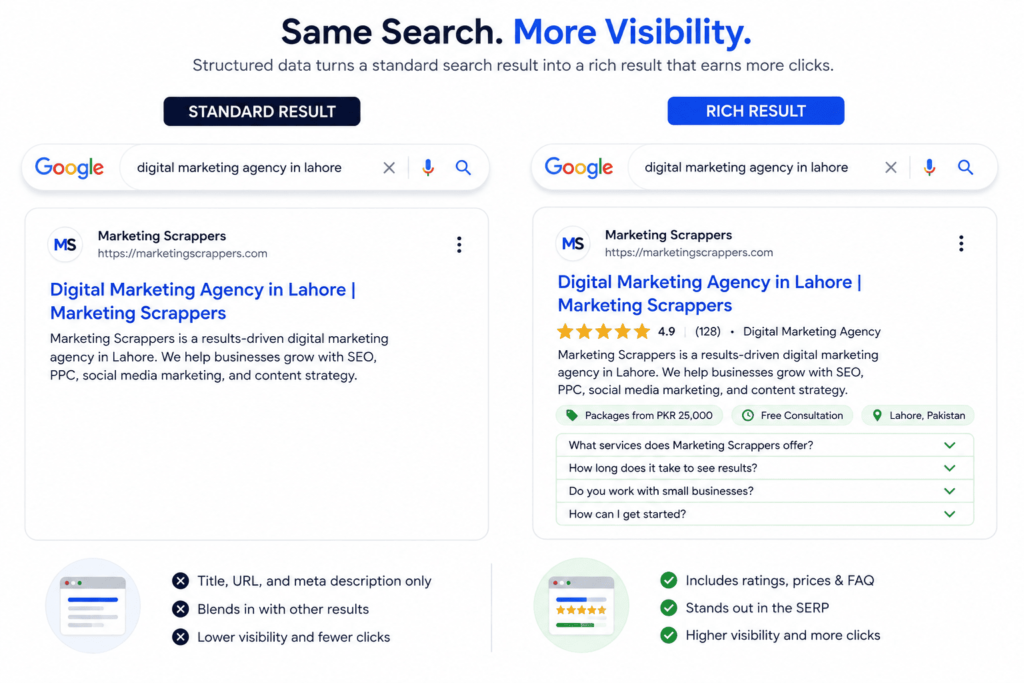
Rich results don’t move a page up the rankings — they change how it looks at whatever position it earns. A listing with a visible star rating or expandable FAQ typically draws more clicks than a plain listing in the same position.
For service businesses and product catalogs, that’s rare in SEO: visual space earned through markup rather than rank — a real differentiator when competitors haven’t bothered to implement it.
One Business Example
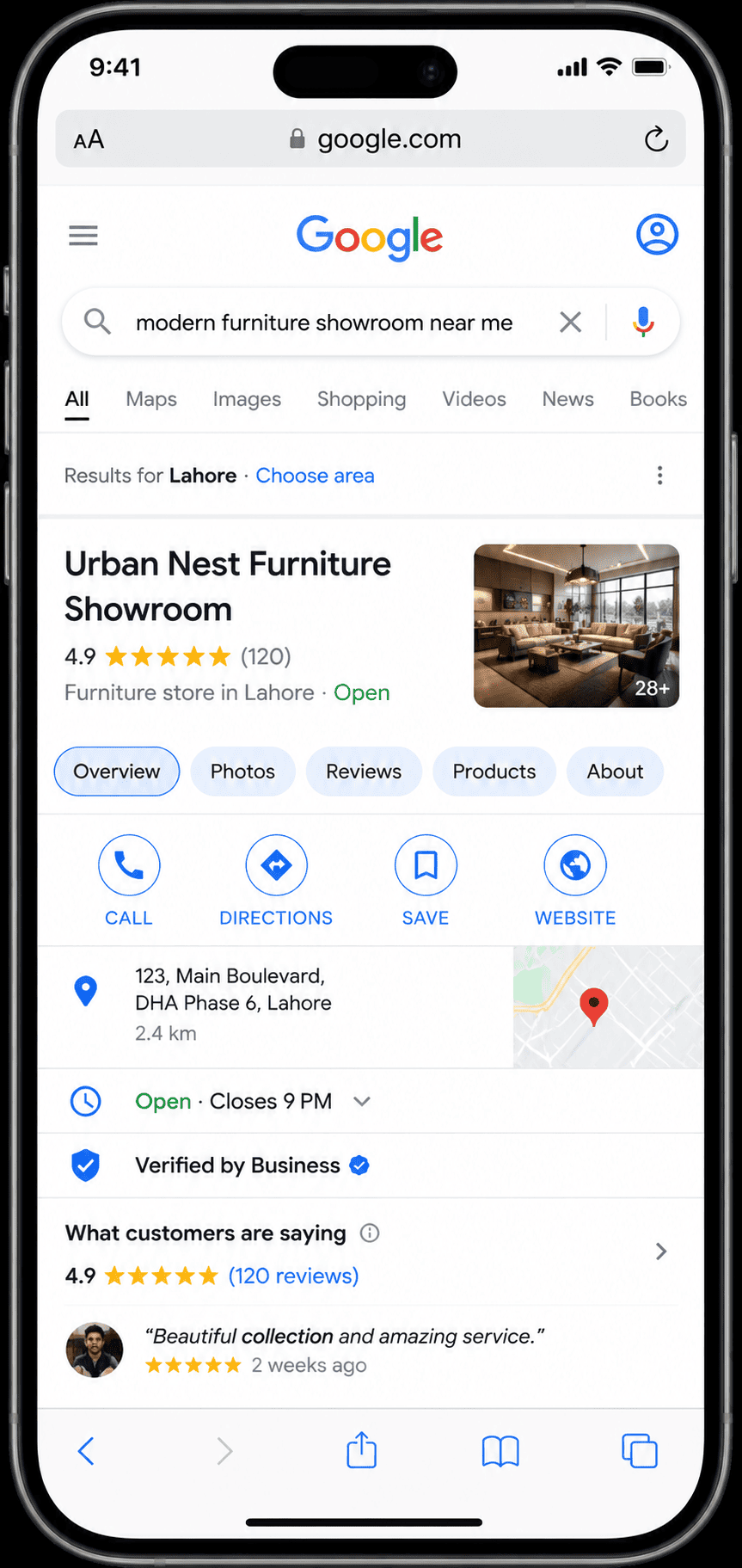
A tile and stone showroom marks up its verified customer reviews using Schema.org’s review vocabulary. If Google finds the markup valid, the listing may display a star rating beneath its title — something a competitor ranking one position above it, without that markup, won’t have. The rank didn’t change; what a searcher sees before clicking did.
Rich Results vs. Rich Snippets
“Rich Snippet” is Google’s earlier term, referring mainly to enhanced text — a rating, a price, an author name added to the standard result. “Rich Results” is the current, broader umbrella covering that same text-level enhancement plus larger formats: carousels, expandable FAQs, product panels. A rich snippet is best understood as one type of rich result, not a separate category.
Rich Results vs. Standard Search Results
A standard result is the baseline: a clickable title, a URL, and a plain-text description — nothing drawn from structured data. A rich result is that same listing with structured elements layered on top. The underlying page and its ranking are unaffected either way; only the listing’s presentation differs.
Relationship to Structured Data and Schema.org
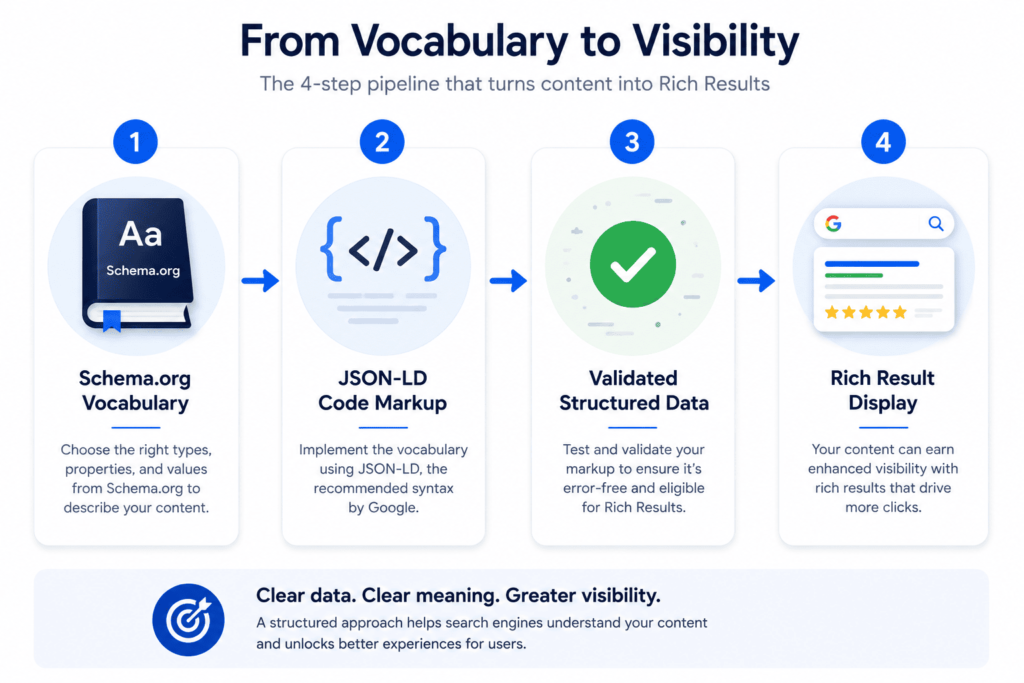
These entities form a dependency chain. Schema.org is the shared vocabulary that defines how to label a “Review,” “Product,” or “Event.” Structured data is the practice of applying that vocabulary to a page, usually written as JSON-LD. Rich results are the possible search-facing outcome once that markup is present, valid, and judged eligible. Each layer is a precondition for the next — none guarantees the one after it.
Common Misconceptions
- “Rich results and rich snippets are different things.” They overlap; rich snippet is a legacy term for one subtype of rich result.
- “Schema markup guarantees a rich result.” It creates eligibility only — Google still decides whether to render it.
- “Rich results improve rankings.” Not directly. They change presentation at an existing position, which can lift click-through rate.
- “Every enhanced search feature is a rich result.” Featured Snippets are algorithmic; Knowledge Panels draw from the Knowledge Graph — neither uses page-level markup.
Related Entities
- Structured Data — the parent practice that makes rich results possible.
- Schema.org — the vocabulary structured data is built on.
- JSON-LD — the common syntax for that markup.
- Rich Snippets — the earlier, narrower term for text-based rich results.
- SERP Features — the broader category rich results belong to.
- Knowledge Graph — a separate database behind Knowledge Panels, not rich results.
- Entity SEO / Technical SEO — the disciplines this entity sits within.
Related Terms
- Featured Snippet — algorithmically extracted text answer; not generated from a page’s structured data, unlike a rich result.
- Knowledge Panel — drawn from the Knowledge Graph rather than an individual page’s markup.
- SERP Feature — the umbrella category; rich results are a subset of it, not a synonym.
Frequently Asked Questions
What are rich results in Google Search? Enhanced listings — ratings, images, expandable FAQs — built from a page’s structured data instead of the standard title-and-description format.
What’s the difference between rich results and rich snippets? Rich snippet is the older term for text enhancements like ratings or prices. Rich results is the current, broader term, also covering larger visual formats.
Do rich results affect rankings? No. They affect how a listing looks at its existing position, not where that position is.
Is a rich result guaranteed once I add structured data? No. Structured data creates eligibility; the search engine still decides whether to render it.
What’s the difference between a rich result and a featured snippet? A rich result comes from a page’s own markup. A featured snippet is extracted algorithmically, with no markup required.
Summary
Rich results are enhanced Google listings built from structured data — a presentation upgrade, not a ranking mechanism. They sit downstream of Schema.org, overlap with the older “rich snippets” term, and stay distinct from algorithmic features like Featured Snippets. Markup creates eligibility; display is always the search engine’s decision.
Implementing that markup — schema selection, JSON-LD, eligibility — is where the visibility gain happens, in Marketing Scrappers’ Technical SEO service and Structured Data guide.
Next Steps in Technical Implementation
Structured data creates search eligibility, but real business visibility comes from clean execution, schema validation, and technical site health. Explore how we can help.
Explore Technical SEO Services