
JSON-LD (JavaScript Object Notation for Linked Data) is a standardized format for embedding structured data into web pages. It helps search engines and AI systems understand the meaning of page content by describing entities and their relationships in a machine-readable format, supporting richer search experiences and improved content interpretation.

Expanded Definition of JSON-LD
JSON-LD packages a page’s structured data using the vocabulary defined by Schema.org. Rather than tagging visible text, it adds a separate block of code describing the same content in machine-readable terms — a business, a product, an article — along with the properties and relationships that define it.
Google has recommended JSON-LD as its preferred structured data format since 2015, because it doesn’t need to be woven into visible HTML. That separation matters operationally: editors can update page text without breaking the structured data, and developers can update the structured data without touching page design.
Why It Matters
Search engines and AI systems parse a page’s code, not its visual layout. Without explicit structured data, an entity’s identity and relationships are left to inference from surrounding text — usually reasonable, but never guaranteed. JSON-LD removes that ambiguity by stating directly what a page is about.
That clarity increasingly decides whether a business gets included in AI-generated answers. Systems like AI Overviews, ChatGPT, and Perplexity have to identify entities and relationships accurately before summarizing or citing a source. Explicit structured data is one of the most reliable signals available for that identification.
Free Asset: Technical SEO Checklist
Ensure your site’s schema, indexing, and architecture are optimized for search engines and AI systems.
Download Technical SEO ChecklistKey Characteristics of JSON-LD
- Built on Schema.org vocabulary — describes recognized entity types (Organization, Product, Article, FAQ, and others) using standardized properties.
- Added as a separate code block — sits inside the page’s code without altering visible text or design.
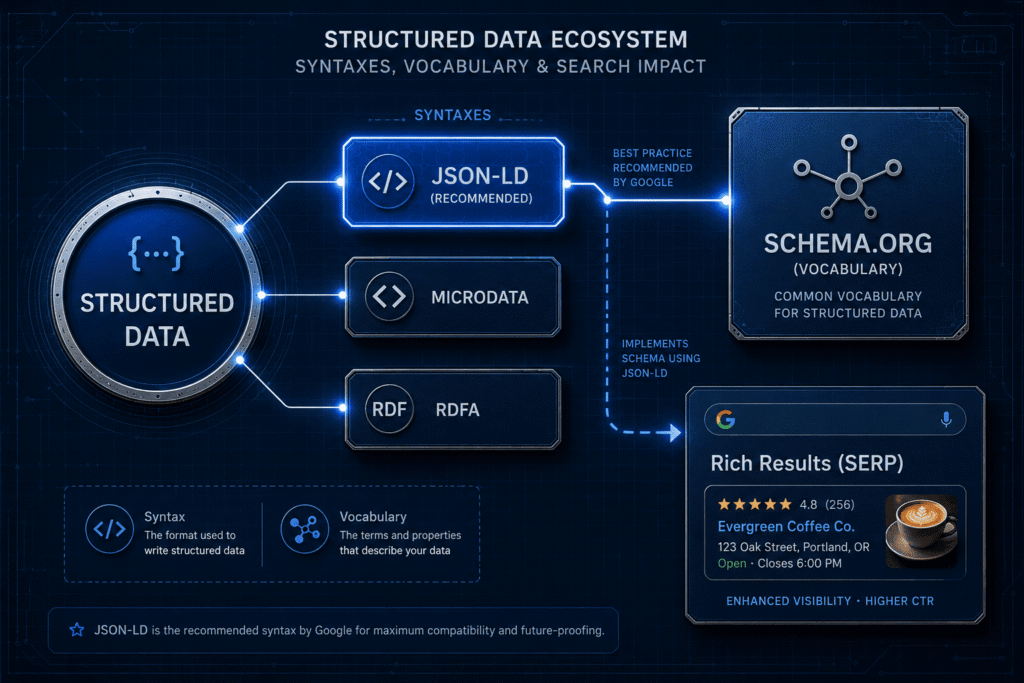
- One of three Google-supported formats — alongside Microdata and RDFa, though Google has specifically recommended JSON-LD since 2015.
- Machine-readable, not visually rendered — communicates meaning to search engines and AI systems, not to the person reading the page.
- A prerequisite for many Rich Results — well-formed JSON-LD is typically what qualifies a page for enhanced listings like star ratings or FAQ dropdowns.
Practical Example
Consider a page listing a countertop fabricator’s hours, phone number, and service area. A visitor reads that information directly off the page. JSON-LD states the same facts in a separate, invisible layer: this is a local business named X, located at this address, reachable at this number, open during these hours.

Nothing on the page looks different to a visitor. But a search engine or AI system reading the code now has an explicit statement of who the business is and how to reach it, rather than one inferred from surrounding text and formatting.
Common Misconceptions
- “JSON-LD is a ranking factor.” Not directly. It improves how accurately search engines and AI systems interpret content, which can influence rich results and AI citations.
- “JSON-LD and Schema.org are the same thing.” Schema.org is the vocabulary; JSON-LD is one syntax used to write that vocabulary into a page.
- “All structured data formats work the same.” Google supports Microdata and RDFa too, but has recommended JSON-LD specifically for ease of implementation.
- “JSON-LD changes what visitors see.” It doesn’t. JSON-LD is invisible to visitors and exists only to inform machines.
Entity Relationships
- Structured Data (parent entity) — JSON-LD is one syntax for implementing structured data, alongside Microdata and RDFa.
- Schema.org (source vocabulary) — JSON-LD borrows its entity types and properties from Schema.org; the two are often confused but play different roles.
- Rich Results (outcome) — well-formed JSON-LD generally qualifies a page for enhanced search listings.
- Knowledge Graph (destination) — entity data in JSON-LD is one input Google’s Knowledge Graph uses to connect entities.
- Entity SEO (application) — JSON-LD is the primary technical mechanism for applying entity SEO on a page.
- Technical SEO (parent discipline) — implementing and validating structured data sits within technical SEO.
Related Terms
- Microdata — an older, HTML-attribute-based structured data syntax, less commonly recommended today than JSON-LD.
- RDFa — another HTML-attribute-based syntax, used less frequently in mainstream SEO than JSON-LD.
- Schema Markup — a general term often used interchangeably with “structured data,” referring to any Schema.org-based markup regardless of syntax.
FAQ
What is JSON-LD? A structured data format that describes entities and their relationships in a page’s code, using Schema.org’s vocabulary, so search engines and AI systems can interpret content unambiguously.
Is JSON-LD the same as Schema.org? No. Schema.org defines the vocabulary — the entity types and properties. JSON-LD is one syntax for writing that vocabulary into a page; Microdata and RDFa are the other two.
Does JSON-LD affect Google rankings directly? Not directly. It’s not a standalone ranking factor, but it improves how accurately search engines and AI systems interpret a page, which can influence rich results and AI citations.
Why does Google recommend JSON-LD over Microdata or RDFa? Because it’s added as a separate code block rather than woven into visible HTML, which is easier to implement and maintain without disrupting page content or design.
Does JSON-LD change what visitors see on a page? No. JSON-LD is invisible to visitors — it communicates structure and meaning to machines, not to the person reading the page.
What’s the difference between JSON-LD and Rich Results? JSON-LD is the structured data format itself. Rich Results are the enhanced search listings — star ratings, FAQ dropdowns, breadcrumbs — that well-formed JSON-LD can make a page eligible for.
Summary
JSON-LD gives search engines and AI systems an explicit, machine-readable description of what a page is about, built on Schema.org’s vocabulary. It doesn’t change what a visitor sees, and it isn’t a ranking factor by itself — but it removes ambiguity that would otherwise be left to inference. Implementation, validation, and schema strategy belong to Marketing Scrappers’ Technical SEO service and Structured Data Guide; this page defines the concept those disciplines apply.
JSON-LD is one piece of a broader structured data strategy — see how we implement and validate it as part of our technical SEO service.
Explore the Technical SEO Service