
Structured Data
AI Overview Understanding what is structured data begins with recognizing it as a standardized format of code added to a webpage that describes its content in a way search engines and AI systems can read directly. Instead of inferring what a page is about from visible text alone, machines receive an explicit, labeled description of the entities, attributes, and relationships it contains.
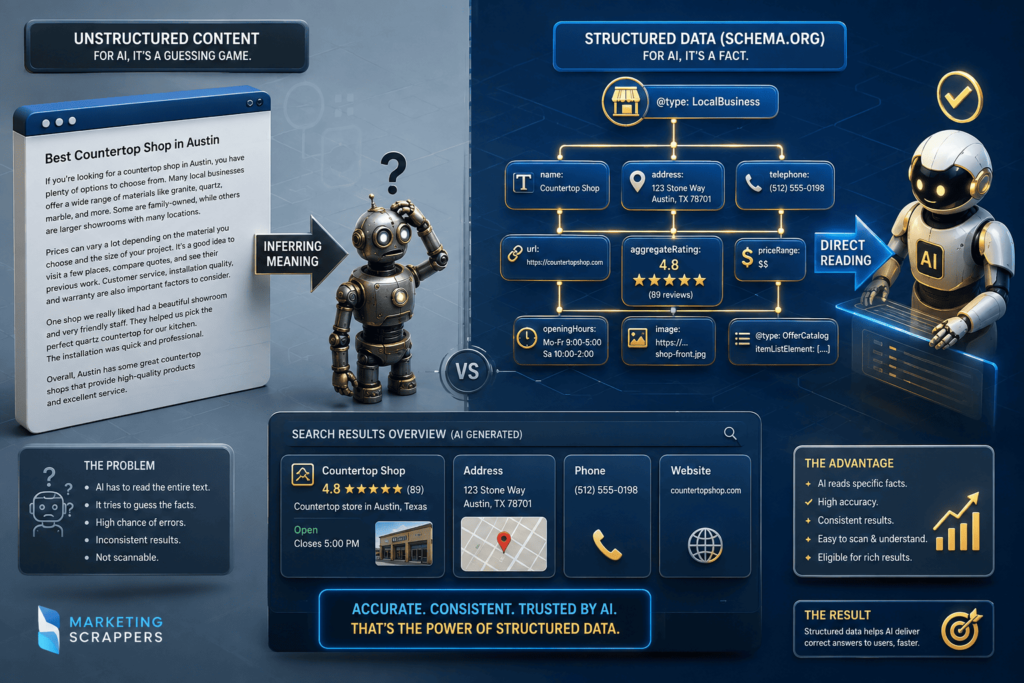
Structured data is one of the foundational building blocks of technical and semantic SEO. It doesn’t change what a page says — it changes how confidently machines can understand what that page means.
Canonical Definition Structured data is a standardized vocabulary and markup format — most commonly Schema.org vocabulary written in JSON-LD — used to label the entities, attributes, and relationships within a webpage’s content. It lets search engines and AI systems interpret information with certainty rather than inference, supporting rich results, Knowledge Graph connections, and machine-readable content understanding.
Featured Snippet Target Q: What is structured data? A: Structured data is code added to a webpage that labels its content using a standardized vocabulary, typically Schema.org in JSON-LD format. It helps search engines and AI systems identify entities like products, organizations, and events accurately, supporting rich results and machine understanding.
Key Takeaways
- Structured data uses a standardized vocabulary — commonly Schema.org — to describe webpage content.
- It helps search engines and AI systems identify entities, attributes, and relationships with precision.
- It supports rich results and Knowledge Graph connections, but it is not itself a ranking factor.
- Common formats include JSON-LD, Microdata, and RDFa, with JSON-LD as Google’s recommended syntax.
- It clarifies meaning; it doesn’t add or change content that isn’t already on the page.
Simple Explanation
Think of structured data as a labeled inventory list for your website. A visitor can read your homepage and immediately understand you’re a countertop fabricator in Dallas with strong reviews. Search engines and AI systems are far less certain — they have to infer that from surrounding text and layout.
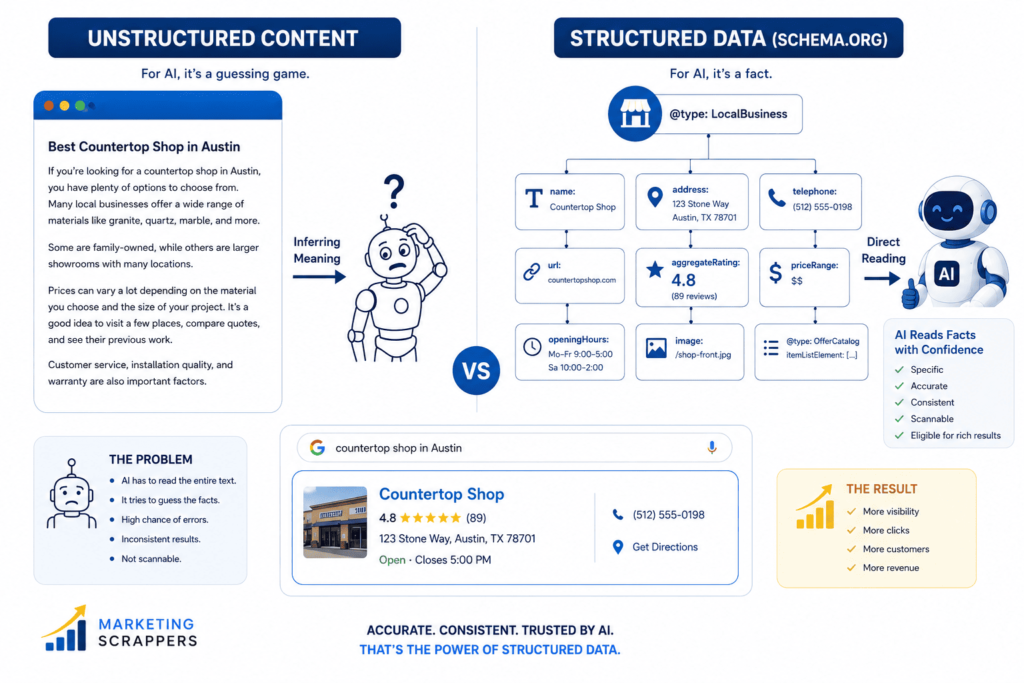
Understanding what is structured data removes that guesswork. It’s a behind-the-scenes tag that explicitly states: this is a LocalBusiness, its name is X, its rating is Y. The visible page doesn’t change — only how confidently machines can describe the business to someone searching for it.
Why Structured Data Matters
When analyzing what is structured data, search engines and AI systems rely on explicit markup to answer queries directly, without a click. Google’s AI Overviews, ChatGPT, Gemini, and Perplexity all draw on verifiable, structured facts rather than unstructured prose when composing answers.
Structured data raises the odds that a business’s facts — offerings, reviews, location, credentials — get extracted and represented correctly. It also feeds Google’s Knowledge Graph, helping establish an entity profile independent of any single page’s ranking.
None of this replaces content quality or authority. Structured data clarifies what’s already true on a page; it doesn’t manufacture relevance that isn’t there.
Practical Example
A local countertop fabrication business adds Organization and LocalBusiness markup identifying its name, address, phone number, service area, and aggregate review rating. When someone searches “quartz countertops near me” or asks an AI assistant for a recommendation, that structured information — not just the page’s paragraph text — is what search engines and AI systems draw on to represent the business accurately.
Relationship to Other Entities
Structured data sits at the center of a broader semantic ecosystem, connecting raw content to machine understanding:
Structured Data → Schema.org → JSON-LD → Rich Results → Knowledge Graph → Entity SEO → Semantic SEO → AI Search
- Parent concept: Machine-Readable Metadata
- Implemented via: Schema.org vocabulary, most often in JSON-LD (also Microdata, RDFa)
- Enables: Rich Results eligibility and Knowledge Graph entries
- Supports: Entity SEO, Semantic SEO, and visibility in AI search
Common Misconceptions
- “One misconception about what is structured data is that it directly boosts rankings.” It isn’t. Google has repeatedly confirmed structured data affects display and understanding, not rankings.
- “Structured data and Schema.org are the same thing.” Schema.org is the vocabulary; structured data is the broader practice of using it to label content.
- “Structured data guarantees rich snippets.” Eligibility is necessary but not sufficient — Google decides whether and how to display a rich result.
- “Structured data creates new content.” It labels information that must already exist and be accurate on the visible page.
Related Glossary Terms
Schema.org · JSON-LD · Rich Results · Knowledge Graph · Semantic SEO · Entity SEO · Indexation · Crawling · Robots.txt · XML Sitemap
Frequently Asked Questions
What is structured data? Structured data is standardized code added to a webpage that labels its content — such as business details, products, or reviews — so search engines and AI systems can read it directly instead of inferring meaning from surrounding text.
Why is structured data important? It increases the accuracy with which search engines and AI systems represent a business’s information, supports eligibility for rich results, and contributes to a business’s entity profile in tools like Google’s Knowledge Graph.
Does structured data improve rankings? No. Google has repeatedly confirmed structured data is not a ranking factor. It affects how content is displayed and understood — rich results, knowledge panels, AI citations — not where a page ranks.
Is Schema.org the same as structured data? No. Schema.org is a shared vocabulary used to write structured data. Structured data is the broader practice; Schema.org is simply the most common vocabulary used to implement it.
What is JSON-LD? JSON-LD is the syntax Google recommends for writing structured data — one of several formats, alongside Microdata and RDFa, used to express Schema.org vocabulary in a page’s code as per Google’s JSON-LD format guidelines.(Named types only — no JSON-LD code, per brief scope.)
Optional: Speakable (if voice/AI read-aloud is on the roadmap); AboutPage (if the Glossary hub itself is architected as a collection page).
DefinedTerm (primary) — nested inside a DefinedTermSet representing the MS Glossary as a whole; name, description, and inDefinedTermSet populated from this page.
WebPage / Article — with mainEntity pointing to the DefinedTerm.
BreadcrumbList — Home → Glossary → Structured Data.
FAQPage — mapping the 7 Q&A pairs above.
Organization — Marketing Scrappers as publisher.
Person — for the named SME author, if using individual bylines.
Who should use structured data? Any business with a website benefits, particularly local businesses, e-commerce sites, publishers, and service providers whose products, reviews, or credentials are clearer when explicitly identified to search engines and AI systems.
Is structured data the same as metadata? Not exactly. Metadata is any data describing other data — title tags and meta descriptions qualify too. Structured data is a specific, standardized subset of metadata that uses a shared vocabulary so machines interpret it consistently.
Structured data is one piece of a complete technical SEO and AI-visibility strategy.
Want the step-by-step version? Read the Structured Data Implementation Guide for hands-on Schema.org and JSON-LD setup. (Placeholder — link live once that guide is published; until then, point this secondary CTA at /services/seo/technical-seo/ or the Glossary hub.)
Next Step
Structured data is one piece of a complete technical SEO and AI-visibility strategy.
Explore our Technical SEO Service →
Want the step-by-step version? Read the Structured Data Implementation Guide for hands-on Schema.org and JSON-LD setup. (Placeholder — link live once that guide is published; until then, point this secondary CTA at /services/seo/technical-seo/ or the Glossary hub.)
3. E-E-A-T Block
| Field | Recommended Value |
| Author | Hassan Sulaimani — Founder & SEO Strategist, Marketing Scrappers (adjust if a different SME is the standing byline for glossary content) |
| Reviewed by | MS Technical SEO review pass before publish |
| Last Reviewed / Updated | Set to actual publish date; revisit if Google or Schema.org guidance changes |
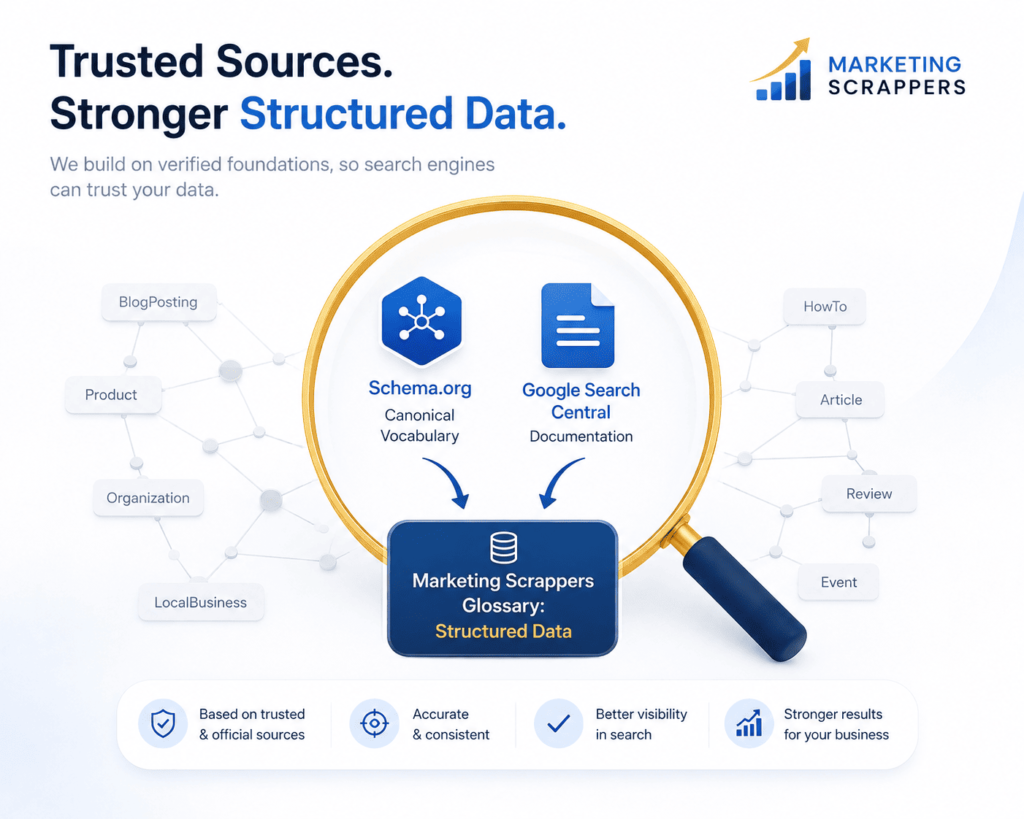
| Editorial Policy | Reviewed for technical accuracy against current Schema.org and Google Search Central documentation. Updated when official guidance changes — not on a fixed schedule. |
| Methodology | Definition synthesized from primary sources (Schema.org, Google Search Central), not copied from third-party glossaries. Checked for consistency with how current AI systems (ChatGPT, Gemini, Perplexity, Google AI Overviews) describe the concept, to confirm citation compatibility. |
| Sources | schema.org; Google Search Central — “Intro to How Structured Data Markup Works” (developers.google.com/search/docs/appearance/structured-data/intro-structured-data) |