
Search Demand Analysis: A 5-Layer Framework for Evaluating Real Demand
Search demand analysis is the process of evaluating whether real, sustainable interest exists around a topic before committing content, SEO, or product resources to it. It goes beyond pulling a search volume number — it examines the type of demand, its direction over time, the format currently satisfying it, and how likely it is to persist. The output isn’t a keyword list. It’s a demand verdict: strong and durable, strong but format-locked, seasonal, declining, or too thin to justify investment.
Most teams skip straight to keyword research and treat monthly search volume as a proxy for opportunity. That’s the core error this framework corrects. Volume is one input into demand, not a definition of it.
Why This Is Different From Keyword Research
It’s worth separating these clearly, because the terms get used interchangeably in most SEO content.
Keyword research identifies specific query strings, groups them by topic, and maps them to pages or content.
Search demand analysis happens earlier. It asks whether a topic has enough real, durable demand to justify building anything at all — before a single keyword list is built. It’s a judgment layer, not a list-building exercise.
This article intentionally stays inside that judgment layer. It does not cover how to build a keyword list or map keywords to pages (that belongs in a dedicated keyword research guide), how to score and prioritize topics against business fit and competition, how competitors are covering a space(see Competitor Analysis), or the broader external market context (see the Market Research Framework). Those are separate, downstream decisions that depend on a clear demand verdict from this stage.
Why Search Demand Analysis Matters
Content, SEO, and product decisions consume real resources — research time, writing time, design time, promotion time. Every one of those decisions is a bet that demand exists and will still exist by the time the asset is live and ranked.
Get the demand read wrong and the failure modes are predictable:
- Content is built for a topic where volume looks attractive but the intent is too broad or too ambiguous to convert.
- A topic that was trending six months ago gets treated as a permanent opportunity and the content underperforms the moment interest fades.
- A format mismatch goes unnoticed — the SERP is dominated by video or by an AI-generated overview, and a long-form article was never going to compete for that placement.
- Seasonal spikes get mistaken for consistent demand, leading to a publishing calendar that’s misaligned with when the audience is actually searching.
Search demand analysis exists to catch these before resources are committed, not after a page has been live for six months with nothing to show for it. It’s also part of our broader MS Research Frameworks that guide strategic content investments.
How Search Demand Analysis Works
The discipline follows a simple sequence: gather demand signals from multiple sources, run them through structured layers, and arrive at a verdict before any content or keyword work begins.
- Collect demand signals from search volume tools, trend data, SERP observation, question-and-answer platforms, and AI answer engines.
- Evaluate each signal through the five layers below rather than relying on a single metric.
- Cross-check signals against each other — a topic with rising trend data but declining SERP stability tells a different story than one where all signals agree.
- Assign a demand verdict to the topic before moving to opportunity scoring.
- Document the reasoning, not just the number, so the verdict can be revisited when conditions change.
The most common shortcut — pulling one search volume figure and treating it as the answer — skips steps 2 through 4 entirely. That shortcut is exactly why so much content gets built against demand that turns out to be thinner, more seasonal, or more format-locked than it appeared.
The MS Search Demand Analysis Framework
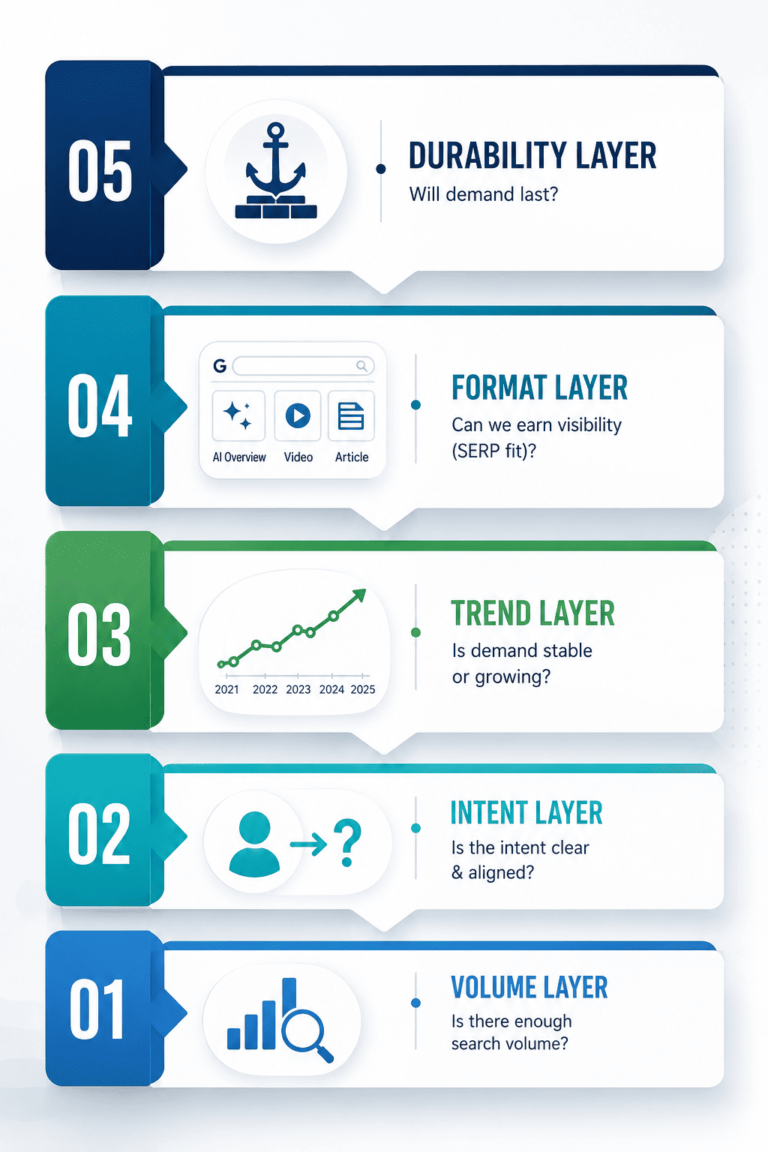
The MS Search Demand Analysis Framework evaluates demand across five layers. A topic only earns a strong verdict when multiple layers agree — a single strong metric surrounded by weak ones is a warning sign, not a green light.
| Layer | Core Question | Primary Signal Sources |
| 1. Volume Layer | How much raw search activity exists around this topic? | Keyword tools, aggregate topic volume, question volume |
| 2. Intent Layer | What kind of demand is this — informational, commercial, transactional, navigational? | SERP composition, query modifiers, existing ranking content |
| 3. Trend Layer | Is this demand rising, stable, declining, or seasonal? | Historical trend data, year-over-year comparisons, seasonality patterns |
| 4. Format Layer | What content or answer format is currently satisfying this demand? | SERP features, AI Overview presence, video/image pack presence |
| 5. Durability Layer | Will this demand still exist in 12–24 months, or is it tied to a temporary trigger? | Structural vs. event-driven cause, category maturity, adjacent trend behavior |
Layer 1 — Volume Layer
This layer captures raw search activity: search volume, keyword demand, and aggregate topic demand across all related query variations, not just the head term. A single high-volume keyword surrounded by no supporting query variety is a weaker signal than a moderate-volume keyword sitting inside a dense cluster of related searches — the cluster indicates a real topic audience, not a single lucky query.
What to check:
- Aggregate volume across the full query variant set, not one keyword in isolation
- Volume distribution — concentrated in one query or spread across many related phrasings
- Whether volume is inflated by a single recent event (a product launch, a news cycle, a viral moment)
Layer 2 — Intent Layer
Volume without a clear intent signal is close to meaningless. This layer identifies what kind of demand is present — informational, commercial investigation, transactional, or navigational — by reading the current SERP rather than guessing from the keyword phrasing alone. See Search Intent for the underlying classification model.
What to check:
- What content types currently rank (guides, comparisons, product pages, tools)
- Whether the SERP shows mixed intent (a sign the topic may need to be split into narrower, single-intent pages)
- Whether query modifiers (“best,” “how to,” “vs,” “near me,” “pricing”) indicate a specific stage of the buyer journey
Layer 3 — Trend Layer
This layer determines direction, not just current size. A topic with moderate but rising volume over 18–24 months is frequently a better investment than a topic with high but flat or declining volume, because content built today needs to still be relevant by the time it ranks and compounds.
What to check:
- Multi-year trend direction, not just the last 90 days
- Seasonal patterns — recurring annual spikes tied to a calendar event, budget cycle, or industry rhythm
- Whether a recent spike correlates with a specific, time-bound trigger (a regulation change, a platform update, a cultural moment) rather than sustained interest
Layer 4 — Format Layer
This layer identifies what’s currently winning the SERP for this demand — and whether the format is even one a business can compete in. A topic dominated by video content, tool-based interactive results, or AI-generated overviews that fully answer the query without a click represents a different opportunity than one still dominated by long-form written content.
What to check:
- Presence and prominence of AI Overviews or AI-generated answer summaries
- Presence of video, image packs, or interactive tools occupying top positions
- Whether featured snippet or “People Also Ask” real estate is contestable
This layer is where AI-assisted search behavior most directly changes the calculus: a topic can carry strong volume and clear intent and still be a poor content investment if the dominant answer format has shifted away from written pages entirely.
Layer 5 — Durability Layer
This layer forecasts whether demand will persist long enough to justify the investment required to rank and convert. It separates structural demand — tied to an ongoing business process, recurring need, or permanent category — from event-driven demand — tied to a specific trigger that will fade.
What to check:
- Whether the underlying need is tied to something ongoing (a recurring business process, a permanent category) or something temporary (a single announcement, a short-lived trend)
- Whether adjacent, related topics show the same trend direction (a sign of category-wide durability rather than an isolated spike)
- Realistic time-to-rank for the topic, weighed against how much runway the demand appears to have left
Search Demand Analysis vs. Related Concepts
| Concept | Core Question | Output |
| Search Demand Analysis | Does real, durable demand exist for this topic? | A demand verdict (strong, format-locked, seasonal, declining, thin) |
| Keyword Research | What specific queries should this content target? | A keyword list mapped to pages |
| Opportunity Analysis | Given demand and competition, is this worth pursuing now? | A prioritized list of topics to act on |
| Competitor Analysis | How are competitors currently covering this space? | Gaps and differentiation angles |
| Market Research | How large and active is the broader market? | Market sizing and industry context |
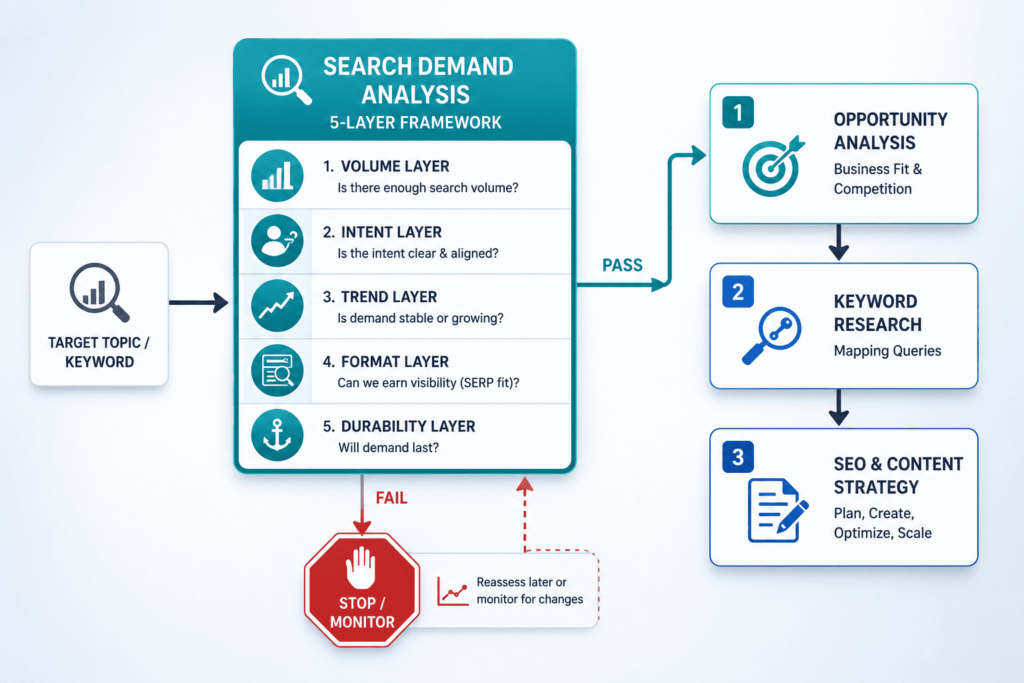
Search demand analysis sits upstream of all four. A topic should clear a demand verdict here before it’s evaluated for competitive opportunity or built into a keyword map.
Applying the Framework: A Practical Scenario
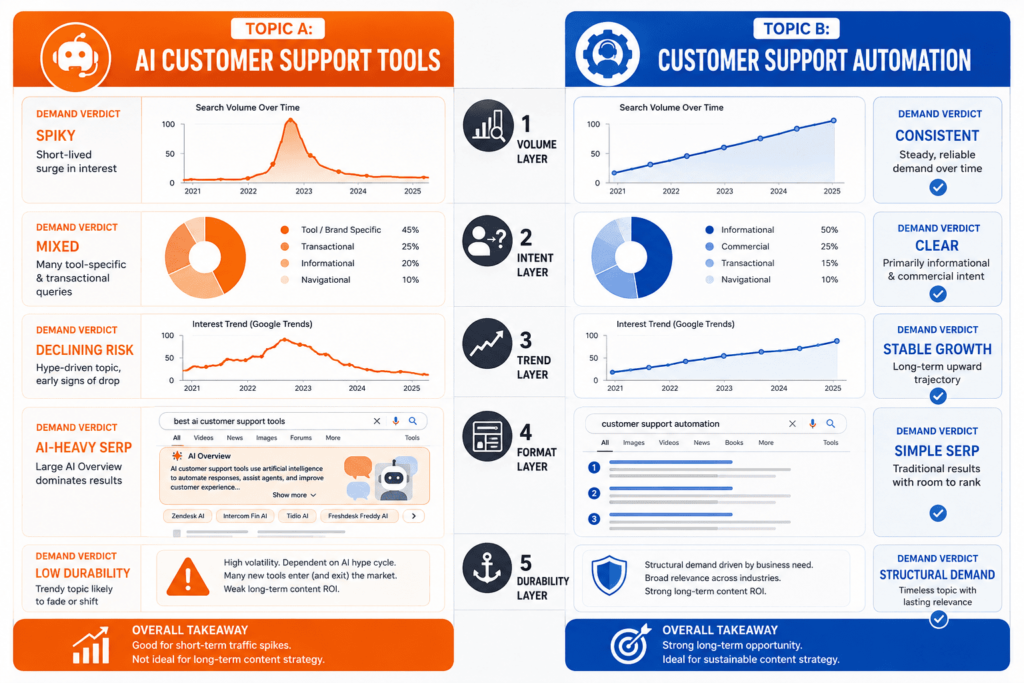
Consider a B2B software company evaluating whether to invest in content around “AI-powered customer support tools” versus “customer support automation.”
- Volume Layer — “AI-powered customer support tools” shows a recent spike in raw volume; “customer support automation” shows steadier, lower but consistent volume across a wider set of related queries.
- Intent Layer — The SERP for the AI-specific term is dominated by comparison and “best of” content — commercial investigation intent. The automation term shows a mix of informational and commercial content, suggesting it may need to be split into two narrower pages.
- Trend Layer — The AI-specific term’s spike correlates closely with recent product launch announcements across the category — a possible event-driven signal. The automation term shows gradual, multi-year growth.
- Format Layer — The AI-specific term’s SERP includes a prominent AI Overview that already synthesizes comparison information, reducing the click-through opportunity for a written guide. The automation term’s SERP is still dominated by written content.
- Durability Layer — The automation term reflects a structural, ongoing operational need. The AI-specific term’s durability is uncertain until at least one more trend cycle confirms whether the spike holds.
The demand verdict favors building durable authority around “customer support automation” first, while monitoring the AI-specific term for another cycle before committing significant resources — a conclusion a single volume metric would never have surfaced.
Implementation Checklist
- Aggregate volume pulled across the full query variant set, not a single head term
- SERP intent classified by reading actual ranking content, not just keyword phrasing
- Multi-year trend data reviewed, not just the most recent quarter
- Seasonality checked and documented if present
- Current SERP format audited for AI Overviews, video, and interactive results
- Recent spikes traced back to a specific trigger, if one exists
- Structural vs. event-driven demand distinguished explicitly
- Adjacent, related topics checked for confirming or conflicting trend direction
- A written demand verdict documented before moving to opportunity scoring or keyword mapping
Common Mistakes in Search Demand Analysis
Treating search volume as the entire analysis. Volume is one of five layers, not the conclusion.
Ignoring SERP format shifts. A topic can have excellent volume and still be a poor investment if AI Overviews or video content have taken over the answer space.
Mistaking a recent spike for a trend. Short windows of data make event-driven demand look identical to structural demand until a full cycle plays out.
Skipping the intent check. A high-volume topic with mixed or ambiguous intent often needs to be split into multiple narrower pages rather than targeted with one broad asset.
Analyzing topics in isolation. Checking adjacent, related topics for confirming trend direction is often what separates a real signal from noise.
Confusing this stage with prioritization. A strong demand verdict doesn’t automatically mean the topic should be built next — that decision belongs to Opportunity Analysis, which also weighs competition and business fit.
Best Practices
- Require agreement across at least three of the five layers before assigning a strong demand verdict.
- Re-run the Format Layer check periodically — SERP formats shift faster than most publishing calendars account for.
- Document the reasoning behind every verdict, not just the number, so it can be revisited without repeating the entire analysis.
- Treat seasonal demand as legitimate but plan publishing timelines around it explicitly rather than ignoring the pattern.
- Pair this framework with customer research findings — real buyer language often reveals demand signals that keyword tools miss entirely.
FAQ
What is the difference between search demand analysis and keyword research?
Search demand analysis evaluates whether real, durable demand exists for a topic before any content or keyword decisions are made. Keyword research maps specific query strings to pages once that demand has been confirmed.
Is search volume enough to measure search demand?
No. Search volume is one of five layers in a complete demand analysis. Intent clarity, trend direction, SERP format, and durability all affect whether volume translates into a viable content or SEO opportunity.
How do AI Overviews affect search demand analysis?
AI-generated answer summaries can fully satisfy a query without a click, which changes whether a topic is worth targeting with a written page. The Format Layer in this framework accounts for that shift directly.
How often should search demand analysis be repeated?
At minimum annually for core topics, and immediately when a noticeable SERP change occurs — a new AI Overview appearing, a competitor entering the space, or a sudden volume shift.
Can a topic have high demand but still be a poor investment?
Yes. A topic can show strong volume and clear intent while still being a poor investment if the dominant SERP format has shifted away from written content, or if the demand is tied to a temporary trigger rather than a structural need.
Does this framework replace keyword research?
No. It precedes it. A confirmed demand verdict is what determines whether a topic deserves a full keyword research and content mapping effort in the first place.
Next Step
Search demand analysis produces the demand verdict; it doesn’t decide what to build next. Once a topic clears this stage, the next step is running it through Opportunity Analysis or applying the findings directly within an SEO strategy engagement.