
Indexation
Indexation is the process a search engine uses to add a crawled page to its index — the searchable database it draws on to answer queries. It is the step that turns a page from “known to exist” into “eligible to appear in search results.”
Short Definition
Indexation is the process by which a search engine adds a crawled web page to its index — a searchable database of web content — after evaluating the page’s quality, uniqueness, and accessibility. As detailed in Google Search documentation, a page must be indexed before it can appear in search results; being crawled does not, by itself, guarantee this.
(48 words — written for direct extraction by AI answer engines and featured snippets.)
Expanded Definition
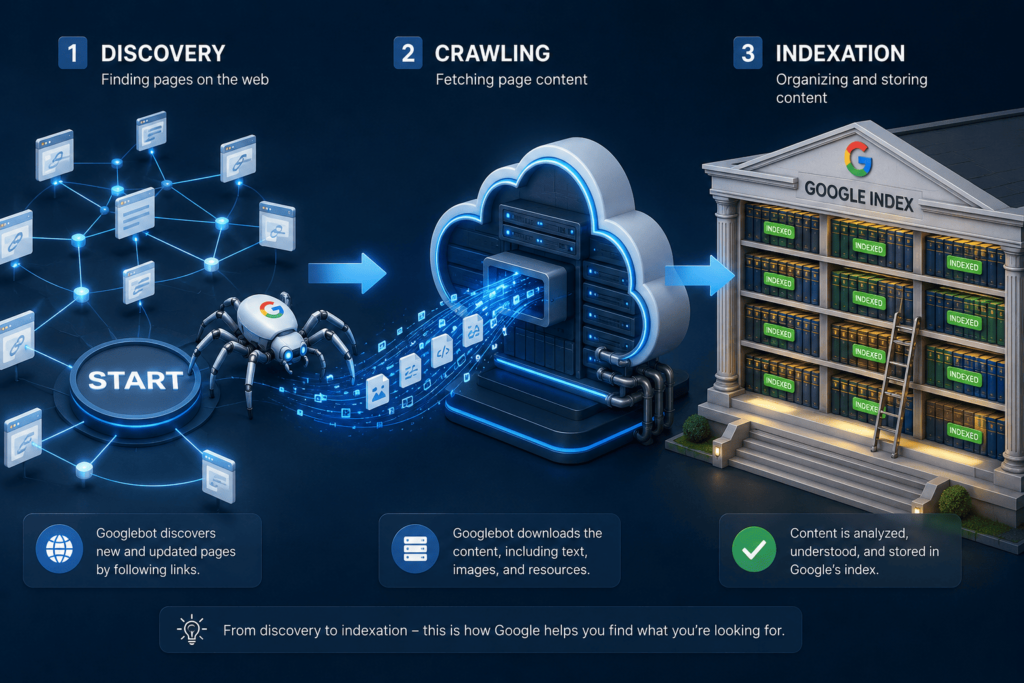
Search engines locate content in three broad stages: discovery (finding that a URL exists), crawling (fetching and rendering that URL’s content), and indexation (deciding whether to store it, and how, in the index). Indexation is the third stage, and it is the one most people conflate with crawling.
Once Googlebot or another crawler renders a page, the search engine’s systems analyze the text, structural markup, and media on it, then decide whether the page adds sufficient value to warrant a place in the index. That decision weighs signals such as content quality and uniqueness, canonicalization (whether another URL already represents the same content), and explicit directives like noindex or robots.txt disallow rules. A page can be crawled and still not indexed — the two outcomes are related but not interchangeable.
Indexation is a precondition for ranking, not a ranking signal itself. A page that is not indexed cannot rank for any query, regardless of its content quality or backlink profile. Conversely, indexation alone says nothing about where a page will rank — it only confirms the page is in the pool of documents the engine can retrieve at query time.
Why It Matters
For a business, an unindexed page is invisible — it functions the same as a page that doesn’t exist, no matter how well it’s written or designed. This makes indexation the first checkpoint in any SEO diagnosis: before asking why a page ranks poorly, confirm it’s indexed at all.
The practical stakes rise with site size. A ten-page brochure site rarely has indexation problems. A site with hundreds of service, location, or product pages — the kind Marketing Scrappers builds for clients — can have entire sections silently excluded from the index due to issues like misconfigured canonical tags or wasted crawl budget. This is why comprehensive Technical SEO Services are critical to auditing and resolving crawl debt.
Indexation is also the shared foundation beneath both traditional search and AI-driven answer systems: a page generally has to be discoverable and indexable before it can be surfaced, cited, or summarized by search engines or AI assistants, as highlighted in our State of SEO Research. Getting this layer right is table stakes for every downstream SEO and GEO effort.
Need to Fix Indexation and Crawl Issues?
Unindexed pages silently drain your site’s potential. Discover how dedicated technical auditing and site architecture optimizations resolve crawl debt and ensure your valuable content gets indexed.
Explore Technical SEO Services →Key Characteristics
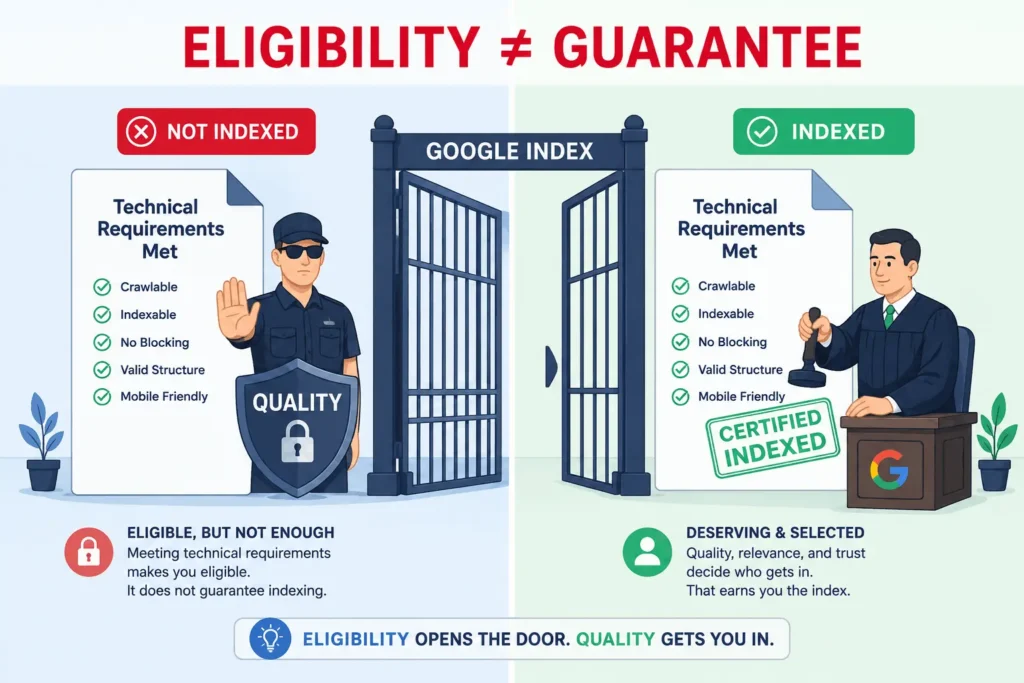
- Sequential, not simultaneous. Indexation happens after crawling, as a distinct evaluation step.
- A decision, not a guarantee. Search engines index selectively; meeting Google’s technical requirements makes a page eligible, not automatically included.
- Governed by multiple signals. Content quality and uniqueness, canonical signals, noindex/robots.txt directives, and crawl budget allocation all influence the outcome.
- Verifiable per URL. Indexation status can be checked page-by-page (for example, via a search engine’s URL inspection tools), and a site commonly has some pages indexed and others deliberately or inadvertently excluded.
- Reversible. Pages can be de-indexed later if quality signals change, content is removed, or a directive is added — indexation is not a one-time, permanent state.
- Distinct from ranking. Indexation determines eligibility to appear in results; ranking algorithms determine position among indexed pages.
Practical Example
A countertop fabrication company publishes a new page: “Quartz Countertops — Austin, TX.” A search engine’s crawler discovers the URL (through an internal link or an XML sitemap), fetches and renders it, then evaluates the content. If the page is technically accessible (no blocking directive), reasonably unique, and clears the engine’s basic quality checks, it gets added to the index. From that point on, the page is eligible to surface when someone searches “quartz countertops Austin” — though whether it appears near the top of those results is a separate, later question, decided by ranking factors.
Common Misconceptions
- “Crawling and indexing are the same thing.” They aren’t. Crawling is discovery and retrieval; indexation is the subsequent decision to store the page for retrieval in search results.
- “If a page is crawled, it will be indexed.” Not necessarily. A crawled page can still be excluded for reasons such as thin or duplicate content, a noindex tag, or a canonical tag pointing elsewhere.
- “More indexed pages means better SEO.” Not automatically. Indexing large volumes of low-value or duplicate pages can dilute topical focus and consume crawl budget that would be better spent on pages that matter.
- “Submitting a sitemap guarantees indexation.” A sitemap helps a search engine discover URLs faster; it does not guarantee that any listed URL will be indexed.
Related Entities
- Crawling — the discovery-and-retrieval step that precedes and feeds indexation.
- Googlebot — Google’s crawler; the agent responsible for finding and fetching pages before they can be indexed.
- Search Engine Index — the database a page is added to once indexed (Google’s specific implementation is commonly called the Google Index).
- XML Sitemap — a file that helps a search engine discover URLs, supporting — but not guaranteeing — indexation.
- Robots.txt — a directive file that can prevent a page from being crawled, which in turn prevents indexation.
- Canonical Tags — signals used to consolidate duplicate content so the correct version is the one indexed.
- Noindex — an explicit directive that tells a search engine not to index a specific page.
- Crawl Budget — the finite crawl activity a search engine allocates to a site, which limits how much content is even considered for indexation.
- Technical SEO — the parent discipline governing crawlability, indexability, and site architecture as a whole.
Related Terms
- De-indexation — the reverse process: removal of a previously indexed page from the index.
- Crawlability — a related but distinct property describing whether a page can be crawled, which is a prerequisite for indexation.
- Index Coverage — the aggregate, site-wide view of which URLs are indexed, excluded, or flagged — the diagnostic layer built on top of this concept.
- Discoverability — whether a search engine can find a URL exists at all, the stage prior to crawling and indexation.
Frequently Asked Questions
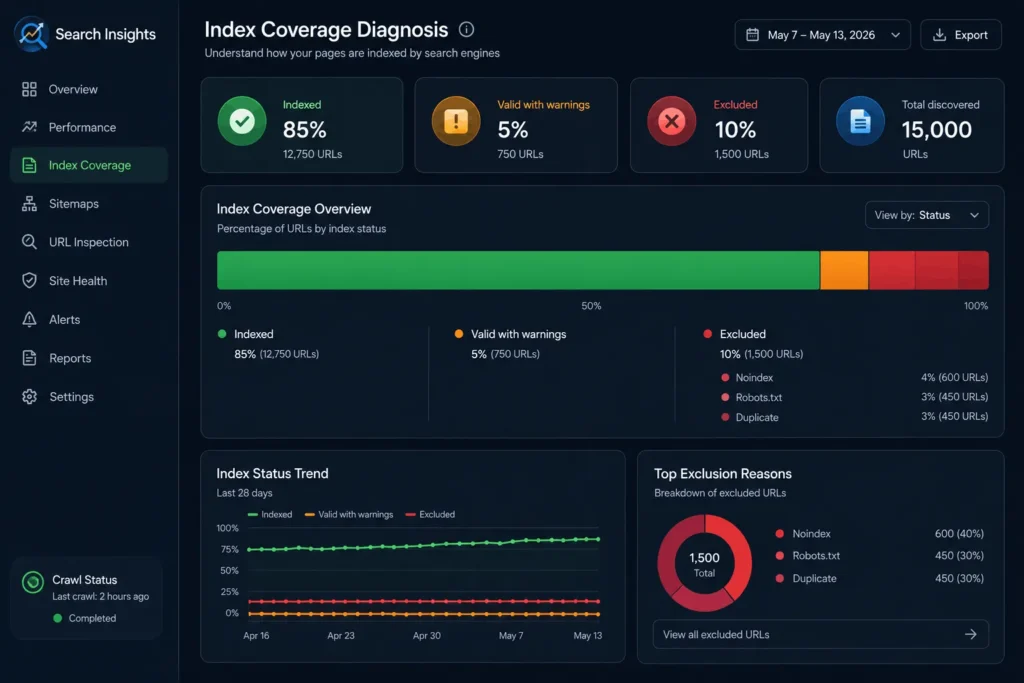
What is the difference between crawling and indexing? Crawling is when a search engine visits and downloads a page’s content. Indexing is the subsequent decision to store that page in the search index, making it eligible to appear in results. A page can be crawled without being indexed.
How do I know if a page is indexed? Most search engines provide a URL-level inspection tool, as detailed in the Google Search Console Indexing documentation
, and a rough public check is running a site: search for the specific URL.
Why would a page not be indexed? Common reasons include a noindex directive, a robots.txt block, duplicate or thin content, a canonical tag pointing to a different URL, or the page simply not being discoverable yet.
Does being indexed guarantee good rankings? No. Indexation only makes a page eligible to appear in search results. Where it appears — if at all, for a given query — is decided separately by ranking algorithms.
How long does indexation take? It varies from hours to weeks depending on the site’s authority, crawl frequency, and how the page was discovered (for example, an internal link from a frequently crawled page tends to be faster than an isolated, unlinked page).
Can a page be indexed but not shown for a relevant search? Yes. Indexed pages are only shown when a search engine’s systems judge them relevant and sufficiently competitive for that specific query.
Summary
Indexation is the step where a search engine decides to store a crawled page in its search engine index, making that page eligible — but not guaranteed — to appear in search results.
It sits between crawling and ranking: without it, no amount of content quality or link authority matters, because the page is never in the pool a search engine draws answers from. For any site with more than a handful of pages, confirming and maintaining indexation is a foundational, ongoing part of technical SEO.
Looking for Implementation Depth?
Step beyond the definition. Learn how to configure sitemaps, manage robots.txt directives, and diagnose index coverage errors step-by-step.
Read the Complete Technical SEO Guide →