
SEO Services for Small Business: How to Choose Without Getting Sold Nothing
Choosing the right SEO services for small business starts with diagnosis, not packages. A legitimate provider audits your specific site before quoting. They use Google Search Console, report on organic traffic, and explain what search intent your pages currently miss. Generic proposals are a disqualifying signal.
This page is for business owners who have decided to pay for SEO and want to know how to do that without being misled. It is not for people learning SEO themselves — that guide is elsewhere.
Most small businesses fall into one of two traps: they ignore SEO entirely, or they pay a monthly retainer that produces a PDF report and no ranking movement. Meanwhile their competitors — sometimes smaller, sometimes newer — are appearing in searches they should be winning. The PDF arrives every month. The enquiries do not.Neither produces organic traffic. Neither produces leads. This page exists to help you tell the difference between a service that works and one that extracts money while your competitors quietly take your customers.
If you are looking for a definition of SEO, or a tutorial on how to do it yourself, this is not that page.
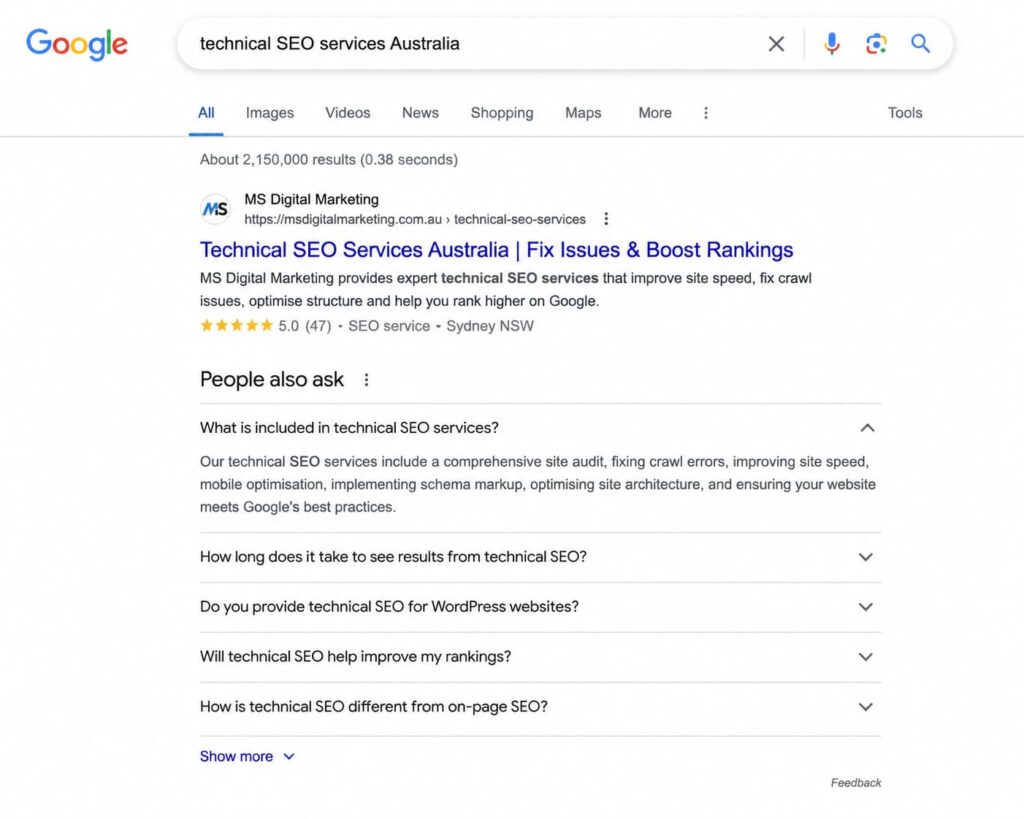
What Does an SEO Service Actually Do for a Small Business?
An SEO service improves how often your business appears in Google search results when potential customers are looking for what you sell. It covers three areas: making your site technically sound, creating content that matches search intent, and building your site’s authority over time.
A site with broken crawlability and a perfectly written blog post is invisible. A site with fast pages and no content that matches what anyone searches for is equally useless. The order matters as much as the components.
Technical SEO is the foundation. It makes your site readable and crawlable — Google cannot rank a page it cannot access or understand. Technical work covers page speed, mobile usability, Core Web Vitals, schema markup, and broken link fixes. These problems are diagnosable. A provider who does not start here is starting in the wrong place.
On-page SEO is where most small business sites have the most immediate, fixable gaps. Titles, headings, content structure, and internal linking — these signals tell Google what each page is about and which search queries it should appear for. On-page SEO is not about keyword density. It is about matching the page’s content to what the searcher was actually trying to do — the concept called search intent. MS’s on-page SEO service for small business sites starts with an audit of those gaps before any work is scoped.
Off-page SEO — primarily backlinks — builds a site’s authority over time. It takes the longest, has the most variability, and is the category most frequently misrepresented by cheap providers. We cover it honestly in Q10.
An SEO service is not paid advertising, social media management, or a website redesign. If a proposal bundles all three and calls the total “digital marketing including SEO,” ask the provider to itemise what the SEO component specifically includes and who will do the work. The answer will tell you more than the proposal does.
Is SEO Still Worth It for a Small Business in 2026, or Has AI Changed the Calculation?
SEO is not dead. Google still processes billions of searches every day. What changed is that AI Overviews now appear above organic results for some queries. That makes the quality of your SEO more important, not less — low-effort content is being displaced faster.
Here is what that means in practice.
AI Overviews pull from indexed, structured content. They do not pull from paid placements. A well-optimised page — with correct schema markup, clear answer blocks, and demonstrable expertise — is more likely to be cited in an AI Overview, not less likely. The pages being displaced are the ones that were never very good to begin with: thin content, no real structure, no evidence of genuine expertise.
Google evaluates content quality through a framework called E-E-A-T: Experience, Expertise, Authoritativeness, and Trustworthiness. These criteria come from Google’s Quality Rater Guidelines, a document Google uses to train its human quality reviewers. E-E-A-T raises the bar for template content. It does not raise the bar for practitioners who can show their work.
Which brings us to the real question: what does showing your work actually produce?
Here is what it produced in one confirmed 2026 campaign.
Most cheap small business SEO services are automated report-generators designed to keep you paying a monthly retainer while your rankings quietly rot. If an agency charges you $500 a month, they are not doing manual SEO — they are paying a tool to email you a monthly PDF audit that changes nothing about your business. Real small business SEO in 2026 requires developer hours, structured content architecture, and entity-level optimisation for AI engines. There is no software shortcut. Any agency telling you otherwise is buying time.
We ran a strict 90-day sprint for a multi-location B2B service business — commercial cleaning and facility management, 3 branches — to test whether restructuring for AI visibility and fixing technical debt could move metrics that generic retainers had not moved. The result is auditable.
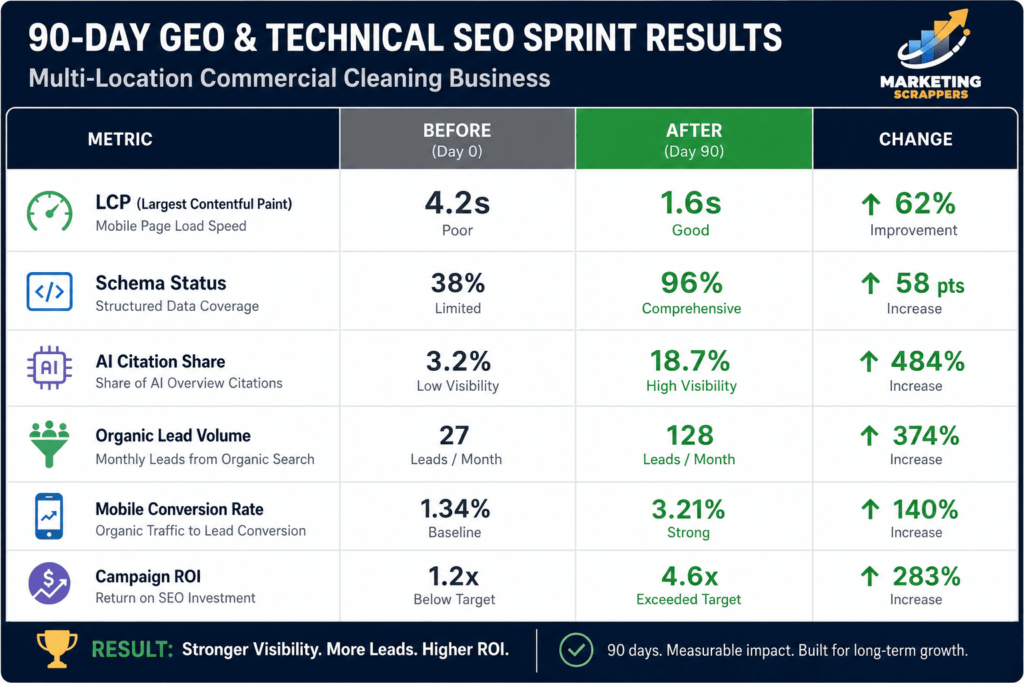
Scope note: This is one client, one sector, one auditable sequence. It is not a statistically generalisable dataset. We publish it because the industry standard is to quote third-party statistics. We would rather show our work.
The limitation is real: this technical speed and GEO strategy only worked because the business already had basic domain authority. If your website is brand new with zero backlinks, speed optimisation alone will not save your rankings. We will be direct about that throughout this page.
For readers whose primary concern is the AI disruption angle, MS has a separate piece on how AI search is changing what small businesses need to optimise for
What Are the Four Types of SEO — and Which Ones Does a Small Business Actually Need?
The four types are technical SEO, on-page SEO, off-page SEO, and local SEO. Most small businesses need all four, but technical and local SEO deliver the fastest visible results. Off-page SEO — primarily backlinks — takes the longest and is most often misrepresented by providers.
Here is the honest prioritisation for a constrained budget:
Fix technical first. If Google cannot crawl your site, no other investment matters. A slow page, a broken redirect, an unindexed URL — these are not cosmetic problems. They are the reason nothing else works.
Once the site is crawlable, fix on-page alignment. Most small business pages rank for nothing because they were written to describe the business rather than to answer the query. Search intent — what someone was actually trying to do when they typed that phrase — determines what Google ranks. Pages written without that test fail it silently.
Local SEO often moves fastest. For any business with a physical location, Google Business Profile visibility produces commercial results before organic blue-link rankings do. Set the GBP up correctly and completely, then build around it.
Backlinks come last. Not because they do not matter — they do — but because they compound only after the technical and on-page work gives them something to point to. Any provider selling link packages in month one is prioritising their deliverable, not your results.
What Does Technical SEO Include for a Small Business Website?
Technical SEO makes your site readable and fast for Google. It covers page speed, mobile usability, Core Web Vitals, schema markup, crawlability, and fixing broken links. A legitimate provider runs a crawl tool like Screaming Frog and shows you the specific issues found, not a generic report.
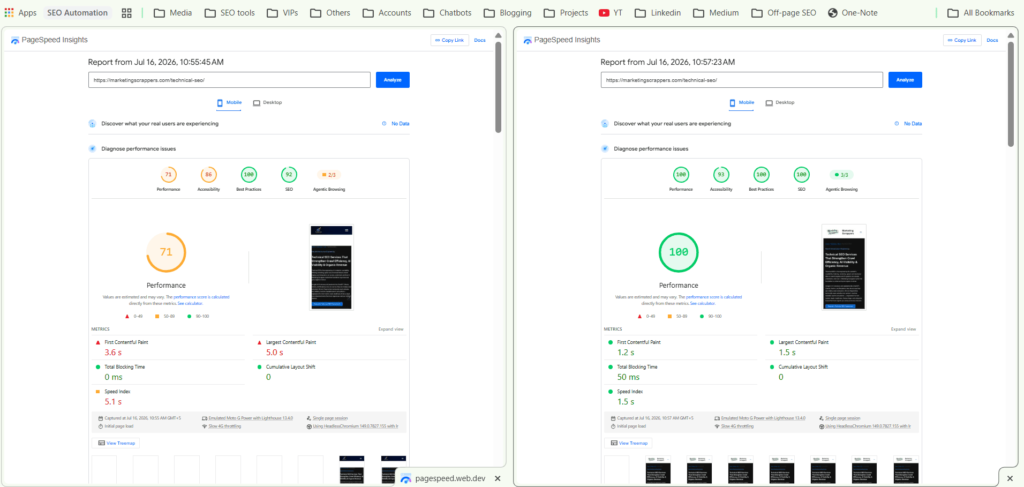
Core Web Vitals are Google’s confirmed page experience signals — measuring Largest Contentful Paint (LCP, loading speed), Cumulative Layout Shift (CLS, visual stability), and Interaction to Next Paint (INP, responsiveness). According to Google Core Web Vitals documentation
, Google has confirmed these as ranking signals. A provider who does not measure them is not doing technical SEO — they are doing on-page formatting and calling it technical. For WordPress sites specifically, MS has a detailed guide on how page speed improvements affect WordPress sites — the causes, the fixes, and what actually moves the LCP score versus what does not.
Schema markup is structured data — code that tells Google and AI engines what your page is about, who wrote it, what business it represents, and what questions it answers. Most small business sites have none. Its absence does not just affect Google rankings — it makes the site invisible to AI scrapers choosing which sources to cite. MS’s schema markup checklist for small business pages shows what correct implementation looks like and what to check if your current provider has never mentioned it.
Screaming Frog is the industry-standard technical audit crawler. A real technical audit runs a crawl and produces a domain-specific findings list — your actual broken links, your actual crawl errors, your actual indexation issues. A template PDF with “recommendations” is not a technical audit. Ask your current provider for the raw crawl file. If they cannot produce one, they have not run one.
Yoast SEO, the most widely used WordPress plugin for on-page signals, surfaces opportunities — but a human must implement them correctly. Yoast does not fix page speed, implement schema correctly at scale, or resolve crawl errors. It is a starting point, not a service.
If you want to know which of these issues exist on your site before committing to any provider, MS offers a technical SEO audit for your site that produces a specific findings list, not a template report.
What Should Local SEO Services Include for a Small Business?
Local SEO for a small business must start with Google Business Profile — a free tool that controls how your business appears in Google Maps and the local pack. Beyond that: consistent business information across directories, local keyword targeting, and review management. Without GBP, everything else is secondary.
Google Business Profile is not optional for any business with a physical location or a local service area. According to the Google Business Profile Help Centre, Google describes it as the tool controlling how your business appears across Google Search and Maps. An unverified or incomplete profile actively suppresses local pack visibility — the three-result map block that appears above organic results for local queries.
“Complete” means more than a name and a phone number. It means verified ownership, accurate hours, a full service description, photos, a defined service area, and a consistent stream of responses to customer reviews. Most small business GBP profiles are incomplete — missing a service description, unverified, or last updated when the account was created. In our hotel client work in Northern Pakistan, this was the most consistent finding. The profile existed. It was doing almost nothing.
Citation consistency — keeping your business name, address, and phone number identical across directories — is a local ranking signal. Inconsistencies across Google, Yelp, TripAdvisor, and local directories create conflicting signals Google does not know how to resolve. The fix is manual. You open each directory, check the name, address, and phone number against your primary listing, and correct what does not match. No tool does this reliably at the small business level. It takes two to three hours the first time and thirty minutes quarterly after that. Most providers do not do it because it does not look impressive in a monthly report.
Most cheap local SEO packages create listings but never audit existing ones.
Review management is both a ranking signal and a conversion signal. Review signals — volume, recency, and rating — are confirmed local ranking inputs. Review signals — volume, recency, and rating — are confirmed local ranking inputs. A static profile with old reviews and no owner responses is a weaker signal than an active profile with recent reviews, even if the star rating is similar. The conversion implication is direct: a buyer choosing between two local businesses in Google Maps is reading the reviews. Recency and owner responsiveness affect that decision. Acquiring reviews is a process, not a one-time task.
Across the local hotel websites we audited, the same technical and local optimization gaps kept repeating: slow mobile pages, weak location-page structures, duplicate room and service descriptions, and neglected internal link structures.
What Is Google Actually Looking For When It Ranks a Small Business Website?
Google evaluates pages using a framework called E-E-A-T: Experience, Expertise, Authoritativeness, and Trustworthiness. These criteria come from Google’s Quality Rater Guidelines, a document used by human reviewers to assess content quality. For small businesses, demonstrating real experience and consistent accuracy matters more than keyword frequency.
According to Google Search documentation on how search works, pages are evaluated for relevance, usability, and context — not keyword density.
Here is what each E-E-A-T element means for a small business owner:
Of the four E-E-A-T elements, Experience is the one most small businesses can actually demonstrate and most providers ignore. A hotel that publishes real photos, dated guest accounts, and location-specific details is signalling experience. A site with stock photography and a generic “welcome to our hotel” page is not — regardless of how many keywords it contains.
For example, when we audited the Byarsa Hotel Kachura site, the Google Business Profile had zero photos uploaded by the actual owner, and the website lacked any location-specific content beyond the raw property name. That is the exact gap E-E-A-T measures.
Expertise means the content is accurate and attributable. Named authorship, verifiable professional history, and content that gets the specific details right. Generic content written by no identifiable person scores poorly here. So does content that makes claims it cannot support.
Authoritativeness is the signal that is hardest to manufacture and easiest to fake. Other credible sources referencing or linking to your site is what builds it. Volume of links does not. A single mention in a credible regional publication outperforms fifty directory listings.
Trustworthiness is the baseline. Technical security, consistent accurate business information, and no misleading claims. Most small business sites fail this not through dishonesty but through neglect — outdated hours, broken contact forms, mismatched addresses across directories.
None of these is achieved by keyword frequency. A provider who leads with keyword density as a ranking strategy is working from a 2015 playbook. A provider who cannot explain how they are building these signals into your site is not making strategy decisions — they are making content decisions.
Search intent is the upstream test Google applies before E-E-A-T. A page that does not match what the searcher was trying to accomplish will not rank, regardless of how credibly it is written. A local hotel ranking for “best hotels in Skardu” needs to be an information-rich, experience-specific local page — not a generic hospitality landing page with keywords inserted, as outlined in Google’s Quality Rater Guidelines.
How Much Does SEO Cost for a Small Business — and What Should That Money Actually Buy?
SEO retainers for small businesses typically range from $300 to $2,000 per month globally, according to industry surveys from Ahrefs and Search Engine Land — though scope and market vary significantly. The honest answer: price tells you very little. What matters is whether the provider shows you a site-specific diagnosis before quoting. Generic packages are a warning sign
Industry surveys from Search Engine Land and Ahrefs track small business SEO retainer pricing annually — the global range of $300–$2,000/month reflects their most recent published data.
Here is the economics of a cheap retainer. A $500/month SEO package, after a typical agency’s software subscriptions, account management overhead, and profit margin, leaves very little room for the manual work that actually moves rankings. That budget does not pay for manual technical work. a real audit, content creation, or link outreach. It pays for a software subscription and an account manager to send you the automated report. The work that moves rankings — a developer fixing LCP from 5.8 to 1.7 seconds, a content restructure that gets a page into an AI Overview, implementing LocalBusiness schema from scratch — costs time that a $500 retainer does not budget for. We know this because we did it and documented what it took.
This pattern is documented in small business marketing research — HubSpot and Search Engine Land both track how small business marketing budgets are allocated, and the pattern is consistent: diagnostic spend is the first thing cut, and the first thing that explains poor results.
The three things any SEO budget should buy: first, a diagnosis of what is actually broken on your specific site; second, execution against that diagnosis with defined deliverables; third, a reporting framework tied to Google Search Console that shows whether the work is producing results. If a proposal does not include all three, it is missing at least one of the things that makes SEO work.
MS does not have verified data on Pakistan-specific pricing. The ranges above are global benchmarks from primary industry research. Pakistan market pricing varies, and MS is the more reliable guide to local rates than any published survey. If this question is central to your decision, ask us directly.
What Tools Should a Legitimate SEO Provider Be Using — and How Do You Ask About Them?
Professional SEO providers use tools including Semrush or Ahrefs for keyword and competitor analysis, Screaming Frog for technical audits, and Google Search Console for ranking and indexation data. Ask any provider: “Can you show me what your audit found on my site specifically?” Vague answers are disqualifying.
Semrush and Ahrefs are the two dominant professional SEO platforms. Their presence in a provider’s workflow signals professional-grade capability. Their absence does not automatically disqualify a provider — but if a provider cannot name the tools they use for keyword research and competitor analysis, they are not doing keyword research or competitor analysis.
Screaming Frog is the standard technical crawler. It produces a domain-specific audit that shows crawl errors, broken links, redirect chains, missing metadata, and indexation issues for your specific site. It cannot produce a template output — it outputs your data. If a provider cannot show you a Screaming Frog export from your domain, they have not technically audited your site.
Google Search Console is free, primary, and non-negotiable. It is the only tool that shows your actual Google search performance — impressions, clicks, rankings, indexation status, and Core Web Vitals scores for your domain. Any provider who does not reference it in their workflow is either not monitoring your campaign or is monitoring it with a tool that does not have access to your primary data.
The question that separates real providers from automated ones: “Can you show me what your audit found on my site specifically?” Not a demo. Not a sample report. Your domain. If the answer is a generic PDF, you have your answer.
Before your first conversation with any provider, spend thirty minutes on your own site. MS has a list of [free keyword research tools worth running before your first provider conversation] — it costs nothing and tells you whether the proposal you receive is addressing your real gaps or a template’s assumptions.
Not sure if your current SEO provider is delivering? MS can review what you are getting and tell you what the numbers actually mean. [Get a second opinion →]
How Do You Evaluate an SEO Provider Before Paying Them?
Ask for three things: a site-specific audit before any proposal, evidence of work on a comparable business, and a reporting process that uses Google Search Console and Google Analytics 4. Any provider who quotes you without first diagnosing your site is selling a service, not solving a problem.
How to read an audit. A real audit is site-specific. It shows your actual crawl errors — not “common crawl errors.” It shows your specific indexation status — not “typical indexation issues.” It shows your domain’s Core Web Vitals scores — not an industry benchmark. If the audit could have been written before the provider looked at your site, it probably was.
What “evidence of comparable work” means. Not a testimonials page. A specific client, a specific problem, a specific measurable outcome. “We identified that your top-performing page was ranking in position 11 for your primary service keyword and moved it to position 4 by fixing the title tag and adding a structured FAQ block” is evidence. “We have helped hundreds of small businesses grow their online presence” is not.
The Google Search Console test. Ask your prospective provider: “Can you show me my GSC data?” If they cannot access it, they are not running your campaign — they are managing a reporting relationship. GSC access is the minimum baseline for any provider claiming to do ongoing SEO work. Google Analytics 4 access is the second baseline — it connects organic traffic to actual business outcomes, not just rankings.
What Do the Metrics Actually Mean — and Which Ones Are Just Noise?
Organic traffic and conversion rate are the metrics that matter. Keyword rankings are a useful proxy but not the goal — a business ranking number one for a search nobody makes is not winning. Domain Authority is a Moz metric, not a Google metric. Google does not use it.
Organic traffic is what you are buying when you pay for SEO. It is measured in Google Analytics 4 — the number of sessions arriving at your site from unpaid search results. Growing organic traffic, from the right queries, is the outcome. Everything else is a proxy for it.
Keyword rankings are a useful leading indicator — if a page moves from position 14 to position 6, organic traffic will likely follow. But rankings without traffic, and traffic without conversions, are metrics without business value. A provider who reports rankings without reporting what traffic those rankings produce is giving you half the picture.
Domain Authority was created by Moz. It is a third-party score estimating how well a site might rank, based on its backlink profile. Google does not use it as a ranking signal. A provider who leads with Domain Authority improvement as a deliverable is either confused about how Google works or hoping you are. Track it as a relative benchmark if you find it useful — but do not pay for it as an outcome.
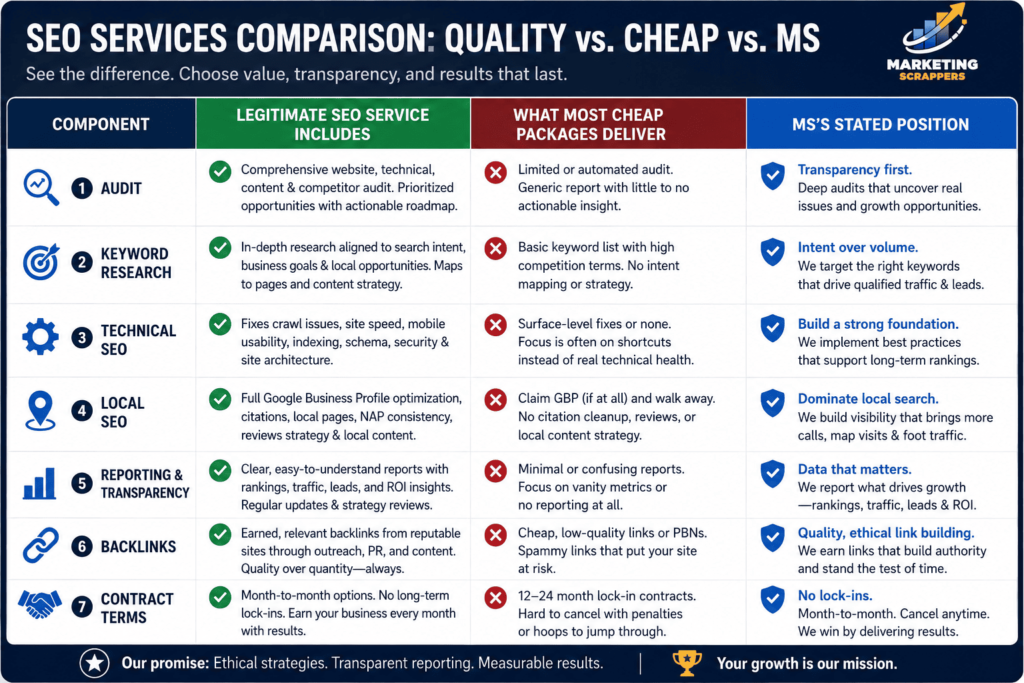
Backlinks are a ranking signal. A link from a credible regional publication or an industry association is worth something. A link from a directory that accepted your submission and your payment on the same page is worth almost nothing — and a cluster of them can actively harm a site that Google is already watching. We do not sell backlinks. We say so in our comparison table above and we mean it.The quality of a backlink matters more than the quantity. A single link from a credible industry publication outperforms one hundred links from generic directories. Be sceptical of any proposal that promises a specific number of backlinks per month — legitimate link acquisition is not that predictable.
SEO Agency, SEO Platform, or Freelancer — Which Is Right for a Small Business?
An SEO agency handles strategy and execution but costs more. A platform like Hike SEO gives you tools and guidance to do it yourself for less. A freelancer sits between the two. The right answer depends on how much time you can spend versus how much you can spend monthly.
An agency gives you a team and removes the implementation burden. That is what you are paying for. The accountability risk is real: a managed retainer that nobody actively manages is the most common failure mode in small business SEO. If you choose an agency, the contract and reporting framework matter as much as the pitch.
A platform like Hike SEO costs less and puts the implementation on you. That is the honest trade. If you have time to engage with the work and want to understand what you are doing, a platform is often the right answer. If you want to offload the function entirely, it is not.
A freelancer is the highest-variance option in either direction. A strong independent practitioner — someone who has done this for multiple clients in your sector, who can show you specific results, who uses Screaming Frog and Google Search Console unprompted — is often the best value available. A weak one has no accountability mechanism and no team to catch errors. The audit-before-proposal test applies here more than anywhere else: a freelancer who quotes without diagnosing is telling you exactly how they will run your campaign.
The model matters less than the methodology. We are an agency. We run the same audit-before-proposal test we have described throughout this page. If another provider — agency, platform, or freelancer — runs the same test, they are a legitimate option. If they do not, the model is irrelevant.
What Results Should a Small Business Expect from SEO — and How Long Does It Take?
Technical fixes can improve crawlability within weeks. Ranking changes for competitive keywords take three to six months minimum. Local pack visibility through Google Business Profile can move faster — sometimes within thirty days of consistent optimisation. Any provider promising page-one rankings in two weeks is not being honest with you.
Technical wins are measurable fastest. Indexation improvements, crawl error fixes, and Core Web Vitals score changes appear in Google Search Console within weeks of implementation, as outlined in Google Core Web Vitals documentation. These are the early signals that the work is being done correctly — not the final outcome.
Keyword ranking changes take three to six months for competitive terms. Google needs to re-crawl the page, re-index the updated signals, and reassess its position relative to every competing page. That process has a rhythm. It cannot be shortened by paying more. Google needs to re-crawl the page, re-index the updated signals, and re-evaluate its ranking relative to competing pages. Three to six months is the honest minimum for competitive keywords. The exceptions — brand-new local queries with almost no competition — exist, but they are not what most small businesses are targeting. If a provider quotes you a faster timeline for a competitive term, ask them to show you a comparable result from a comparable site. They will not be able to.
Local pack visibility moves faster than organic blue-link rankings because Google Business Profile signals are processed more frequently than organic index updates. A fully verified, complete, and consistently optimised GBP profile in a low-competition local market can produce local pack movement within thirty days. This is the intervention with the fastest measurable commercial impact for most small businesses.
Specific timeline data from MS hotel and hospitality client work in Pakistan is pending editorial confirmation for this section. We document specific engagements on the [results MS has produced for small business clients] page — including work with hospitality clients where local SEO timelines differ from Western market benchmarks. We will not quote a number we cannot attribute.
How Do You Know If the SEO You Are Already Paying for Is Actually Working?
Check three things in Google Search Console: is organic traffic growing month over month, are the pages your provider claims to be optimising actually ranking, and are the keywords they target ones your customers use? If the answer to any of these is “I don’t know,” your provider owes you a report.
How to check. Open Google Search Console. Go to the Performance report. Filter by the date range you have been paying for SEO. Look at total clicks and total impressions. If both are flat or declining over a three-month period, ask your provider to explain why — and ask for the specific work completed each month, tied to specific pages.
The three failure signals. Traffic flat despite months of retainer payments. The pages your provider says they are “optimising” have no ranking movement in GSC. The keywords in their monthly report do not match the queries your customers actually use. Any one of these warrants a direct conversation. All three together warrant termination of the contract.
What a provider should show you unprompted. A monthly report that names the specific pages worked on, the specific keywords targeted, the ranking movement (if any), and the organic traffic change. A report that shows you traffic graphs without page-level data is showing you what they want you to see, not what the campaign produced.
Google Analytics 4 connects that organic traffic to actual business outcomes — form submissions, phone call clicks, e-commerce transactions. A provider who reports rankings without connecting them to GA4 conversion data is reporting activity, not results.
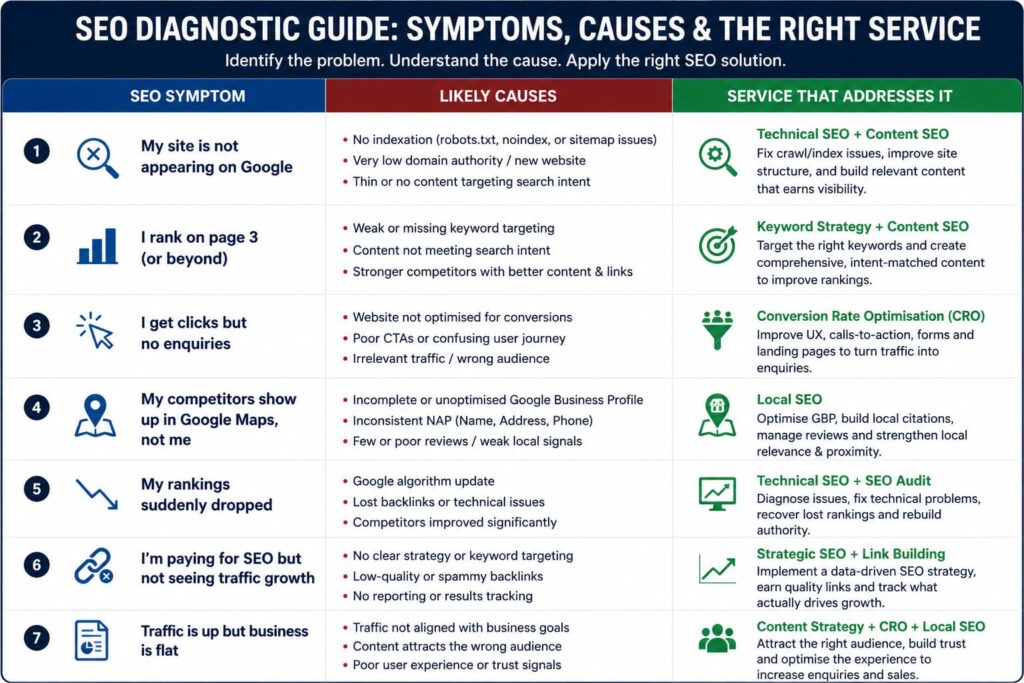
What Is the Difference Between an SEO Audit and an SEO Service — and Which Do You Need First?
An SEO audit diagnoses your site — it tells you what is broken and why. An SEO service fixes it. Paying for a service without an audit first is like paying for surgery without a diagnosis. The audit costs less and tells you whether the surgery is necessary.
A real audit produces a findings list organised by impact — not by what is easiest to fix or what looks most impressive in a report. It shows specific crawl errors, specific pages with intent mismatches, specific schema gaps, specific Core Web Vitals failures. It is domain-specific. It could not have been written before someone looked at your site.
An ongoing SEO service executes against that findings list. It works through the technical issues in priority order, restructures the pages with the worst intent alignment, implements schema where it is missing, and tracks the result of each change in Google Search Console. The audit is the plan. The service is the execution of the plan.
MS’s position is explicit: diagnosis before execution is not a sales technique. It is the correct professional sequence. A provider who skips the audit and goes straight to a retainer proposal has told you, before you have paid a penny, how they will run your campaign. We have seen what happens in month four when nobody diagnosed anything in month one. That is what this page is about. A provider who skips the audit and goes straight to a retainer proposal has told you, before you have paid a penny, how they will manage your campaign.
To understand what a proper audit should examine before any service begins, MS’s guide to [what a proper site audit should examine before any service begins] walks through the full scope.
Can a Small Business in Pakistan — or Any Non-Western Market — Compete on Google Against Larger Players?
Yes — and in many local markets, the competition for Google visibility is thinner than it appears from the outside. Most competitors in non-Western markets have not invested in technical SEO, structured content, or entity optimisation at all. In most Pakistan local markets we have worked in, the competition has not done the basics. No verified GBP. No schema markup. No structured content. That is not a disadvantage to overcome — it is a gap to step into.
Yes. In most non-Western local markets, direct SEO competition is thin. Competitors rarely have verified Google Business Profiles, schema markup, or structured content. A small business that implements these basics correctly can outrank larger players who have not addressed them at all.
The structural advantage. Google’s ranking signals are language- and location-aware. A well-structured local page — with a verified GBP, consistent NAP (name, address, phone) data, and schema markup for a local business — can outrank a larger competitor who has never addressed any of these. The larger competitor’s size does not protect them from a smaller, better-optimised local presence.
The GBP advantage in low-adoption markets. In markets where GBP adoption and optimisation rates are low — which describes most local markets outside major Western cities — a fully verified, complete, and actively managed GBP profile can produce local pack movement faster than the global benchmark timelines suggest. The thirty-day timeline mentioned in Q12 is, in some Pakistan local markets, conservative.
The E-E-A-T opportunity. Most local competitors in non-Western markets publish thin, generic content. A business that publishes accurate, specific, locally relevant content — with named authorship and verifiable detail — meets Google’s quality threshold at a relatively low bar because the competition for that threshold is limited.
What Should a Small Business Owner Do in the 48 Hours Before Hiring an SEO Provider?
Before hiring any SEO provider: verify you have Google Search Console access and can see your own data, identify the three pages currently driving the most traffic, and note which keywords you believe you should rank for but do not. This takes one hour and makes every provider conversation more productive.
Before hiring any SEO provider, check three things to prepare.
First, verify GSC access. Open Google Search Console in your browser. If you can see your domain’s performance data, you have access. If you cannot, contact whoever built or manages your site and request it before you meet any provider. A provider who asks you to grant them GSC access on the first call — before you have seen the data yourself — is controlling information you should own.
Second, read your top three pages. In the GSC Performance report, sort by clicks. Your top three pages tell you what the market currently wants from your site. They are your existing organic assets. Any provider who does not reference them in their proposal has not done their homework.
Third, build a quick keyword gap list. Look at what your competitors rank for that you do not. Look at what queries you appear for in GSC positions 8–20 — these are your fastest-opportunity keywords, already indexed, already partially relevant, just not optimised. Note the gaps. Bring them to your provider conversation.
This matters because it changes the conversation from a pitch to a diagnostic. A provider who ignores your GSC data and presents a pre-built proposal has answered the question for you.A provider who responds to your data with a template proposal has answered the question for you. MS has a list of [free keyword research tools worth running before your first provider conversation] if you want to extend this preparation.
What Does a Genuinely Bad SEO Proposal Look Like — and What Are the Lines That Should Make You Walk Away?
A bad SEO proposal does not mention Google Search Console. It promises rankings, not a process. Its audit is a PDF with your domain name inserted into a template. It cannot explain what search intent means when you ask. These are not edge cases. They are the industry standard.
We have seen proposals that quote a monthly retainer without mentioning Google Search Console once. We have seen audits that are PDFs with the client’s domain name in the header and generic “best practices” as findings. We have seen ranking guarantees in writing. These are not from obviously bad providers — they are from providers who present professionally and charge standard rates. The template is the tell, not the price.
The five disqualifying signals:
1. No mention of Google Search Console. It is free. It is primary. If a provider’s proposal, discovery call, or onboarding process does not reference it, they are not planning to use it.
2. Ranking guarantees. Any provider who guarantees first-page rankings is either lying or planning to use manipulative link tactics that produce short-term gains and long-term penalties. Google does not guarantee rankings to anyone. Neither can your provider.
3. The template audit. Ask for the raw crawl file. A real technical audit runs Screaming Frog or equivalent against your domain and produces a file with your specific errors. A template cannot produce this. If your “audit” arrived before anyone asked for access to your site, it is a template.
4. Inability to define search intent. Ask your prospective provider: “What is search intent and how does it affect what you will do for my site?” A provider who cannot explain this in plain language — the concept that what someone is trying to accomplish determines what Google ranks — is not making strategic decisions about your content.
5. A multi-month contract before any site-specific data. A provider who asks you to sign a six-month contract on the first call, before producing any audit findings, is protecting their revenue, not your results. Month-to-month terms after an initial audit are the professional standard.
What a good proposal looks like in contrast: specific findings from a crawl of your domain, specific proposed fixes in priority order, a defined reporting cadence using GSC, and month-to-month terms once the audit phase is complete.
FAQ’s About SEO Services for Small Businesses
What is the most important SEO service for a small business?
Google Business Profile optimisation is the single highest-impact starting point for most small businesses. It controls local pack visibility, which is often more commercially valuable than blue-link organic rankings. Beyond GBP, technical SEO — page speed, schema markup, crawlability — provides the foundation everything else depends on.
How long does SEO take to show results for a small business?
Technical improvements can show in Google Search Console within weeks. Keyword ranking changes take three to six months for competitive terms. Local pack visibility through Google Business Profile can move within thirty days of consistent, complete profile optimisation. Any provider promising faster results for organic rankings is not being accurate.
What should I ask an SEO provider before hiring them?
Ask three questions: Can you show me a site-specific audit of my domain before you propose anything? Can you show me results from a comparable business? What does your monthly reporting look like — and does it use Google Search Console? Inability to answer any of these clearly is a disqualifying signal.
Is SEO worth it for a small business with a limited budget?
Yes — but only if the budget is spent on diagnosis first. A technical audit and a Google Business Profile optimisation are the two highest-return, lowest-cost interventions available. A $300/month retainer that includes neither is not SEO — it is a reporting service.
What is Domain Authority and should I care about it?
Domain Authority is a metric created by Moz, a third-party SEO tool company. Google does not use it as a ranking signal. It is a useful indicator of a site’s relative strength compared to competitors, but it is not a metric you should optimise for directly or ask your provider to prioritise.
What is the difference between SEO and Google Ads?
Google Ads places your business at the top of search results through paid placement — you pay per click, and visibility stops when payment stops. SEO builds organic visibility over time — it takes longer but compounds. For most small businesses, both are useful at different stages; neither replaces the other.
What does a local SEO service include?
Local SEO starts with Google Business Profile — verifying and fully completing the profile. It then covers consistent business information across directories, local keyword targeting on service pages, and review acquisition and management. Without a verified, complete GBP, other local SEO work has limited impact.
How do I know if my current SEO provider is doing anything?
Open Google Search Console and check the Performance report. If organic clicks and impressions are not growing over the period you have been paying, ask your provider to explain why — and ask to see the specific work completed each month. If they cannot show you domain-specific data, they are not running your campaign.
Before you sign anything, get a diagnosis.
MS audits your site, identifies what is actually holding your rankings back, and tells you what needs to be fixed — before you pay for execution.