Growth Marketing Agency That Diagnoses Before It Executes
Marketing Scrappers is a growth marketing agency that audits what is blocking your revenue before recommending a single channel. Most businesses have a conversion problem, not a traffic problem. We diagnose first. Then we execute.
A growth marketing agency uses data, experimentation, and cross-channel execution to drive measurable customer acquisition and revenue growth — not just traffic or brand awareness. This page is for business owners and marketing leads who are evaluating whether to hire one. If you are still learning what digital marketing actually covers as a discipline, that is a better starting point than this page.
How Is Growth Marketing Different From Performance Marketing?
Growth marketing optimises the full customer journey — acquisition, activation, retention, and referral — not just ad spend or traffic volume. Performance marketing optimises for a single conversion event. Growth marketing treats CAC, LTV, and churn as a connected system, not separate metrics.
The terms are not interchangeable. Agencies that treat them as synonyms either do not understand the difference or are hoping their clients do not ask. Here is what the difference actually costs you if you hire the wrong one.
Performance marketing runs a campaign brief and optimises toward one event — a click, a lead, a purchase. It is the right tool when you have a proven offer and need volume. If your unit economics are already healthy and you need to scale a specific paid channel, a performance agency is the correct hire.
Growth marketing sits above that. It does not start with a channel. It starts with a question: where is the funnel losing people, and why? Then it builds a cross-channel system — paid search, organic, email lifecycle, CRO — calibrated to move CAC down and LTV up simultaneously.
Demand generation — the practice of creating awareness and intent among buyers who are not yet actively searching — operates inside a growth marketing system as the top-of-funnel input that paid social and content channels feed.
Traditional brand marketing, the third category, optimises for awareness and sentiment. It does not belong in this comparison for buyers who need revenue.
If you want the fuller breakdown of channel-level strategy frameworks before committing to an engagement, that context is covered separately. This page is for buyers who have already done that reading.
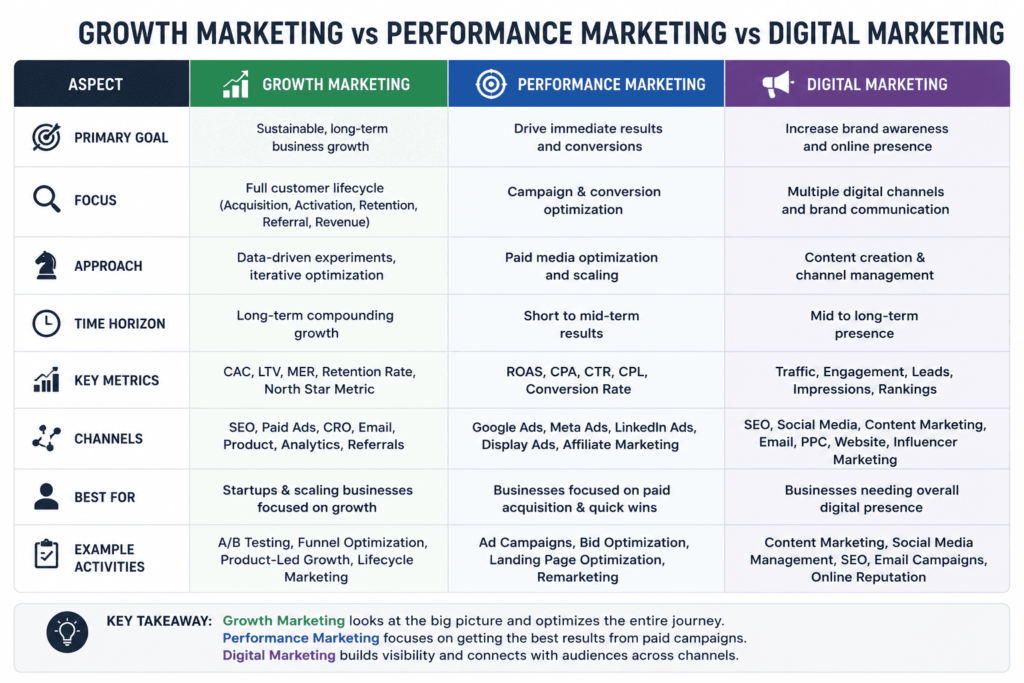
| Factor | Growth Marketing Agency | Performance Marketing Agency | Digital Marketing Agency |
| Primary goal | Increase LTV relative to CAC across full funnel | Maximise conversions on a specific paid channel | Increase online presence and traffic |
| Metrics reported | CAC, LTV, churn, revenue contribution | ROAS, CPC, CPL, conversion volume | Traffic, rankings, followers, impressions |
| Engagement model | Diagnosis first, then execution | Campaign brief, then execution | Retainer with defined channel scope |
| Timeline to revenue impact | 60–90 days (paid), 3–6 months (organic) | 2–4 weeks (paid) | 3–12 months (organic) |
| When to use | When you need to grow revenue systematically | When you have a proven offer and need volume | When you need broad online visibility |
| When NOT to use | If funnel conversion rate is under 1% | If you have no product-market fit yet | If you need revenue, not visibility |
What Metrics Does a Growth Marketing Agency Actually Optimise?
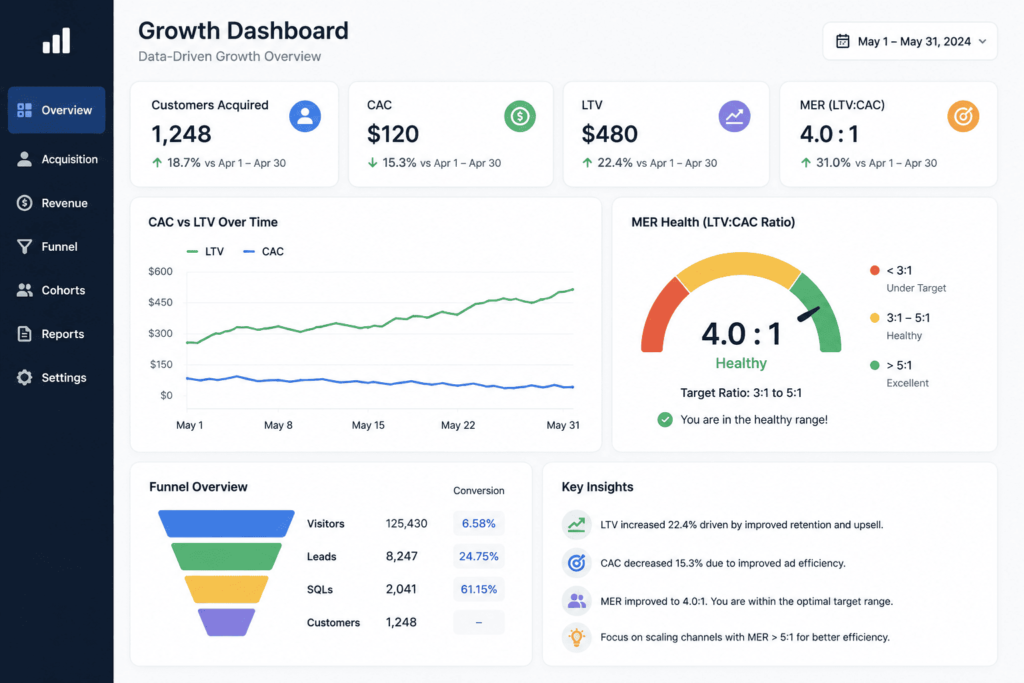
A growth marketing agency tracks customer acquisition cost (CAC — what it costs to bring in one customer), lifetime value (LTV — total revenue that customer generates), and the ratio between them. A healthy engagement increases LTV relative to CAC over time.
The CAC:LTV ratio is the primary health check. A ratio below 3:1 signals inefficiency — you are spending too much to acquire customers who do not generate enough return. A ratio above 5:1 is not always healthy — it can mean the business is under-investing in acquisition and leaving addressable market to competitors. The target range sits between 3:1 and 5:1 for most growth-stage businesses. Below 3:1 means the economics are broken. Above 5:1 means the business may be growing slower than it should. The target range sits between these.
ROAS — Return on Ad Spend — is the standard paid-media metric. It tells you how much revenue a specific ad campaign generated per dollar spent. It is useful at the channel level. It becomes misleading at the business level, because it cannot account for what happens after the click.
MER — Marketing Efficiency Ratio — is the post-iOS 14.5 replacement for ROAS as a blended efficiency measure. MER is calculated as total revenue divided by total marketing spend, across all channels simultaneously. Apple’s App Tracking Transparency (ATT) framework, launched in 2021, broke cross-channel attribution for most businesses running paid social. MER does not depend on clean tracking at the individual level. It measures the system output, not the channel attribution. For any business running two or more paid channels, MER is now the more honest number.
For B2B growth clients, MQL (Marketing Qualified Lead) and SQL (Sales Qualified Lead) track lead quality through the funnel. They exist because traffic volume and even conversion rate can be misleading if the leads converting are not the right buyers.
Churn rate and NPS sit on the retention side. They matter because acquisition economics only compound if customers stay. A growth agency that ignores churn is optimising a leaking bucket.
Conversion tracking for growth marketing campaigns is implemented through Google Analytics 4 — Google’s current measurement standard for cross-channel attribution. [CITATION NEEDED: https://developers.google.com/analytics/devguides/collection/ga4]
What Frameworks Do Growth Marketing Agencies Use?
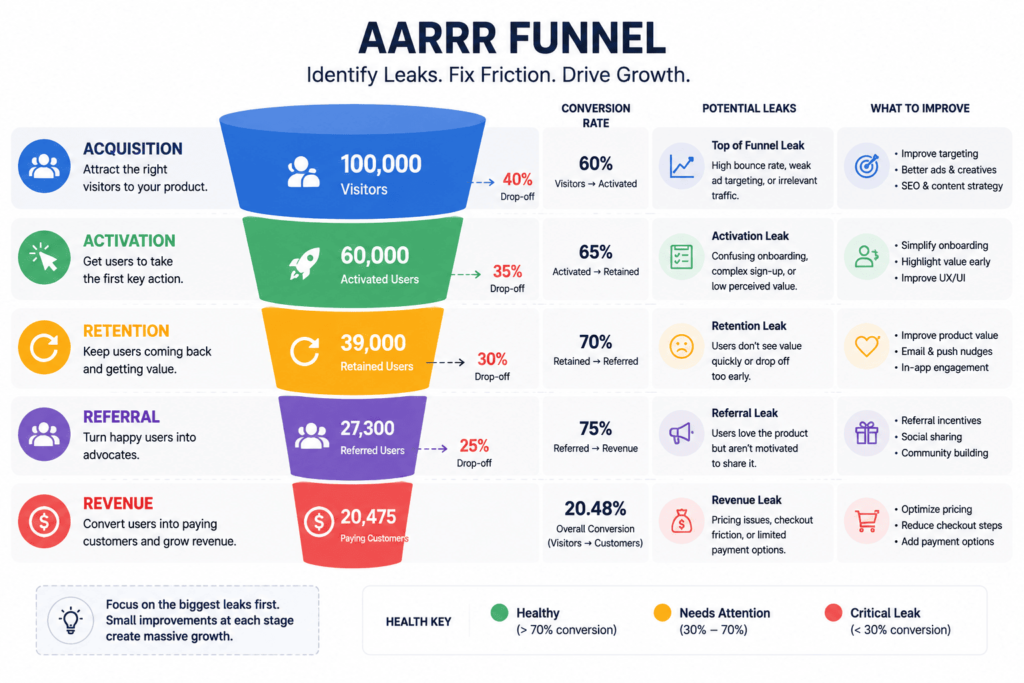
The AARRR framework — Acquisition, Activation, Retention, Referral, Revenue — maps every stage a customer passes through. A growth agency identifies which stage is losing the most people and concentrates resources there first. The North Star Metric defines which single number the entire strategy optimises toward.
AARRR, known as Pirate Metrics, was codified by Dave McClure as a diagnostic tool — not a content calendar template. Each stage represents a question:
- Acquisition: Where are people finding us?
- Activation: Are they experiencing value quickly enough to continue?
- Retention: Are they coming back?
- Referral: Are satisfied customers generating new ones?
- Revenue: Are we making money at each stage, or only at the end?
The AARRR framework locates the constraint. It does not prescribe the fix — that requires data. When MS runs this analysis at the start of an engagement, the bottleneck is almost never where the client believes it is. They arrive thinking they have an acquisition problem: not enough traffic, not enough reach, not enough spend. The data usually shows an activation failure. Visitors are arriving. They are not staying long enough to understand what they are looking at. Pouring more paid budget into that situation does not fix it. It makes the waste faster.
Growth hacking, as originally practised in early-stage startups, relied on rapid, low-cost experiments to find any acquisition channel that worked — without a systematic measurement framework. Growth marketing takes the same experimental instinct and applies AARRR structure, multi-touch attribution, and unit economics to make the results repeatable.
The North Star Metric translates this diagnosis into a single number the whole team aligns on. For a SaaS business it might be weekly active users. For a hotel it might be direct booking revenue per available room. The North Star is not a vanity metric — it is chosen because moving it requires improving the whole system, not just one channel.
Multi-touch attribution replaces last-click reporting. Last-click gives 100% of conversion credit to the final touchpoint — typically a branded search or direct visit — and gives zero credit to the blog post, the paid social ad, or the email that brought the buyer into the funnel six weeks earlier. Research into media mix modelling consistently shows that last-click attribution undervalues brand and content channels by assigning all conversion credit to the final touchpoint. [CITATION NEEDED: https://www.nielsen.com/insights/ — confirm specific article URL before publishing]
That is the operational difference between a discipline that finds what works and one that scales it.
What Services and Channels Does a Growth Marketing Agency Cover?
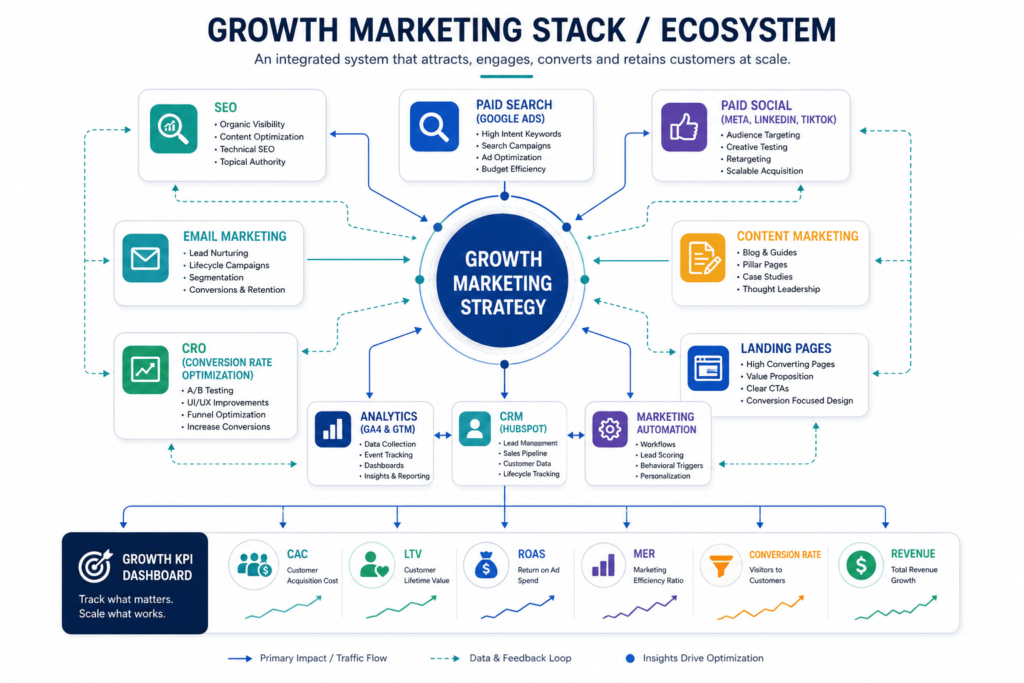
Growth marketing services include paid search (Google Ads), paid social (Meta, LinkedIn, TikTok), organic search (SEO), email lifecycle campaigns, and conversion rate optimisation (CRO). The channel mix is determined by where the client’s funnel leaks — not by agency preference or default retainer scope.
Here is what each channel does inside a growth system:
Paid search (Google Ads) captures buyers who are already looking. The demand exists — someone typed the query. The question is whether you appear, and whether your landing page converts what you pay to acquire. It is the fastest channel to a revenue signal. MS uses the first 30 days of paid search data primarily as a diagnostic — to understand what the buyer is actually searching for before scaling spend on it.
Paid social (Meta Ads, LinkedIn Ads, TikTok Ads) creates demand among people who are not yet searching for what you sell. Meta is the dominant platform for B2C and DTC businesses. LinkedIn is where B2B growth campaigns run when the buyer is a decision-maker rather than a search-intent user. TikTok belongs in the stack for consumer brands targeting audiences under 35 — its cost-per-click remains lower than Meta for most consumer categories. That gap will close. It has not yet.
Organic search (SEO) compounds over time. Organic search growth runs through on-page SEO optimisation — improving title tags, content relevance, and internal structure so that traffic Google is already sending converts at a higher rate. It is the slowest channel to revenue and the most durable.
Email lifecycle campaigns work because the acquisition cost is already paid. You are not buying attention — you are using attention you earned. For businesses with a customer base above a few hundred contacts, email is consistently the most efficient revenue channel in the stack. MS builds lifecycle sequences around what the customer does, not what month it is.
CRO (Conversion Rate Optimisation) is the compounding layer and the one most agencies skip because it does not produce a channel report. A 0.4% improvement in conversion rate across 10,000 monthly visitors is 40 additional conversions per month, permanently, without additional spend. A/B testing is the methodology — structured experiments that generate statistically valid evidence before scaling. Paid acquisition without a content strategy that supports the funnel produces clicks that stop at the landing page.
The explicit boundary: SEO is one channel inside a growth system. It is not the same as SEO outsourcing or white-label SEO. Those are vendor arrangements, not growth strategy.
What Tools and Platforms Does a Growth Marketing Agency Use?
The standard measurement stack is Google Analytics 4 for cross-channel attribution, Google Tag Manager for data layer management, and HubSpot for CRM and lifecycle automation. Semrush or Ahrefs handles organic search data. No single tool replaces a clear measurement framework agreed before campaigns launch.
HubSpot’s marketing automation layer handles lead nurturing sequences, lifecycle email triggers, and CRM pipeline updates — removing the manual handoff between marketing activity and sales follow-up that most growing businesses lose leads inside.
Tool selection follows strategy. It does not precede it. An agency that opens the first client meeting with “we use HubSpot and GA4” before understanding the client’s funnel stage is selling vendor familiarity, not diagnostic thinking.
Here is how each tool functions inside a growth stack:
Google Analytics 4 is the current measurement standard following the Universal Analytics sunset. It tracks cross-channel user behaviour and supports event-based conversion measurement. [CITATION NEEDED: https://developers.google.com/analytics/devguides/collection/ga4]
Google Tag Manager is the implementation layer. It deploys conversion pixels, event triggers, and custom dimensions without requiring a developer to touch the site’s code on every update. One misconfigured container is enough to corrupt the attribution data an entire campaign is being optimised against. MS audits Tag Manager configuration before the first campaign goes live — not after the first month’s report shows numbers that do not add up.
HubSpot connects the marketing data to the CRM. It tracks leads from first touch through to closed revenue — which is where most agency reporting stops making sense. An agency that cannot show you what happened to the leads after they converted is not measuring growth. It is measuring activity.
Semrush or Ahrefs handles organic search research — keyword gap analysis, backlink profiles, competitor content audits. These are the tools MS uses for the diagnosis phase on organic.
The framework is the thinking. The tools execute it. If the thinking does not exist before the tools are configured, the tools produce faster noise with better dashboards.
How Does a Growth Marketing Agency Handle Data Privacy and Compliance?
Since Apple’s App Tracking Transparency framework launched in 2021 and third-party cookies began deprecating, growth marketing measurement has shifted toward first-party data and modelled attribution. A compliant agency builds campaigns assuming tracking gaps exist — not assuming full visibility across the conversion path.
Two structural shifts changed how growth agencies measure campaigns.
iOS 14.5 and ATT removed opt-in tracking from approximately 60–80% of Apple device users who declined app tracking. For any agency running Meta Ads, this meant that a significant portion of conversions became invisible at the platform level. Agencies that did not adapt continued reporting ROAS numbers that were partially fabricated by platform attribution models filling in missing data. MER emerged as the honest alternative.
Third-party cookie deprecation removed the cross-site tracking that allowed display advertising networks to follow users across the web. Chrome’s deprecation timeline has shifted, but the direction is permanent. Agencies building campaigns that depend on third-party cookie data are building on a shrinking foundation.
The correct response is building data infrastructure that does not depend on platform permission. Lists you own. CRM records you control. Conversion events that do not require a platform’s willingness to share what it knows. Platforms optimise their attribution data to make their own ad products look efficient. First-party data does not have that conflict of interest. The IAB (Interactive Advertising Bureau) has published standards for first-party data activation that MS follows as the operational baseline.
Data collection practices for paid growth campaigns must comply with both platform-level restrictions and regulatory requirements — including FTC guidelines on consumer privacy. [CITATION NEEDED: https://www.ftc.gov/business-guidance/privacy-security/privacy]
UK and EU clients operate under GDPR. MS builds data collection to those requirements from the start of the engagement — not as a legal retrofit after the campaign is already running. [CITATION NEEDED: https://ico.org.uk/for-organisations/uk-gdpr-guidance-and-resources/]
How Does a Growth Marketing Agency Work With Hospitality and Local Businesses?
For hotels and local businesses, growth marketing shifts revenue away from costly OTA commissions toward direct bookings — optimising RevPAR, ADR, and occupancy rate using Google Business Profile, metasearch listings, and PMS integrations. The goal is direct booking share, not just traffic volume.
The OTA commission problem is structural. A hotel paying 18–25% commission to Booking.com or Expedia on every room sold is not facing a marketing problem. It is facing a margin problem disguised as a distribution problem. Every booking that moves from OTA to direct increases net revenue per booking by the full commission amount — without acquiring a single new customer.
In hospitality audits, MS examines four systems before recommending any paid or metasearch spend:
- Structured data for room pricing — whether Google can read and display the property’s rates correctly in search results and Google Hotel Ads
- Mobile load time — whether the direct booking path converts on the device most hotel searchers use
- Google Business Profile completeness — whether the property appears correctly in local search and Maps, with accurate rates, photos, and booking links
- Metasearch feed accuracy — whether the rates showing on Google Hotel Ads and TripAdvisor match the property’s actual inventory via the channel manager
If any of these four systems is broken, paid metasearch spend drives traffic into a conversion failure. The channel manager and PMS integration must be accurate before any growth spend makes sense.
RevPAR (Revenue Per Available Room), ADR (Average Daily Rate), and occupancy rate are the three metrics hospitality growth engagements are measured against. Direct booking share is the KPI that connects all three — because a higher direct booking share improves net RevPAR even when total occupancy stays flat.
Here is what most growth agencies will not tell you.
Most agencies push you to increase top-of-funnel traffic because more traffic produces more impressive-looking monthly reports. Pageviews go up. Sessions go up. The deck looks busy. But without precise behavioural intent mapping — understanding which visitors are active buyers versus passive browsers — that traffic burns budget on people who will never purchase. It does not generate revenue. It generates the appearance of activity.
The commercially inconvenient truth: if your site converts less than 1% of visitors and you do not know why, hiring a growth marketing agency to send more traffic will increase your losses, not your revenue.
Here is what we found when we stopped selling traffic and started diagnosing.
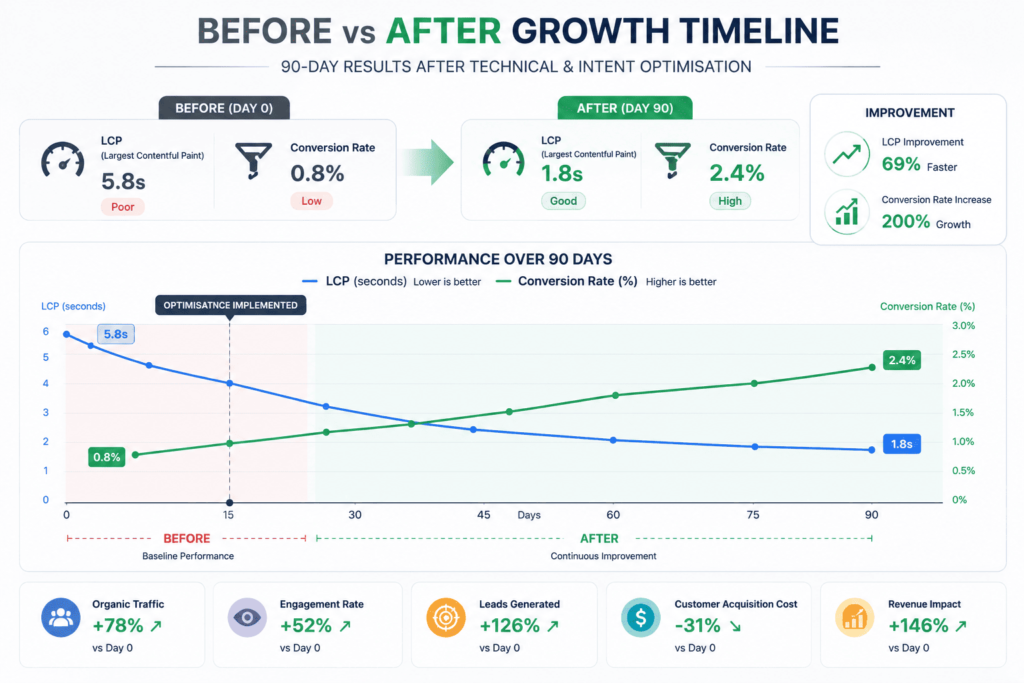
A B2B SaaS client operating a mid-market sales platform approached MS with stagnant organic pipeline and a dangerously high CAC. They were spending $15,000 per month on paid acquisition. Their visitor-to-lead conversion rate was 0.8% — significantly below the 2026 B2B benchmark of 2.2%. Their attribution model was single-touch last-click. Nearly 40% of their marketing spend was unattributable. Their primary lead generation pages had a Largest Contentful Paint (LCP) of 5.8 seconds on mobile — a page speed that, under 2026 mobile UX standards, generates drop-off rates of up to 45% before the page fully loads.
They did not need more traffic. They needed a diagnosis.
MS executed in three phases:
Phase 1 — Technical overhaul. We optimised the code and media assets on their primary lead generation pages. LCP dropped from 5.8 seconds to 1.8 seconds — below Google’s Core Web Vitals threshold of 2.5 seconds.
Phase 2 — Intent-based funnel restructure. We shifted keyword targeting from generic informational blog content to high-intent commercial diagnostic templates — content that reaches buyers who are actively evaluating solutions, not passively reading.
Phase 3 — Attribution rebuild. We replaced single-touch last-click with a multi-touch model in GA4, connecting paid, organic, and email touchpoints to revenue events in HubSpot.
The results at 90 days:
| Funnel Metric | Before MS Audit | After MS Optimisation (90 Days) | 2026 Industry Benchmark |
| Largest Contentful Paint (LCP) | 5.8 seconds | 1.8 seconds | < 2.5 seconds |
| Visitor-to-Lead Conversion Rate | 0.8% | 2.4% | 2.2% |
| Blended CAC (same $15k/mo spend) | Baseline | 31% reduction | N/A |
| Primary traffic focus | Generic TOFU blogs | High-intent action templates | Intent-mapped funnels |
The constraint is real and must be stated clearly: a technical and structural overhaul of this scale requires a minimum of 90 days to show compounding results. The conversion rate improvement was directional at 60 days and statistically valid at 90. This is not a short-term fix. Businesses looking for results inside 30 days should not begin this engagement.
Before we recommend a single channel or budget for any client, we run a technical SEO audit to identify what is already blocking conversions on your existing traffic. The audit output is the first deliverable. It defines the engagement that follows.
How Much Does a Growth Marketing Agency Cost?
Growth marketing retainers typically range from $1,500 to $10,000+ per month depending on channel scope, ad budget size, and whether creative and analytics are bundled. Marketing Scrappers does not publish fixed-rate pricing. Scope drives cost. The first step is a diagnostic conversation, not a quote.
Three pricing models exist in the market:
Monthly retainer — a fixed fee for a defined scope of work. Predictable for the client. The trade-off: if scope expands, the retainer needs renegotiation or work gets dropped.
Percentage of ad spend — typically 10–20% of the monthly paid media budget. Aligns the agency’s revenue with the client’s investment level. The conflict: it incentivises the agency to increase ad spend, not necessarily to improve efficiency. Watch for this in any agency proposing this model.
Performance-based fees tie payment to agreed results. The problem is attribution. When tracking is fragmented — which it is, post-iOS 14.5 — the agency and the client will eventually disagree on what caused a conversion. Performance billing turns that disagreement into a billing dispute. MS does not use this model because it creates the wrong incentive: optimising for what can be attributed rather than what actually works.
What drives price upward: the number of active channels in scope, creative production requirements, reporting depth, and whether the engagement includes CRO work or only campaign management. An engagement covering paid search only is less complex — and less expensive — than one covering paid search, paid social, email, and CRO simultaneously.
The disqualification signal: any agency that quotes a monthly retainer before asking about your current conversion rate, your attribution setup, and your CAC baseline is selling a package. Not a diagnosis.
Note: the $1,500–$10,000+ range above reflects industry-wide published benchmarks. MS will confirm or replace this range before this page publishes.
How Do You Measure Real ROI From a Growth Marketing Agency?
Real ROI compares total marketing spend against incremental revenue generated, using CAC-to-LTV ratio as the primary health check. A ratio below 3:1 signals inefficiency. If your agency’s monthly report leads with impressions or follower growth, they are measuring their activity — not your revenue.
The measurement hierarchy is straightforward:
Primary metrics — CAC, LTV, CAC:LTV ratio, MER. These connect directly to business economics. If CAC is falling and LTV is stable or rising, the engagement is working.
Secondary metrics — ROAS by channel, conversion rate by funnel stage, churn rate. These diagnose which specific channel or stage is performing or underperforming. They explain the primary metrics. They do not replace them.
MS excludes impressions, reach, follower count, and raw traffic volume from client reporting by default. A client who received 2 million impressions last month and converted 0.6% of them does not have an awareness problem. They have a conversion problem. Showing them the impressions number is not reporting — it is misdirection with a dashboard.
MER — total revenue divided by total marketing spend — is the single number that survives the iOS 14.5 attribution gap. It does not require clean cross-channel tracking at the individual level. It measures what the system produced.
The NPS (Net Promoter Score) sits at the retention end of the measurement stack. It is a leading indicator of churn. A declining NPS while CAC is stable and LTV is flat means the pipeline is about to get more expensive.
The North Star Metric ties all of this together. It is the single number the business and the agency agree to move — chosen because improving it requires improving the system as a whole, not gaming one metric at the expense of another. [CITATION NEEDED: confirm specific Think With Google article URL on consumer behaviour / mobile conversion rates at time of writing]
We do not quote average results across the industry. We quote our own work. The client results we have published show the specific starting conditions, what we changed, and what moved.
How Do You Choose the Right Growth Marketing Agency for Your Business?
Before hiring any growth marketing agency, confirm you know your current conversion rate, have 90 days of clean analytics data, and track marketing spend to revenue — not clicks. An agency that skips these questions before proposing a retainer is selling execution, not growth.
Work through this before contacting anyone:
| Readiness Condition | Why It Matters | If No — Do This First |
| You know your current website conversion rate | Without this baseline, no agency can show you lift | Install GA4 and measure for 30 days |
| You have 90+ days of clean analytics data | Less data means the agency is guessing at attribution | Fix tracking before signing a retainer |
| Your site’s mobile load time is under 3 seconds | Paid traffic into a slow site produces no ROI | Start with a technical SEO audit |
| Your marketing spend is tracked to revenue, not clicks | Click data cannot prove growth | Set up conversion goals tied to actual revenue events |
| You have a defined ideal customer profile (ICP) | Growth marketing without ICP produces volume, not customers | Complete ICP definition before the first campaign |
If you answered No to three or more of these, do not hire a growth marketing agency yet. Fix the gaps first — with MS’s help or without it. An agency that takes your retainer before these conditions exist is not set up to show you real results.
Three questions to ask any agency in the first meeting:
1. How do you handle attribution post-iOS 14.5 and cookie deprecation? If the answer is “we use platform-reported ROAS,” they have not adapted to the current measurement environment.
2. What appears in a monthly report — and what does not? If impressions and reach appear before CAC and conversion rate, that is the reporting hierarchy they have chosen.
3. What would you tell a client who is not yet ready to engage? An agency that cannot answer this question does not have a diagnostic process. They have a sales process.
This page is not for businesses that need brand visibility rather than revenue growth. It is not for businesses with less than 30 days of any conversion data. Multi-touch attribution, North Star Metrics, and Google Analytics 4 event tracking require a data foundation to function. Without one, MS is guessing — and we will tell you that before we take your money.
What Results and Timeline Should You Expect After Hiring a Growth Marketing Agency?
In the first 30 days, a growth engagement produces a diagnostic output — what is blocking conversions and in what order to fix it. Paid channel revenue impact typically appears in 60–90 days. Organic search compounds over 3–6 months. Any agency promising faster timelines is quoting traffic, not revenue.
Here is the honest sequence:
Days 1–30 — Diagnosis. The first deliverable is not a campaign. It is an audit output: current conversion rate by funnel stage, attribution setup review, technical performance baseline, and a ranked list of what to fix first. This document defines the engagement. Every channel recommendation flows from it. If an agency skips this step and moves directly to campaign setup, they are executing without diagnosing.
Days 30–90: directional. Paid channels generate signal within this window — whether CAC is moving the right direction at target volume. Do not ask for conclusions at day 45. The data is telling you whether the diagnosis was correct. It is not yet telling you the final number. A/B tests on landing pages begin producing valid results if traffic volume is sufficient. What you are looking for is direction, not declaration.
Months 3–6 — Compounding. Organic search changes take this long to move because Google’s indexing and ranking cycle operates on its own timeline. CRO changes compound — a 0.4% improvement in conversion rate across 10,000 monthly visitors is 40 additional conversions per month, permanently, without additional spend. This is where the MS SaaS case study results became statistically valid. Not at 30 days. At 90.
The 90-day minimum is not a contract protection clause. It is an operational reality. Structural changes to a funnel — technical performance, intent-based content architecture, attribution rebuild — require time to index, test, and compound. Businesses that need revenue inside 30 days should evaluate paid-only performance campaigns, not full-funnel growth engagements.
If Your Marketing Spend Is Not Tracking to Revenue — Start With a Diagnosis
MS reviews your current funnel data, identifies the highest-leverage fix, and tells you whether a growth engagement makes sense for your situation. If it does not, we will tell you that too.
[Book a diagnostic call — marketingscrappers.com/contact/]
Frequently Asked Questions
What is a growth marketing agency?
A growth marketing agency is a specialist firm that combines data analysis, channel execution, and structured experimentation to drive measurable customer acquisition and revenue — not just awareness or traffic. It differs from a digital marketing agency by optimising unit economics (CAC, LTV) rather than channel-level metrics.
Is growth marketing the same as growth hacking?
Growth hacking is an early-stage, often ad-hoc approach to finding quick acquisition wins — associated with startup tactics like viral loops and referral incentives. Growth marketing is the systematised, data-driven evolution of that approach, applied across the full customer lifecycle with repeatable frameworks rather than one-off experiments.
How long does it take to see results from a growth marketing agency?
Paid channel impact is typically directional within 30–60 days. SEO and CRO compounding takes 3–6 months for statistically valid results. Any agency promising meaningful revenue impact in under 30 days is describing traffic movement, not revenue growth.
What is the difference between a growth marketing agency and a performance marketing agency?
Performance marketing optimises a single paid channel for a specific conversion event — clicks, leads, or purchases. Growth marketing optimises the full funnel across multiple channels using unit economics. A performance agency maximises volume. A growth agency improves the system that volume flows through.
How much does a growth marketing agency charge per month?
Retainers typically range from $1,500 to $10,000+ per month depending on channel scope, ad budget size, and whether creative production and analytics are included. The first conversation should be diagnostic, not a price comparison — because scope drives cost, and scope cannot be defined before the audit.
What metrics should a growth marketing agency report on?
The primary reporting metrics are CAC, LTV, and their ratio; MER as a blended cross-channel efficiency measure; and conversion rate by funnel stage. Secondary metrics include ROAS by channel and churn rate. Impressions, reach, and follower growth are not primary growth metrics — they do not connect directly to revenue decisions.
Do I need a growth marketing agency or just an SEO agency?
If your primary goal is organic search visibility, on-page SEO optimisation may be the right scope. If your goal is revenue growth across multiple channels with unit economics as the measure of success, a growth marketing engagement covers SEO as one channel within a broader system.
What should I ask a growth marketing agency before signing a retainer?
Ask how they measure attribution across channels post-iOS 14.5 and cookie deprecation. Ask what appears in a monthly report and what does not. Ask whether their pricing model incentivises your CAC reduction or their billable hours. Ask what they would tell a client who is not yet ready to engage. An agency that cannot answer the last question clearly is an execution shop, not a diagnostic partner.