Direct Answer
Knowing how to choose an SEO agency comes down to evaluating seven things evaluating seven things when considering SEO services: their strategy process, technical capability, reporting transparency, communication structure, alignment with your business goals, AI-search readiness, and how they measure ROI. Avoid any agency that guarantees specific rankings, hides its methodology, or reports traffic and rankings without connecting them to leads or revenue. If an existing agency fails three or more of these checks across two consecutive reporting cycles, that’s not a reason to worry — it’s a reason to replace them.
Why Most Businesses Get This Wrong
Businesses rarely fire their first SEO agency because of one catastrophic mistake. They fire it because no one set evaluation criteria before signing, so eighteen months pass with rising invoices and no reliable way to tell whether the work is accountable for anything. That’s not a vendor problem — it’s a process problem, and it’s far cheaper to fix before you sign, or request a free SEO audit to evaluate existing setups.
This guide gives you a repeatable process on how to choose an SEO agency, the specific questions to ask on how to choose an SEO agency, the specific questions to ask in a sales call, the red flags that should end a conversation immediately, and — because most buyers eventually need it — a clear-headed process for recognizing when it’s time to walk away from an agency you already hired.
It does not rank named vendors, and it will not tell you SEO is dead, dying, or about to be replaced entirely by AI. It also will not tell you anyone can guarantee a first-page ranking. Nobody can. Any agency that says otherwise has already answered your most important evaluation question, just not in the way they intended.
Why Agency Selection Got Harder in 2026
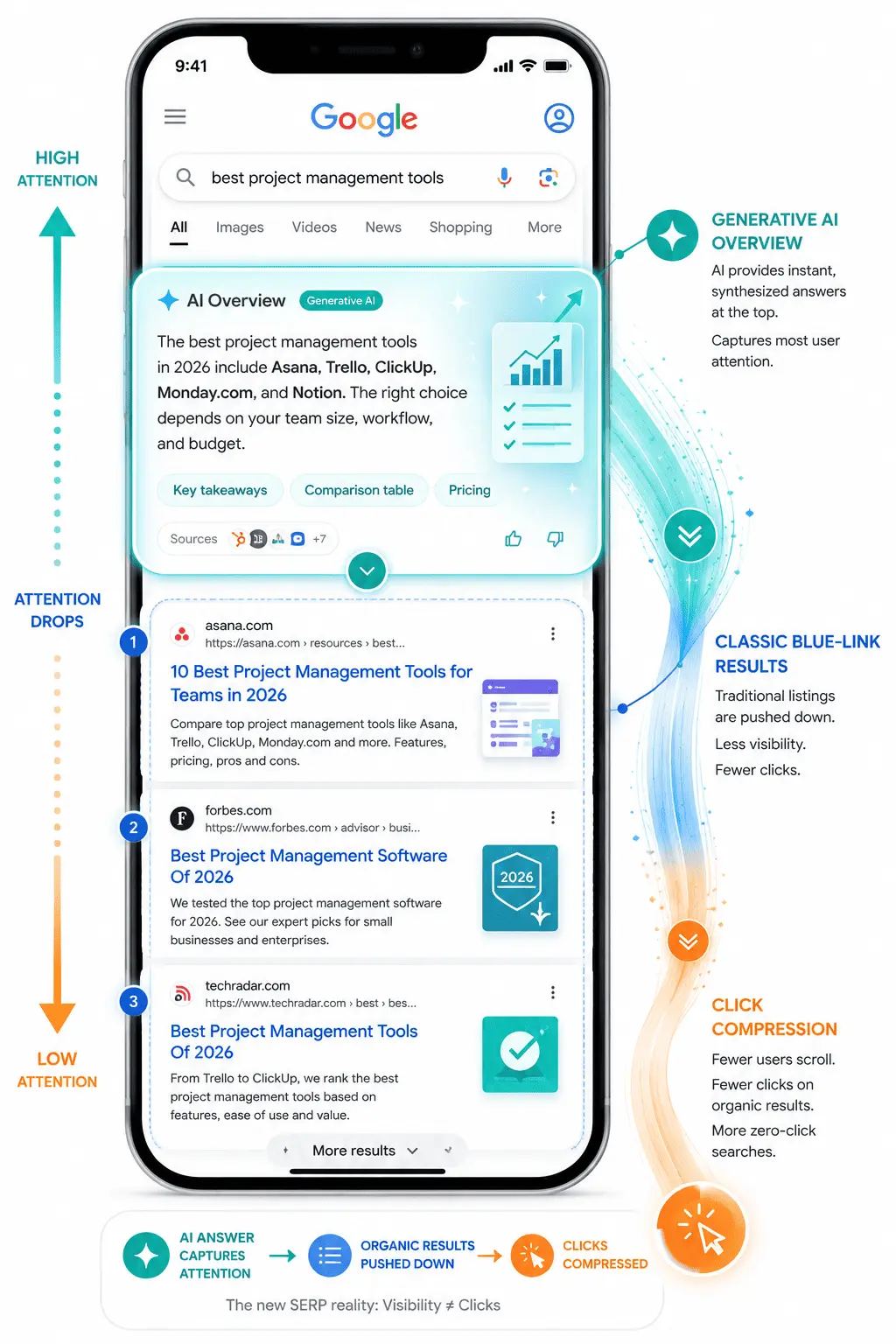
Two things changed at once, and most evaluation advice still written online hasn’t caught up with either.
AI search moved from experimental to structural. Google’s AI Overviews and AI Mode now appear across a large share of queries, and independent trackers have shown the click-through rate for the traditional first organic position dropping sharply on queries where an AI answer appears above it. A meaningful share of buyer research — informational, comparison, and even some commercial-investigation queries — is now resolved inside a generative answer before a searcher ever reaches a results page. An agency that cannot explain how it measures and improves your visibility inside those answers, not just inside classic blue links, is running a partial strategy no matter how good its traditional rankings look.
Pricing compressed at the bottom and diverged at the top. AI-assisted workflows have measurably cut the labor cost of routine SEO tasks — keyword research, technical audits, first-pass content drafts, and reporting — which has pushed baseline pricing down even as demand for AI-search strategy has pushed specialist pricing up. The practical effect: two agencies quoting $3,000 a month in 2026 can represent completely different products. One may be reselling AI-generated deliverables with a thin layer of oversight; the other may be pricing genuine strategic capability at a rate that’s simply competitive for its market. The number on the invoice tells you almost nothing on its own — which is exactly why a structured evaluation matters more now than it did three years ago, not less.
Both of these shifts point to the same conclusion: the old evaluation checklist — check their portfolio, ask about link building, compare three quotes — no longer catches the agencies worth avoiding. You need criteria built for how SEO actually works in 2026.
The MS SEO Agency Evaluation Framework: How to Choose an SEO Agency
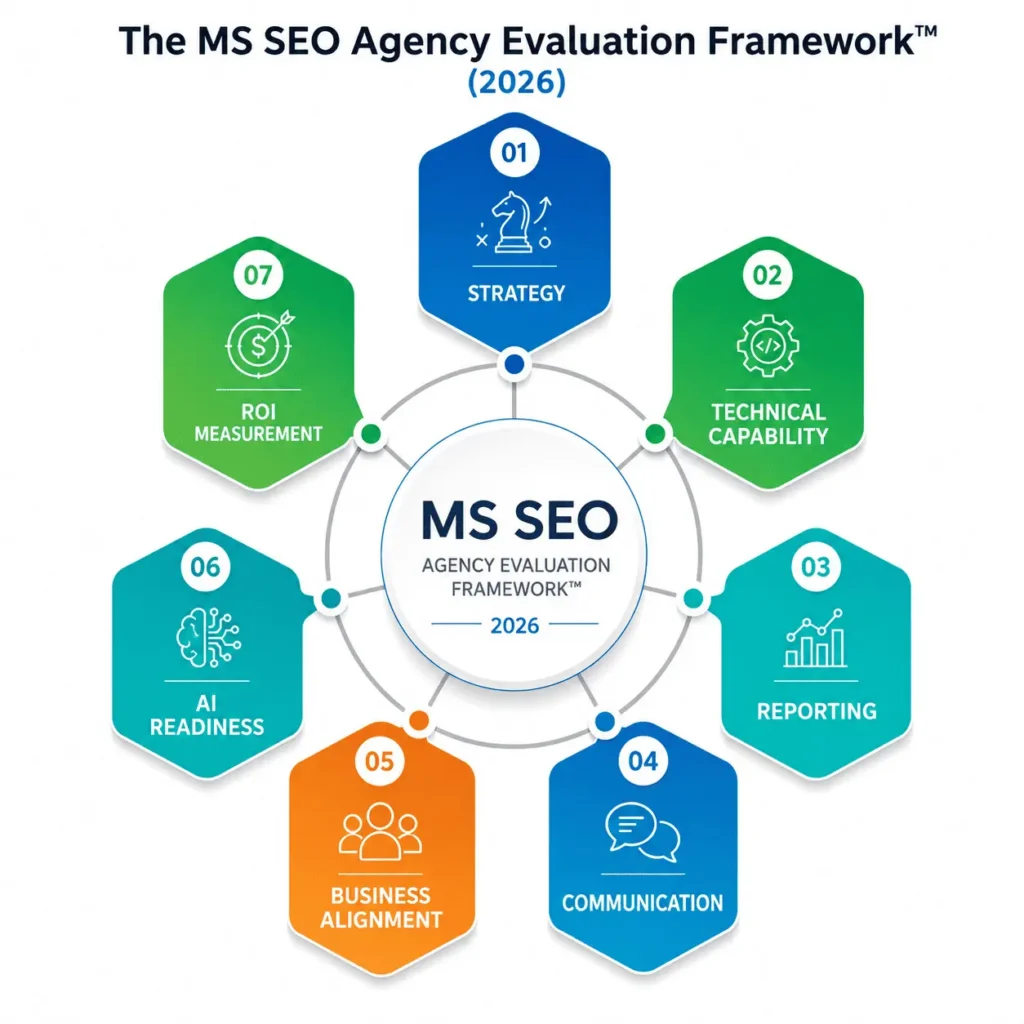
Marketing Scrappers built this framework because most agency-comparison advice online evaluates the wrong things: portfolio size, years in business, client logos. None of those predict whether an agency will move your revenue. This is the same seven-pillar framework we apply internally whenever we’re asked to sanity-check a client’s existing SEO relationship or help them shortlist a new one.
Score any agency you’re evaluating against these seven pillars. An agency doesn’t need a perfect score everywhere — a technical specialist boutique may be thin on paid-media crossover, for instance — but it should be strong on at least five, and it should never be weak on Reporting or Business Alignment. Those two are non-negotiable regardless of specialization.
1. Strategy
What it means: A documented, auditable process for deciding what to work on, not a fixed monthly package of activities.
What good looks like: They run (or propose) an audit before quoting a scope. They can explain why they’d prioritize technical fixes over content, or content over links, for your specific site — and that answer changes from client to client. They map keywords to buyer search intent (awareness, consideration, decision), not just search volume.
What to ask: “Walk me through how you’d decide what to work on first for our site, before you’ve seen it.” If the answer is a generic list of deliverables rather than a diagnostic process, they’re selling a package, not a strategy.
2. Technical Capability
What it means: Genuine fluency in crawlability, indexation, site architecture, Core Web Vitals, and structured data — the infrastructure layer and technical SEO capabilities that determine whether anything else they do can work.
What good looks like: They can describe, unprompted, how they’d check whether your key pages are actually indexed, not just ranking. They understand the difference between a page being crawlable and a page being worth crawling.
What to ask: “How would you find out right now whether Google can actually see and index our most important pages?” Vague answers here are disqualifying — this is the one pillar with almost no room for hand-waving.
3. Reporting
What it means: Reporting built around outcomes you can act on, not activity you have to trust.
What good looks like: Reports tie directly to business metrics — leads, qualified pipeline, bookings, revenue-adjacent events — not just rankings and sessions. You retain full ownership and access to your own Google Search Console and GA4 properties from day one.
What to ask: “If I asked you to show me exactly how last month’s work affected leads or revenue, not traffic, what would that report look like?” An agency that can only point to rising line charts of clicks and impressions is reporting on their own activity, not your outcomes.
4. Communication
What it means: Direct, consistent access to the people actually doing strategic thinking on your account — not just the people who sold it to you.
What good looks like: The person running your strategy is reachable, not rotated out after onboarding. They ask you questions about your business — your sales process, your customers’ objections, your competitive landscape — rather than only asking for login access.
What to ask: “Who will actually be making strategic decisions on our account day to day, and can I talk to them now?” A senior-partner sales pitch followed by a junior account manager handoff is one of the most common and most avoidable disappointments in this industry.
5. Business Alignment
What it means: An agency that understands your revenue model well enough to prioritize the SEO work that actually affects it — not just the SEO work that’s easiest to report on.
What good looks like: They ask about your ICP, your average deal size, your sales cycle, and what your customer-facing team hears in real conversations, before proposing keyword targets. They can explain why a lower-volume, high-intent keyword might matter more to your business than a high-volume awareness term.
What to ask: “How would you decide whether to target a high-volume informational term or a lower-volume term closer to a purchase decision?” If they don’t ask about your business model before answering, the alignment isn’t there yet.
6. AI Readiness
What it means: A working methodology for AI Search Optimization (GEO) and Answer Engine Optimization (AEO) — supported by something more than a claim.
What good looks like: They can show you, live, whether your brand (or theirs) currently gets cited in ChatGPT, Perplexity, Gemini, or Google’s AI Overviews for relevant queries, and explain the Entity SEO, schema, and content-structure work behind improving that. If they can’t demonstrate it for their own brand, be skeptical they can deliver it for yours.
What to ask: “Show me a real example of your content getting cited by an AI answer engine — yours or a client’s, right now.” AI-search expertise claimed without a single verifiable example is one of the fastest-growing red flags in this industry, precisely because it’s currently the hardest area for buyers to fact-check on their own.
7. ROI Measurement
What it means: Realistic timelines and a specific, agreed method for connecting SEO activity to business value.
What good looks like: They set expectations in the range the data actually supports — early movement by month four to six, compounding value from month six onward — rather than promising fast wins to close the deal. Contract terms are reviewed against pre-agreed KPIs, not locked in regardless of performance.
What to ask: “What specifically would need to be true at 90 days for you to call this engagement on track?” An agency that can’t answer this before you sign will struggle to answer it convincingly after.
Following this framework is the single most critical step in learning how to choose an SEO agency that drives genuine business results.
Agency Types Compared
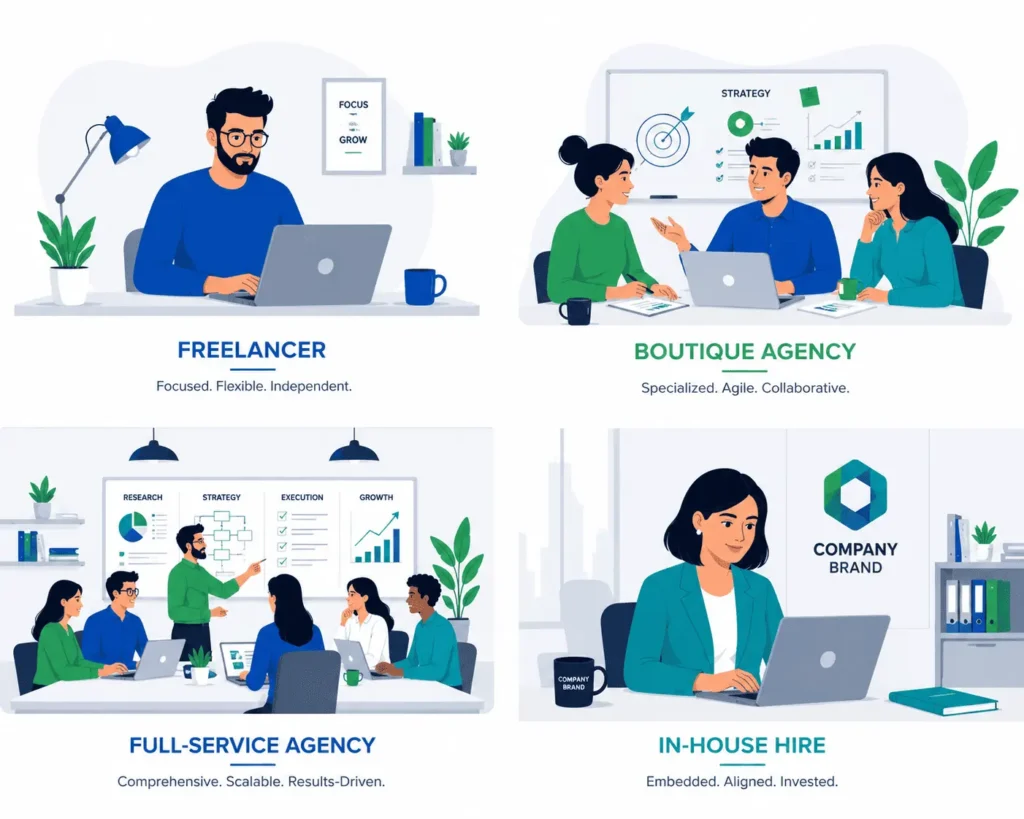
Not every business needs the same shape of partner. Use this as a starting filter before you evaluate individual agencies against the framework above.
| Freelancer / Solo Consultant | Boutique / Specialist Agency | Full-Service Agency | In-House Hire | |
| Typical monthly cost | $500–$3,000 | $1,500–$10,000 | $5,000–$50,000+ | Salary + tools, no retainer |
| Best fit | Single-location local business, tight scope, hands-on owner | Mid-market B2B/SaaS or a defined vertical (e.g. hospitality, healthcare) | Enterprise, multi-channel budgets, regulated industries | Companies with enough scope to justify a full-time role |
| Technical depth | Varies widely — vet carefully | Usually strong within their niche | Strong, but may be spread across many disciplines | Depends entirely on the hire |
| AI-search readiness | Rarely a differentiator yet | Increasingly a core differentiator for good ones | Mixed — often bundled generically into “digital” packages | Depends entirely on the hire |
| Speed to redirect strategy | Fast — one decision-maker | Fast to moderate | Slower — more internal process | Fast, but limited by one person’s bandwidth |
| Biggest risk | Bandwidth and continuity if they get busy or unavailable | Scope mismatch if your needs outgrow the niche | Generic execution, junior handoff after sales | Skill ceiling and lack of outside perspective |
If your business needs specialized strategy without full execution overhead, SEO consulting services offer a lean alternative. If you need multi-channel coordination at scale, a full-service agency’s overhead starts to earn its keep. A freelancer or an in-house hire makes sense mainly when the scope is narrow enough for one person to own it end to end.
SEO Pricing in 2026: What’s Realistic
Pricing surveys converge on a wide but consistent picture. Ahrefs’ 2026 survey of active SEO providers put the average monthly retainer around $3,200, while a separate 2026 survey of 300-plus agencies found roughly half operating in the $1,500–$5,000 range, with about 43% pricing under $1,500 and only a small minority above $5,000. Search Engine Journal’s State of the SEO Agency research places roughly a third of businesses in the $1,000–$5,000 band.Enterprise and regulated industries (legal, healthcare, finance, SaaS) routinely exceed $10,000 and can run past $50,000 for the largest, most competitive programs.
| Business size | Typical realistic range (2026) |
| Local / single-location | $500–$2,500/mo |
| Small business, national competition | $1,500–$5,000/mo |
| Mid-market B2B / SaaS | $3,000–$10,000/mo |
| Enterprise / regulated industry | $10,000–$50,000+/mo |
Two pricing traps are worth naming directly. First, a quoted range like “$3,000–$15,000 a month” is not one product with a sliding scale — it typically spans two incompatible business models: a lower tier that’s largely execution-and-maintenance, and a higher tier that includes genuine strategic ownership, deeper content production, and dedicated technical resourcing. Ask exactly what changes at each price point, not just how much more you get. Second, AI-assisted delivery has genuinely lowered the labor cost of routine SEO tasks by an estimated 20–30%. That’s a legitimate reason for a lower quote — but only if the agency can explain what’s automated and what still gets human strategic review. A low price with no explanation of what’s been automated away is a scope question you haven’t asked yet, not a bargain.
15 Questions to Ask Before You Sign
Run these in the first call. An agency worth hiring will welcome all fifteen.
- Can you walk me through your process for auditing a new client before proposing a scope of work?
- What specific KPIs would you tie our contract renewal to, and how do we measure them?
- Who exactly will work on our account day to day, and can I meet them now — not after signing?
- Will we retain full ownership and admin access to our Google Search Console, GA4, and CMS accounts?
- Can you show a real example of content you’ve produced getting cited in an AI answer engine?
- How do you decide between targeting high-volume awareness keywords versus lower-volume, higher-intent terms?
- What’s a realistic timeline for measurable movement, and what does “measurable” mean specifically?
- How do you source backlinks, and will you disclose exactly where links are placed?
- What’s included in the quoted price versus billed separately (content production, technical fixes, paid media crossover)?
- What’s the contract length, and what’s the exit process if we’re not satisfied?
- Can we speak to a current client about communication and reporting specifically — not just results?
- How do you use AI tools in your own content and research process, and where does human review sit in that process?
- How will you report on business outcomes (leads, pipeline, bookings) rather than just traffic and rankings?
- What happens to our content, data, and historical reporting if we end the engagement?
- What would make you tell us SEO isn’t the right investment for us right now?
That last question matters more than it looks. An agency willing to say “not yet” or “not this budget” is telling you something a agency chasing every prospect never will.
Red Flags That Should End the Conversation
Some signals are severe enough that no amount of a good sales pitch should override them.
- Guaranteed rankings or a fixed timeline to page one. As outlined in Google’s official guidance on hiring an SEO, no one can guarantee a #1 ranking on Google. This is one of the oldest red flags in the industry and it hasn’t gone away.
- Refusal to disclose link sources, or a fixed monthly link quota sold like a subscription. Quality and relevance matter more than volume; bulk link packages and private blog networks (PBNs) risk manual penalties that can take far longer to recover from than they took to cause.
- Data or account “hostage” behavior — the agency owns your Search Console, GA4, or domain-level access rather than granting you administrative rights. If they control your data, they control your ability to leave.
- AI-search expertise claimed with zero verifiable proof. In 2026, this has become one of the fastest-growing red flags precisely because it’s hard for buyers to fact-check without already knowing the space. Ask for a live, specific example — not a slide.
- Long lock-in contracts with no performance benchmarks. A 12-month commitment with no review checkpoint protects the agency, not you. Confident agencies tie renewal to results on a shorter cycle.
- Sales-to-delivery bait-and-switch. You meet the founder or a senior strategist during the pitch; after signing, your account is handed to someone with no visible decision-making authority and no direct line to the people who sold you.
- Reporting that never changes month to month, filled with charts but no explanation of what specific work happened and what it changed. A 50-slide deck is not the same thing as an answer.
- No questions about your business before or during the proposal — no interest in your customers, your sales process, or what your team actually hears from prospects. An agency that skips this step is selling a template, not a strategy.
The Evaluation Process, Step by Step
- Define your goals in business terms before you talk to anyone. Not “rank higher” — specify what a good outcome looks like in leads, bookings, or revenue-adjacent actions, and over what timeframe you’re willing to judge it.
- Shortlist three to five agencies that match your business type, using the comparison table above as a first filter. Prioritize agencies with demonstrated depth in your vertical over generalists with a broader but shallower portfolio.
- Run every finalist through the fifteen questions and the seven-pillar framework. Score each pillar on a simple scale (strong / adequate / weak) rather than relying on gut feel from the pitch alone.
- Request a paid trial engagement or a standalone audit before a full retainer, if the agency offers one. A focused, time-boxed diagnostic — a technical crawl, an AI-visibility baseline, a conversion-friction review — tells you far more about how an agency actually works than a sales deck does, and it caps your risk while you find out.
- Check a reference specifically about communication and reporting, not just results. Results depend on many variables outside any agency’s control; communication quality is something you can verify directly and it predicts your day-to-day experience far more reliably.
- Put the agreed KPIs, timeline, and review checkpoints in the contract itself — not in a slide deck that never gets referenced again. If it isn’t written down, it isn’t a commitment.
📊 Download: The SEO Agency Evaluation Scorecard
Evaluate your shortlisted agencies using our plug-and-play scoring template. Compare vendors across all 7 framework pillars, score sales responses, and identify red flags before signing.
Download Free Evaluation Scorecard (PDF/XLS)When to Fire Your SEO Agency
Signs It’s Time to Re-Evaluate
- No measurable movement past a realistic timeline with no explanation. Real SEO programs typically show early movement by month four to six; flat performance well past month nine with no clear reason is a genuine problem, not just a slow month.
- Reporting stays vague or identical month over month, tracking rankings and traffic with no tie to leads, bookings, or revenue.
- You don’t have full administrative access to your own Search Console, GA4, or CMS — or the agency is slow to grant it when asked.
- Communication degrades after onboarding — slower responses, no proactive updates, strategic questions met with vague reassurance instead of specifics.
- The agency avoids explaining its methods when asked directly, or the explanation changes depending on who you ask.
- Scope creep without added value — new deliverables appear on invoices without a corresponding case for why they matter to your goals.
One complaint in isolation is worth a direct conversation. Three or more at once, sustained across two reporting cycles, is a decision point — not a debate.
Before You Fire Them: A Short Checklist
- [ ] Read the contract. Confirm the notice period, termination clauses, and what happens to work-in-progress.
- [ ] Confirm ownership of your domain, CMS, Search Console, GA4, and any paid tools registered under the agency’s account.
- [ ] Document the specific gap between what was promised (in writing, ideally) and what was delivered — this protects you if there’s a dispute over remaining fees.
- [ ] Request a full data export: historical rankings, backlink profiles, content briefs, and reporting history. You paid for this data; it should leave with you.
- [ ] Change credentials on every account within 24–48 hours of the termination notice taking effect, especially if access was ever shared rather than granted as a separate admin role.
- [ ] Brief the incoming team or hire with the exported history so nothing restarts from zero.
Common Mistakes Buyers Make
- Hiring on price alone. The cheapest quote and the most expensive quote can both be a bad fit; price tells you almost nothing without a scope comparison.
- Accepting a ranking guarantee as a sign of confidence. It’s the opposite — it signals either inexperience or tactics likely to trigger a penalty.
- Signing before KPIs are defined in writing. Without agreed metrics, “it’s working” and “it’s not working” both become matters of opinion.
- Evaluating only on past results, without checking whether an agency’s current methodology accounts for AI search — a portfolio built entirely on pre-2024 tactics may not predict future performance.
- Believing AI-visibility claims with no proof, or dismissing AI search entirely because it feels unproven. Both extremes are currently common, and both are wrong.
- Treating a 12-month contract as standard rather than negotiable. Many agencies will offer shorter initial terms if asked directly.
Best Practices: The Short Version
- Score every finalist against all seven framework pillars — not just the ones that came up naturally in the sales call.
- Insist on full account ownership from day one, in writing.
- Get a specific, numeric definition of “working” at 90 days, before you sign.
- Ask for one live, verifiable example of AI-search citation — theirs or a client’s — not a claim.
- Tie contract renewal to performance checkpoints, not a fixed long-term lock-in.
- Talk to a current client about communication and reporting, specifically, not just outcomes.
Frequently Asked Questions
How much should an SEO agency cost in 2026? Most small and mid-sized businesses pay between $1,500 and $10,000 per month, depending on competitiveness and scope, with enterprise and regulated industries often exceeding that. Industry surveys put the average retainer around $3,000–$3,200 per month. Price alone tells you little without knowing exactly what’s included at that price point.
How long does it take to see results from an SEO agency? Most legitimate programs show early, measurable movement within four to six months, with compounding results from month six onward. Anyone promising page-one rankings within weeks is either overpromising or planning to use tactics that risk a penalty.
Is it normal for an SEO agency to guarantee specific rankings? No. No agency controls the algorithm closely enough to guarantee a specific position for a specific keyword. This is one of the most consistent, well-documented warning signs in the industry — treat it as disqualifying, not as confidence.
Should I sign a 12-month contract with an SEO agency? Be cautious of long lock-ins with no performance review built in. Many capable agencies offer 30–90 day initial terms specifically because they’re confident enough to demonstrate progress before asking for a longer commitment.
What’s the difference between an SEO agency, a freelancer, and an in-house hire? A freelancer offers flexibility and lower cost but depends on one person’s bandwidth and range of skills. An agency offers broader capability and continuity but varies enormously in quality and specialization. An in-house hire offers full-time focus but is capped by that individual’s skill set, with no outside perspective unless you also budget for one.
How do I know if my current SEO agency is underperforming? Look for stalled results well past a realistic timeline, vague or unchanging reports, restricted access to your own data, and declining communication after onboarding. Any one of these deserves a direct conversation; several together, sustained over two reporting cycles, is a legitimate reason to move on.
Does an SEO agency need to understand AI search and GEO in 2026? Yes. A meaningful and growing share of buyer research now happens inside AI answer engines before a traditional search result is ever viewed. An agency with no methodology for AI-search visibility — and no way to prove it — is running an incomplete strategy, regardless of how strong its traditional SEO results look.
What should I do before firing my SEO agency? Review your contract for notice periods and termination terms, confirm you have full ownership of your domain and analytics accounts, document the specific gap between what was promised and delivered, and request a complete data export before the relationship ends.
Need a Second Opinion on Your Current SEO Setup?
Before you sign a new retainer or extend an existing contract, let our strategists run a neutral, diagnostic audit of your site. We’ll uncover technical blockers, evaluate your current AI visibility, and tell you honest benchmarks — no aggressive sales pitch attached.
Request a Free Technical & Strategy AuditNext Step
Deciding how to choose an SEO agency is easier with a structured scorecard — including your current one — is easier with a structured scorecard than with a gut feeling after a good sales call. Marketing Scrappers built the Scrapper Growth Engine™ SEO Agency Evaluation Scorecard as a downloadable version of the seven-pillar framework above, so you can score any agency the same way, side by side.
If you’re not sure whether your current program is actually working, an outside technical and AI-visibility read is usually more useful than another internal debate about it — that’s what a Free SEO Audit is for.