
Keyword Cannibalization Consolidation: Complete SEO Guide to Recover Rankings (2026)
Keyword cannibalization consolidation is the process of identifying pages on your own site that compete for the same search intent, selecting the strongest URL, merging the overlapping content into it, preserving authority through a 301 redirect or canonical tag where appropriate, rebuilding internal links around the survivor, and monitoring performance until one authoritative page ranks instead of several competing ones. It is not a one-time cleanup task. It is a recurring discipline that gets more important, not less, as your content library grows.
If you manage more than a few dozen pages, you almost certainly have some version of this problem right now. The question isn’t whether it exists — it’s whether it’s actually costing you anything, and if so, what to do about it.
What Is Keyword Cannibalization Consolidation?
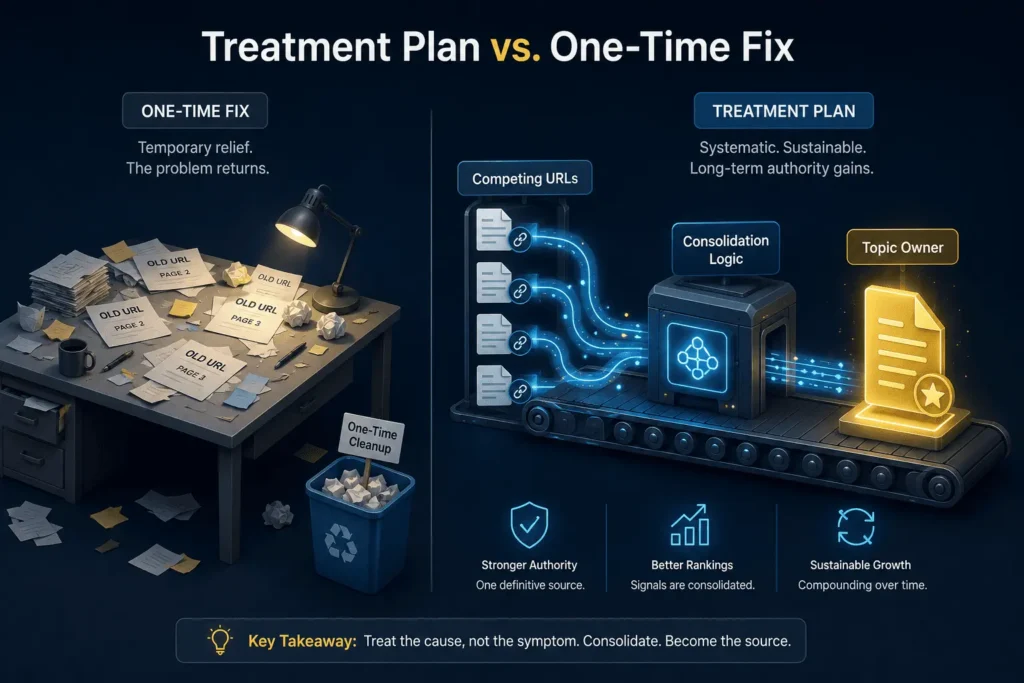
Diagnosis vs. Operational Treatment Plan
Happens when two or more pages on the same domain target the same primary keyword and the same dominant search intent. Instead of one page building a single, strong ranking signal, the signal splits across multiple URLs. Search engines — and increasingly, AI answer engines — are forced to choose between your own pages, and they don’t always choose the one you’d pick.
How Keyword Cannibalization Dilutes Ranking Signals
Is the fix. It’s the deliberate process of resolving that competition by combining, redirecting, or clearly re-scoping the pages involved so that exactly one URL owns the topic.
The two terms get used almost interchangeably, but the distinction matters operationally: cannibalization is the diagnosis, consolidation is the treatment plan. This guide focuses on the treatment — the decision logic and the step-by-step workflow for merging competing pages without losing the rankings and links you’ve already earned. For a shorter definitional reference, see the Keyword Cannibalization glossary entry.
Cannibalization is frequently confused with generic duplicate content, but they aren’t the same thing. Two pages can be technically unique — different words, different structure — and still cannibalize each other if they’re answering the same question for the same searcher. Google’s own canonicalization documentation is written primarily around near-identical or duplicate content; cannibalization is broader, and it’s an authority problem as much as a duplication problem.
Why This Costs More in 2026 Than It Did Two Years Ago
The classic cost of cannibalization is ranking instability. When Google’s index clusters two of your pages as answering the same query, it has to pick one to show — and it can flip between them from one crawl to the next. Neither page accumulates the clicks, dwell time, or engagement history it needs to climb, because the traffic that would build that history is split between two URLs.
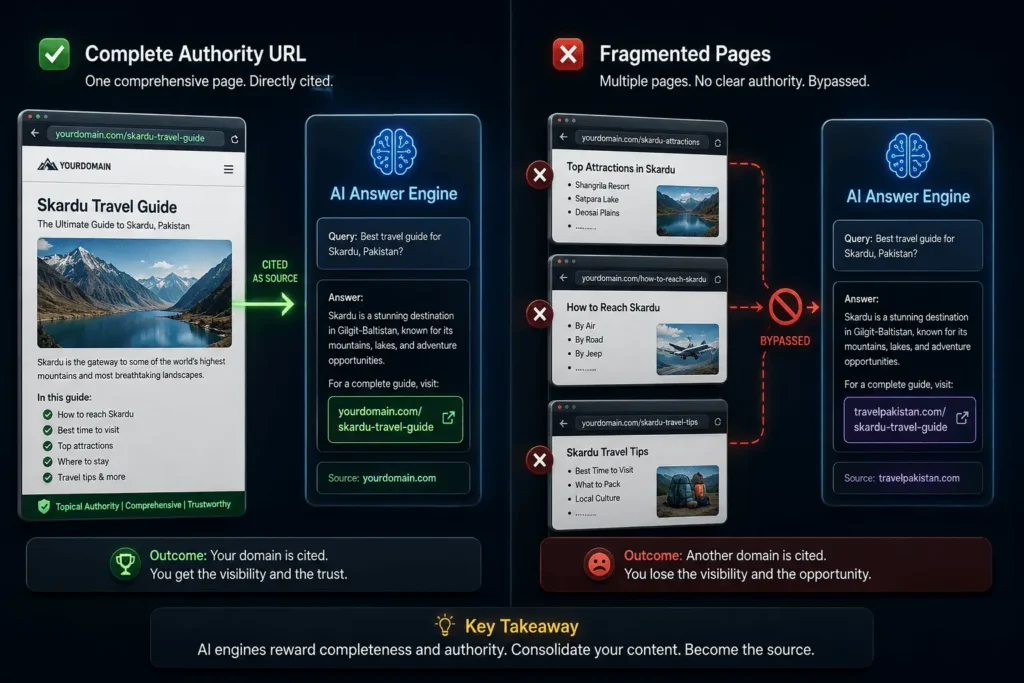
That cost hasn’t gone away. But a second cost has become at least as significant: AI citation loss.
When an AI answer engine — Google’s AI Overviews and AI Mode, ChatGPT, Perplexity, Gemini — evaluates your site as a possible source, it’s looking for one clear, complete, authoritative page on the topic. If it finds three of your pages each partially answering the question, it usually doesn’t average them or pick a favorite. It skips your domain and cites a competitor whose content architecture is cleaner. Several 2026 SEO analyses of this exact pattern converge on the same conclusion: fragmented internal coverage doesn’t just dilute rankings, it actively removes you from consideration as a citable source.
This matters because the ground under organic click-through has shifted. By MS’s internal tracking, roughly 48% of queries now surface an AI-generated answer, up sharply from a year earlier, and position-1 organic click-through on AI Overview queries has fallen from around 27% to as low as 11% in some verticals. Pages that are cited inside an AI Overview, however, see meaningfully more clicks than an uncited #1 result. Consolidation is one of the few levers that directly increases the odds of being the cited page rather than the invisible one. Our State of SEO 2026 research covers this shift in more depth.
There’s also a more advanced version of this problem worth knowing about even if you don’t act on it yet: prompt-level cannibalization. Classic keyword cannibalization is a page-level contest — two URLs targeting the same keyword. Answer engines, however, often resolve at the passage level. Two pages that target different keywords can still both be partially eligible to answer the same AI prompt, splitting citation share in a way that’s invisible to traditional keyword-overlap audits. If you’re already running the audit in this guide and finding nothing, and your AI citation rate still isn’t moving, this is the next layer to investigate.
Real Cannibalization vs. Healthy Topical Overlap
Before you consolidate anything, confirm you actually have a problem. This is the step most guides skip, and skipping it is how good pages get destroyed by well-intentioned “cleanup.”
Independent analysis of large datasets by Ahrefs’ keyword cannibalization research has found that the large majority of pages that appear to overlap in keyword-ranking reports are not true cannibalization at all — they’re healthy topical diversification, with each page earning traffic from a slightly different angle on a broader subject. Only a small fraction of flagged overlaps represent a genuine conflict worth fixing.
Use this test before you touch anything:
Intent Matching & Entity Ownership
- The pages target the same primary keyword or a tight cluster of near-identical variants.
- The pages serve the same dominant search intent — both informational, both transactional, etc
- The pages sit at the same buyer awareness stage — neither one is clearly the “what is X” version and the other the “how to implement X” version.
When Multiple Rankings Are Actually Beneficial
- The pages rank for an overlapping keyword but answer genuinely different questions (a pillar guide vs. a narrow how-to).
- One page is Problem Aware content and the other is Product Aware content — they belong at different points in the same journey, not in competition.
- The overlap is a handful of shared secondary keywords, not the primary target.
This distinction is exactly why Marketing Scrappers assigns every page a single primary entity and a single dominant intent before it’s written — see the Topical Authority guide for how that ownership model prevents this problem at the source rather than cleaning it up after the fact.
Real Cannibalization vs. Healthy Topical Overlap
Cannibalization is rarely intentional. It’s almost always a byproduct of growth without a governing structure. The most common causes:
- Publishing without a keyword map. New content gets created around a keyword that’s already owned by an existing page, because nobody checked first. See the Keyword Research guide for the mapping process that prevents this.
- Chasing every keyword variant as its own page. Treating “content consolidation SEO,” “SEO content consolidation,” and “merge competing pages SEO” as three separate content opportunities instead of three modifiers of one canonical page.
- Site migrations and redesigns. Old URLs get rebuilt as new ones without redirects, and both versions stay indexed and competing.
- Multiple contributors over time. Different writers, freelancers, or agencies touch the same site across years without a shared content inventory.
- Category, tag, and archive pages competing with cornerstone content. A WordPress tag archive can genuinely outrank — or split traffic with — the pillar page it was meant to support.
- Regional or format duplicates. The same core content published as a blog post and later re-published as a landing page, both left live.
How to Detect Keyword Cannibalization
A cannibalization audit takes under an hour for most sites and should be run quarterly, not just when rankings drop.
| Signal | What it means | Where to check |
| Multiple URLs ranking for one query | Google is actively splitting the signal across your own pages | Search Console → Performance → filter by query → Pages tab |
| Position “flip-flopping” for the same query | Google can’t settle on a canonical answer within your site | Rank tracker’s historical position view, or GSC’s date-range comparison |
| A site:yourdomain.com “exact phrase” search returns more than one clearly competing result | Confirms overlap outside of GSC’s sampling | Manual search operator check |
| Declining CTR with stable or rising impressions | Users are landing on the wrong page in the cluster and bouncing | GSC Performance, compared over 3–6 months |
| Inconsistent internal linking to the topic | Some pages link to URL A, others to URL B — no consensus on the authority page | Site crawl (Screaming Frog or similar), filtered by anchor text |
| AI Overview or AI Mode citations absent for a query you should own | AI systems found no single definitive page and skipped your domain | Manual prompt testing across ChatGPT, Perplexity, Gemini, Google AI Mode, cross-referenced with GSC’s AI performance report |
Run this check against your 15–20 most commercially important queries first. That’s where the cost of leaving cannibalization unresolved is highest, and where a fix pays back fastest. For the technical side of confirming index status and crawl behavior on the affected URLs, see the Technical SEO guide.
The MS Content Consolidation Framework™
Once you’ve confirmed genuine cannibalization, resolving it is a sequence, not a single action. Skipping a stage is the single biggest reason consolidation projects lose rankings instead of recovering them.
Audit → Intent Analysis → Authority Evaluation → Consolidation → Redirect → Internal Linking → Validation → Performance Monitoring
Stage 1 — Audit
List every URL that could plausibly be involved in the conflict, not just the two most obvious ones. Pull each page’s current rankings, impressions, clicks, backlinks, and indexation status. Include pages that rank inconsistently or intermittently — those are often part of the same cluster even if they don’t show up in every report. The output of this stage is a single spreadsheet: one row per URL, with its current performance baseline. Capture this baseline before you change anything, or you’ll have no way to prove the fix worked.
Stage 2 — Intent Analysis
For every URL in the audit, confirm the search intent and buyer awareness stage using the test in the section above. This is where you separate genuine cannibalization from healthy diversification. Any page that turns out to serve a distinct intent gets removed from the consolidation list — it should be differentiated, not merged. What remains is your true conflict set.
Stage 3 — Authority Evaluation

Among the confirmed conflict set, identify which URL should survive. This is not automatically the highest-ranking page. Weigh:
- Current organic traffic and ranking position
- Referring domains and link equity
- Content depth and completeness relative to the topic
- URL structure (does it fit the site’s information architecture, or would the winner need a URL change too?)
- Historical authority — an older page with an established index history often has an edge over a newer one, even at similar current rankings
The survivor should be the page you’d want a competitor to have to beat, not just the one currently ahead by a small margin.
Stage 4 — Consolidation
Merge the strongest, most useful sections from every losing page into the survivor. This is content work, not copy-paste work — the goal is a single page that’s more complete than any of the originals, not a longer page that’s simply the sum of its parts. Remove redundant sections, resolve any contradictions between the source pages, and make sure the merged page still satisfies one clear primary entity and intent. See the Content Optimization guide for the editing standard this merge should meet.
Stage 5 — Redirect
Once the survivor is updated, apply a 301 redirect from every losing URL to it. A 301 is the correct default for true cannibalization because it’s a permanent move. According to Google Search Central guidelines on redirects
, permanent redirects transfer ranking signals directly to the target URL. Reserve the canonical tag for cases where you have a specific technical reason to keep the losing URL live (for example, a required legacy path for external systems) rather than as a substitute for actually merging the content. The Technical SEO guide covers redirect implementation and the common configuration mistakes that break this step.
Stage 6 — Internal Linking
Find every internal link that currently points to a losing URL and update it to point directly to the survivor. Don’t rely on the redirect to carry this weight — a page reached through a chain of redirects passes less signal than one linked to directly, and directly-updated links also give users a cleaner experience. This is the stage most consolidation projects skip, and it’s usually why an otherwise correct merge underperforms. See the Internal Linking guide for a systematic approach to finding and fixing these links across a full site.
Stage 7 — Validation
Confirm the technical implementation is clean before you consider the work done: the redirect returns a proper 301 (not a 302, not a redirect chain), the survivor page is indexed and not accidentally blocked, no orphaned internal links remain, and the merged content doesn’t introduce a new cannibalization conflict with a different page. Request re-indexing of the survivor through Search Console.
Stage 8 — Performance Monitoring
Track the survivor’s rankings, impressions, clicks, and — where relevant — AI citation rate against the pre-consolidation baseline from Stage 1. Google has stated that re-evaluating a duplicate content cluster can take up to two weeks even after the underlying issue is fixed; give the change at least four weeks before drawing conclusions, and expect meaningful movement to take four to twelve weeks depending on the query’s competitiveness. If performance hasn’t moved after 90 days, revisit Stage 2 — the intent analysis may have missed something.
Decision Matrix: Which Fix Applies?
Not every conflict resolves the same way. Use this to route each case correctly.
| Approach | Use it when | What happens to authority | Typical timeline to see movement |
| Merge + 301 redirect | Two or more pages share the same intent and none is a clear standalone winner, or one is much weaker | Consolidated onto the surviving URL; the strongest resolution for true cannibalization | 4–12 weeks |
| Canonical tag | Pages are near-duplicates for technical reasons (parameters, printer-friendly versions, syndication) but both must remain accessible | Consolidated for indexing purposes; both URLs stay live | 2–4 weeks |
| Differentiate intent | Pages seemed to overlap but actually serve different awareness stages or sub-intents | No consolidation — both pages are re-optimized around distinct angles and kept separate | 4–8 weeks (re-optimization, not merge) |
| Prune (noindex or delete) | A page is thin, outdated, and contributes nothing the survivor doesn’t already cover better | Removed from the index entirely; any link equity should be redirected first if the page has backlinks | 2–6 weeks |
A quick note on canonical tags specifically: they’re the right tool for genuine duplicate URLs, not a shortcut for avoiding the harder work of merging two pages that are actually different articles competing for the same keyword. Using a canonical tag to paper over unmerged content usually just delays the problem.
What Consolidation Looks Like in Practice
Here’s how the framework plays out on a typical case — a site with three articles all loosely about “on-page SEO checklist,” each written at a different time by a different contributor.
Stage 1 (Audit) shows all three ranking in positions 15–40 for the primary term, with rankings shifting between them week to week. Stage 2 (Intent Analysis) confirms all three share the same intent and awareness stage — none of them is a deeper implementation guide or a narrower sub-topic; they’re genuinely the same article written three times. Stage 3 (Authority Evaluation) selects the oldest of the three as the survivor, since it holds the most backlinks despite not currently ranking highest.
Stage 4 (Consolidation) merges the best checklist items, examples, and structure from all three into the survivor, producing a single page more complete than any predecessor. Stages 5 and 6 redirect the two losing URLs and update roughly a dozen internal links across the site that had been pointing to them. Stage 7 confirms clean 301s and a fresh index request.
By Stage 8, the pattern that typically emerges — consistent with the pattern reported across multiple independent 2026 audits of similar cases — is that the ranking volatility stops first, usually within two to four weeks, followed by a single stable position that’s stronger than any of the three fragmented pages had achieved individually, typically within four to twelve weeks. This is a representative pattern, not a guaranteed outcome for every site — competitiveness of the query and the strength of the merged content both affect the timeline.
This pattern is well-documented externally, too. Backlinko has publicly described consolidating two of its own cannibalizing articles with a 301 redirect and seeing a substantial year-over-year increase in clicks to the surviving page — a useful data point on how much upside a correct consolidation can recover, even though results will vary by site and competitive landscape.
Common Mistakes When Consolidating Cannibalized Pages
- Redirecting the stronger page into the weaker one. Always confirmed by the Authority Evaluation stage, not by which page happens to be open in your CMS.
- Merging pages that actually serve different intents. This is the Intent Analysis stage’s entire purpose — skipping it turns a healthy two-page structure into one confused page that satisfies neither audience well.
- Fixing the redirect but not the internal links. The redirect preserves most signal; direct internal links preserve more. Leaving old links in place is the most common reason a “correct” consolidation underperforms.
- Treating canonical tags as a substitute for merging content. A canonical tag tells search engines which duplicate to index — it doesn’t make two different articles into one better article.
- Expecting results within days. Google’s own documentation notes re-evaluation of a duplicate cluster can take up to two weeks at minimum; meaningful ranking movement typically takes considerably longer.
- Reporting invented “before and after” numbers. If you don’t have a Stage 1 baseline, you cannot honestly claim a specific lift. Capture the baseline first, every time — this is non-negotiable under Marketing Scrappers’ own accuracy standards, and it’s the only way a consolidation result can later become a legitimate case study.
Preventing Cannibalization Going Forward
Consolidation fixes the past. Prevention is a governance habit:
- Maintain a single keyword-to-URL map before any new page is commissioned, and check it as part of your content brief process — see the Keyword Research guide.
- Absorb keyword modifiers into the canonical page instead of spinning up a new page per variant.
- Assign every page exactly one primary entity and one dominant intent before writing begins, and document what it deliberately does not cover — the cannibalization guardrail model described in the Topical Authority guide.
- Review your content inventory quarterly using the detection checklist above, not only when you notice a ranking drop.
- Treat every migration or redesign as a redirect-mapping project first, content-move second.
Frequently Asked Questions
Does keyword cannibalization get a manual penalty from Google? No. There’s no cannibalization penalty. It’s a self-inflicted dilution of your own ranking signals, not a violation of Google’s spam policies. The fix is structural, not punitive.
Should I use a 301 redirect or a canonical tag? Use a 301 redirect when you’re genuinely merging two competing pages into one — it’s the stronger, more permanent signal. Reserve canonical tags for true technical duplicates (URL parameters, syndicated copies) where both versions need to stay accessible.
How long does it take to see results after consolidating? Google’s documentation notes re-evaluation of a duplicate content cluster can take up to two weeks at minimum. In practice, expect four to twelve weeks for full ranking stabilization, depending on the competitiveness of the term and the quality of the merged page.
Can two pages targeting the same keyword ever coexist without hurting each other? Yes — if they serve genuinely different search intents or sit at different buyer awareness stages. The test is intent and awareness overlap, not keyword overlap alone. Most flagged “cannibalization” in large-site audits turns out to be this kind of healthy diversification rather than a real conflict.
Does keyword cannibalization affect AI Overviews and AI citations, not just rankings? Yes. AI answer engines look for one clear, authoritative page per topic. When they find several competing pages from the same domain, they frequently cite a competitor instead of choosing between yours. Consolidation is one of the more direct ways to improve AI citation eligibility, not just traditional rankings.
Should I delete the losing page instead of redirecting it? Only if it has no backlinks and no residual traffic. If it has any external links pointing to it, redirect rather than delete — deleting without a redirect forfeits the link equity entirely.
Key Takeaways
- Cannibalization is a self-inflicted split in your own ranking signal — confirm real overlap in keyword, intent, and awareness stage before treating anything.
- Most flagged keyword overlaps are healthy diversification, not cannibalization. Fixing what isn’t broken can damage a page that was working correctly.
- Consolidation is a sequence — Audit, Intent Analysis, Authority Evaluation, Consolidation, Redirect, Internal Linking, Validation, Performance Monitoring — and skipping the internal-linking step is the most common reason a technically correct fix underperforms.
- The stakes are higher in 2026 than in past years: cannibalization now costs AI citations as well as rankings.
- Give any consolidation four to twelve weeks before judging the result, and always capture a baseline before you start.
Stop Losing Rankings & AI Citations to Competing Internal URLs
Not sure if your site is suffering from true cannibalization or healthy topical overlap? Let our team run a comprehensive content architecture audit on your high-value terms to identify rank-split issues and map your custom consolidation roadmap.
Book Your SEO Architecture AuditNext Step
If you suspect cannibalization is holding back a specific set of pages, the fastest way to know for certain is a structured audit rather than a guess. Marketing Scrappers’ SEO Audit includes a full cannibalization and consolidation review as part of the on-page assessment.