
SHORT DEFINITION
Voice Search Optimization is the practice of structuring website content so voice assistants and AI-powered search systems can accurately interpret, retrieve, and speak back a direct answer. It relies on conversational language, clear entity definitions, structured data, and answer-first writing to remain eligible for selection across voice-enabled and AI-driven search experiences.
EXPANDED DEFINITION
Voice Search Optimization began as a narrow response to smart speakers and mobile voice assistants — Siri, Google Assistant, Alexa — helping content get read aloud as the single spoken result instead of appearing in a list of links. By 2026, that framing is too narrow to be useful on its own.
Search systems do not run a separate index or a separate ranking process for spoken queries. A question asked aloud is interpreted by the same semantic and natural-language models that process a typed or visually-searched query. What has changed is the interface the user chose, not the underlying retrieval logic.
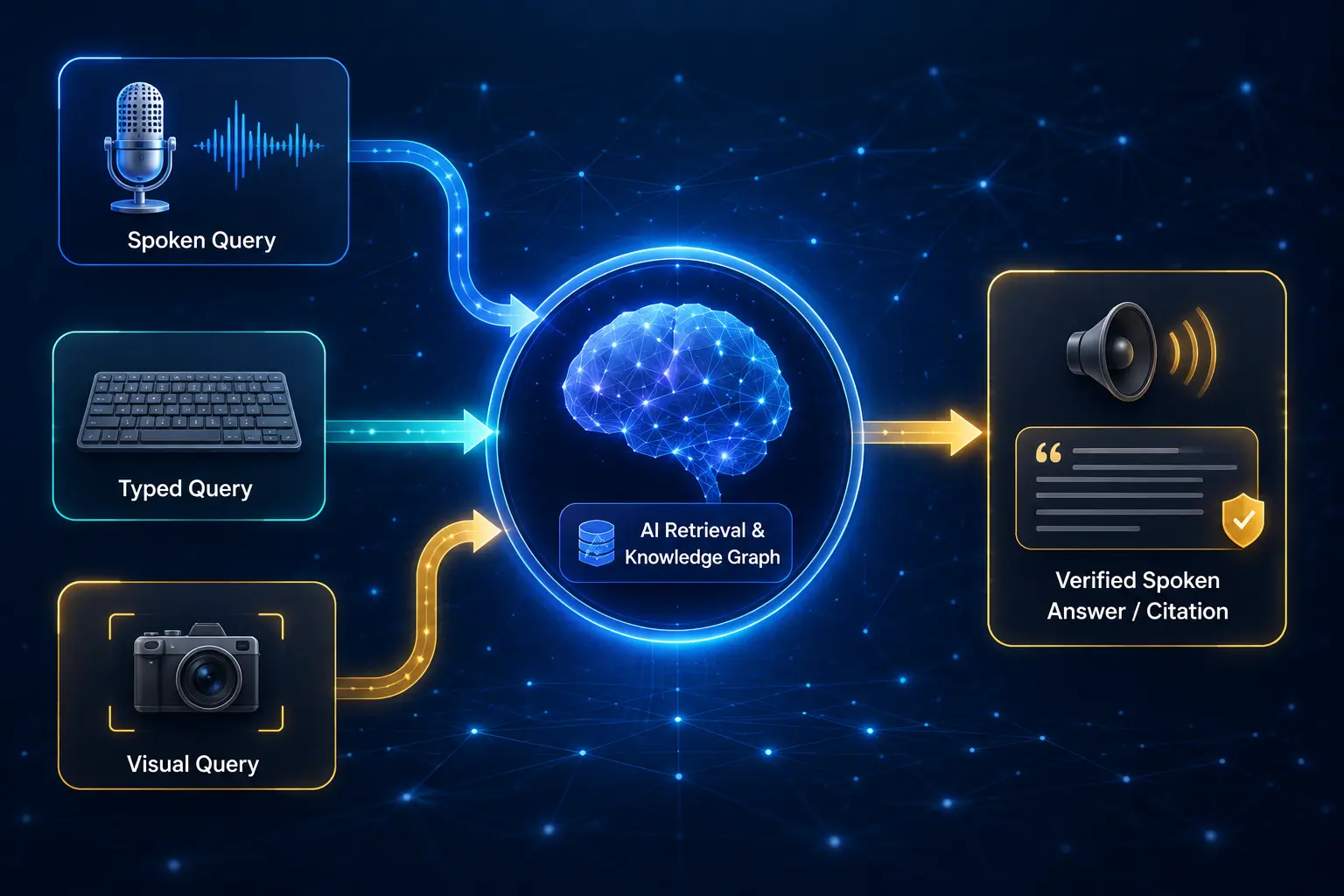
In practice, this means Voice Search Optimization now functions as the spoken-answer layer inside the broader AI Search Optimization discipline (see the parent pillar below). A page becomes eligible to be read aloud by satisfying the same conditions that make it eligible for a featured snippet or an AI Overview citation: an unambiguous entity, a direct answer stated in plain language near the top of the content, and structured data that removes doubt about the facts being spoken, following principles outlined in Google Search Central’s guide on structured data.
At Marketing Scrappers, Voice Search Optimization is treated as one input into the GEO Citation Stack™ methodology — the operating layer governing how content becomes eligible for citation and spoken selection across AI-driven search surfaces. Implementation of that methodology lives on the AI Search Optimization service page, not here.
Ready to implement this framework? Voice Search Optimization is part of our comprehensive GEO Citation Stack™ methodology.
Explore the AI Search Optimization Service →WHY IT MATTERS
Spoken queries are structurally different from typed ones. A typed search might read “hotel Skardu mountain view.” The same intent spoken aloud tends to arrive as a full sentence: “Is there a hotel in Skardu with a mountain view that has rooms available tonight?” Assistants generally return one answer, not a page of options — which makes this a winner-take-most moment rather than a ranking competition.
There is genuine, unresolved debate inside the industry about how much search volume this represents. Some 2026 tracking sources report voice as a meaningfully growing share of all queries. Other, more measured commentary — including from people inside Google’s own developer relations team — argues that isolating “voice” as a distinct channel is increasingly artificial, since the same language models now interpret spoken, typed, and image-based input inside a single conversational session. Marketing Scrappers’ position: the exact percentage matters less than the shift it points to. Whichever way a query arrives, the systems selecting an answer reward the same things — clarity, structure, and an unambiguous entity. Waiting for a settled statistic before acting is optimizing for the wrong question.
For local and transactional businesses — hotels, clinics, service providers — this matters immediately. A large share of spoken queries carry “near me,” “open now,” or “available tonight” intent, which converts directly into calls, direction requests, or bookings when a business is the one selected to answer.
KEY CHARACTERISTICS
- Optimizes for selection as the single spoken answer, not for position within a list of results
- Built on natural, complete-sentence language rather than fragmented keyword phrases
- Runs on the same technical foundation as AI Search Optimization generally — clear entities, structured data, answer-first content — not a separate technical stack
- Frequently intersects with local intent: hours, location, availability, directions
- Draws answers primarily from featured snippets, AI Overview citations, and other direct-answer content already present on a page
- Spans an expanding set of surfaces: smart speakers, mobile assistants, in-car systems, and voice input inside AI chat interfaces
- The outcome is binary at the moment of the query — a page is either the answer spoken aloud or it isn’t
PRACTICAL EXAMPLE
A traveler asks a voice assistant, “Is there a hotel in Skardu with a mountain view that allows late check-in?” The assistant doesn’t read out ten links — it selects one page and speaks a single answer drawn from it. The page most likely to be selected already states its answer plainly (“Yes — mountain-facing rooms are available with check-in until midnight”), defines itself clearly as a specific hotel entity with structured details such as location and amenities, and leaves nothing for the assistant to infer. The competitive question isn’t “how do we rank higher” — it’s “how do we remove every reason the assistant has to guess.”
COMMON MISCONCEPTIONS
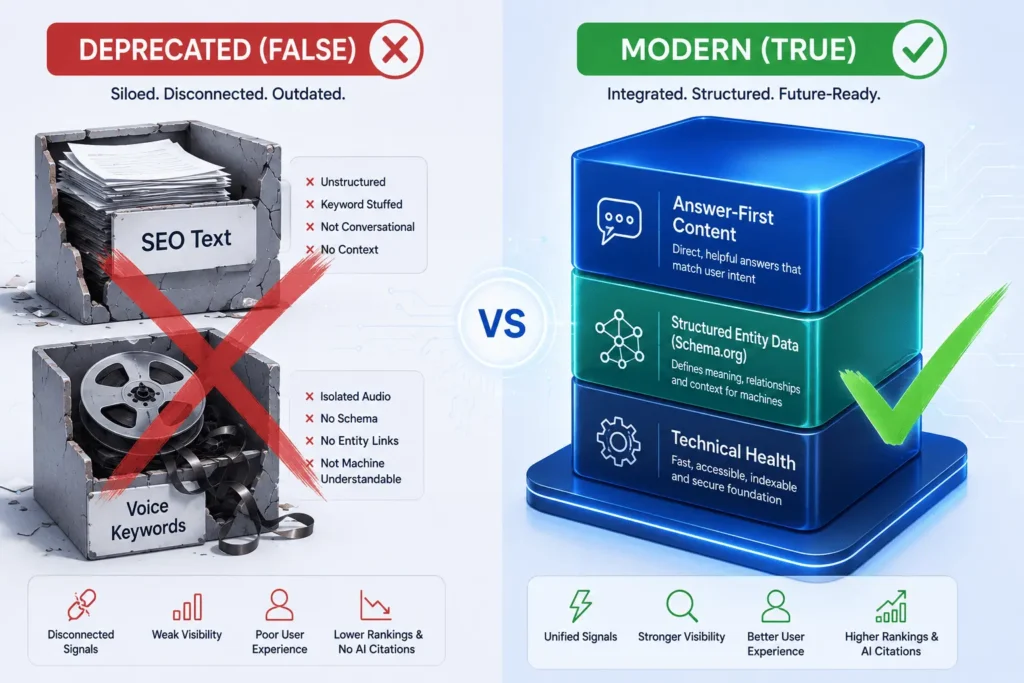
Voice search needs a completely separate technical strategy from SEO.” It doesn’t. Spoken queries are processed by the same language-understanding systems used for typed and visual search. There is no parallel “voice SEO” tech stack to build — there is one AI-ready content foundation that happens to also work when read aloud, as documented in Google’s Speakable documentation.
“Optimizing for voice means front-loading question words like who, what, when, why, how.” Mechanically inserting question phrases is a dated tactic. What matters more in 2026 is matching how people actually phrase problems and comparisons in conversation — not decorating a page with question-shaped headers.
“Voice search only happens on smart speakers.” Smart speakers were the original use case. The surface now includes phones, cars, wearables, and the voice-input option inside AI chat assistants — any interface where a spoken question can be asked.
“More voice activity automatically means more website traffic.” Voice answers are almost always zero-click. The win is being the source the assistant chooses to speak, and the resulting action — a call, a direction request, a booking — not a session logged in analytics.
RELATED ENTITIES
- AI Search Optimization (parent entity) — the umbrella discipline covering how content stays visible across traditional search, AI Overviews, and AI assistants. Voice Search Optimization is the spoken-answer layer within it.
- Conversational Search — the broader shift toward multi-turn, natural-language interaction with search systems. Voice is one input method feeding conversational search, not a separate discipline running alongside it.
- Answer Engine Optimization (AEO) — optimizing content to be selected as the direct answer across answer engines and AI assistants. Voice assistants are one of the surfaces AEO targets.
- Generative Engine Optimization (GEO) — optimizing content for citation inside AI-generated responses. This overlaps with voice search whenever an assistant reads a generated summary aloud rather than a single indexed snippet.
- Natural Language Processing (NLP) — the underlying technology that lets a search system interpret spoken and typed queries as meaning rather than isolated keywords.
- Structured Data — markup that helps a search system or assistant confirm facts, such as hours or location, confidently enough to state them aloud, utilizing technical standards like the Schema.org Speakable specification
- Entity SEO — establishing a business or concept as a clearly defined entity, which reduces the ambiguity an assistant has to resolve before selecting an answer.
- Semantic Search — retrieval based on meaning and context rather than exact keyword matching. Voice queries depend heavily on semantic interpretation because they are phrased conversationally.
- Featured Snippets — one of the primary content formats voice assistants read from when answering a query aloud.
RELATED TERMS
Voice SEO · Voice Search · Conversational Search Optimization · Speakable Content
FAQ
What is voice search optimization? Voice Search Optimization is the practice of structuring website content so voice assistants and AI systems can understand it, retrieve it, and speak it back as a direct answer. It sits inside the broader AI Search Optimization discipline rather than functioning as a separate technical field.
What is an example of voice search optimization? A hotel page that answers “Do you have rooms with a mountain view?” in a plain, direct sentence near the top of the page — supported by structured details like location and amenities — is positioned to be the one answer a voice assistant reads aloud, rather than one of several links a user has to click through.
Is voice search optimization different from regular SEO? Not technically. It draws on the same foundation — structured data, clear entities, answer-first writing — that supports featured snippets and AI Overviews. The difference is the output format: a spoken answer rather than a listed result.
Does voice search optimization still matter in 2026? Yes, though the more useful framing has shifted. Rather than treating “voice” as an isolated channel to chase, it’s one interface inside a single AI-driven search experience that also includes typed and visual queries. Content built for that broader experience is, by extension, built for voice.
How is voice search optimization different from conversational search optimization? Voice search optimization focuses on content being selected as a spoken answer to a single query. Conversational search optimization is broader — it accounts for multi-turn exchanges, follow-up questions, and context carried across an entire session, of which a single voice query is often just one part.
SUMMARY
Voice Search Optimization owns one specific idea: preparing content to be understood, retrieved, and spoken aloud as a direct answer by voice assistants and AI-driven search systems. It is not a separate technical discipline from SEO — it is the spoken-answer expression of the same entity clarity, structured data, and answer-first writing that already govern AI Search Optimization. Businesses with local or transactional intent — where a spoken answer converts directly into a call, a direction request, or a booking — have the most to gain from getting this right. Implementation, technical setup, and strategy live in the AI Search Optimization service and its supporting guide, both linked below.
Take the Next Step in AI Search Optimization
Transform your content eligibility across voice assistants, AI Overviews, and direct conversational answer engines.