Entity SEO & Knowledge Graph Optimization: How to Build an AI-Recognized Brand in 2026
Entity SEO helps search engines and AI systems recognize your organization, people, products, and topics as distinct, connected entities — not just a collection of ranking pages. You build that recognition by combining consistent structured data (Organization and Person schema anchored to a stable @id), a Wikidata entry, citation density across authoritative third-party sources, and internal content that reinforces the same entity relationships site-wide. The result is stronger eligibility for Knowledge Panels, more accurate citations in Google AI Overviews and Gemini, and a brand that AI systems describe correctly without you having to correct them.
That’s the short version. Everything below is the implementation path — the same sequence we run internally at Marketing Scrappers, structured as the Scrapper Growth Engine™ Entity Authority Framework. For the formal definition and terminology, see our Entity SEO glossary entry. This guide picks up where that definition ends: what to actually build, in what order, and how to tell whether it’s working.
Why Ranking Well Isn’t the Same as Being Recognized
Most businesses find this gap the hard way. Their site ranks respectably for the terms that matter. Their content gets indexed, gets traffic, occasionally lands a featured snippet. And yet:
- Searching the company name produces no Knowledge Panel, or one with an outdated description and the wrong founder photo.
- Asking ChatGPT, Gemini, or Perplexity “What does [company] do?” returns a vague, partially wrong, or entirely absent answer.
- A competitor with fewer backlinks gets cited by name in AI Overviews on shared topics… If you’re experiencing a drop in conversational search visibility, review our AI Overview traffic recovery framework.
- Two founders with the same first and last name keep getting merged into one bio, or the company gets confused with an unrelated business that shares its name.
None of this is a rankings problem. It’s a recognition problem. Google’s ranking systems evaluate pages. Its Knowledge Graph — and by extension its AI systems — evaluate entities: whether a name maps cleanly to one specific, disambiguated thing, corroborated by independent sources Google already trusts.
You can rank on page one for years without ever solving this. Entity SEO is the discipline that solves it directly, and in 2026 it has stopped being a nice-to-have. It’s the layer that determines whether AI systems can name you at all.
How Google (and Its AI Systems) Actually Understand Entities
Google’s Knowledge Graph is a structured database of entities — people, organizations, places, products, and concepts — along with the relationships that connect them. It’s separate from Google’s search index of web pages. A page can rank without the entity behind it being resolved in the Graph, and an entity can be well-established in the Graph even if the underlying website isn’t a top performer for competitive keywords. These are two different systems answering two different questions: “which pages match this query” versus “who or what is this.”
As of 2026, Google’s Knowledge Graph is estimated to hold more than 500 billion facts spanning over 5 billion entities, built from a mix of structured sources (Wikidata, Wikipedia, schema.org markup across the web) and Google’s own extraction from crawled content. Google also exposes a Google’s public Knowledge Graph Search API that lets you query whether a given name resolves to a known entity and how confidently — useful, and something we’ll come back to in the measurement section. Two details about that API matter for how you should think about entity work:
- It’s read-only, and Google is explicit that it’s not production-critical infrastructure. You use it to check entity status, not to build a dependent feature on top of it.
- It returns individual matching entities, not a graph of relationships. If you need to understand or reconstruct the relationships between entities, Google’s own documentation points to Wikidata’s structured data dumps instead. This is a strong signal of how central Wikidata is to the underlying architecture — worth remembering when you get to the corroboration stage below.
The part that changes the stakes for 2026 specifically: Gemini, which powers Google’s AI Overviews and AI Mode, is grounded in Google Search and draws on Knowledge Graph context as part of that grounding. Multiple independent 2026 citation studies — with genuinely conflicting numbers on exactly how much weight the Graph carries versus raw organic ranking — agree on the underlying mechanism: entity resolution runs as a distinct step, separate from and prior to the passage-level extraction that produces the actual cited text. A page can be well-written and well-ranked and still lose the citation if the entity behind it can’t be confidently resolved. Entity clarity doesn’t replace content quality or technical SEO. It decides whether your content quality gets attributed to you in the first place.
This is also where Entity SEO connects to Generative Engine Optimization and Answer Engine Optimization: GEO and AEO are about how content gets selected and phrased for AI answers; entity work is about whether the source of that content is even eligible to be named. Our AI Search Optimization service covers the full GEO/AEO methodology — this guide stays focused on the entity layer underneath it.
Knowledge Graph Fundamentals You Need to Operate On
You don’t need a graph-theory background to do this work, but three concepts do all the practical heavy lifting.
Nodes, Edges, and Explicit Relationships
An entity is a node. The relationships between entities — founder, employer, product-of, located-in, sameAs — are edges. Entity SEO is the discipline of making both explicit instead of implicit. A page that mentions your company by name is implicit. A founder property connecting a Person node to an Organization node is explicit.
The entity home
Every entity you want recognized needs one canonical URL that represents it — not five. For your organization, that’s almost always your homepage or /about/ page, never both inconsistently and never a landing page that changes seasonally. For a founder or executive, it’s usually their author or team-bio page. Every other page that references that entity should point back to the same home rather than each declaring its own version of “who this is.”
The Stable @id Anchor
In JSON-LD, @id is the internal anchor that ties every reference to the same node together — commonly written as a URL fragment like https://yourdomain.com/#organization or https://yourdomain.com/#founder-name. Reuse it exactly, on every page, every time you reference that entity in schema. This single habit prevents the most common technical cause of entity confusion: templates that generate a fresh, slightly different Organization block on every page, which reads to Google not as one strong entity but as several weak, competing ones.
Here’s how we mapped this for the article you’re reading, as a worked example of the same process you’ll run for your own brand:
| Role | Entity |
| Primary Entity | Entity SEO |
| Parent Concept | Semantic SEO / Topical Authority |
| Organization Entity | Marketing Scrappers |
| Person Entity | Hassan Sulaimani (Founder & SEO Strategist) |
| Key Supporting Entities | Google Knowledge Graph, Wikidata, Schema.org, sameAs, Knowledge Panel |
| Relationship | Marketing Scrappers → knowsAbout → Entity SEO, Knowledge Graph Optimization → practiced through → structured data, sameAs corroboration, semantic content |
That’s the whole exercise: one primary node, its supporting nodes, and the relationships stated plainly enough that both a reader and a parser can follow them.
Entity SEO vs. Keyword SEO: Where They Diverge
These aren’t competing strategies — they’re solving different problems, and most mature programs need both. If you need help bridging keyword and entity strategies, explore our SEO consulting services.
| Dimension | Keyword SEO | Entity SEO |
| Unit of optimization | Pages and phrases | Concepts and relationships |
| Core signals | On-page keyword usage, backlink anchor text, content depth | Structured data, sameAs corroboration, citation consistency across sources |
| Success metric | Rankings, organic traffic, click-through rate | Knowledge Panel presence, AI citation accuracy, entity resolution confidence |
| Typical failure mode | Cannibalization, thin content, keyword stuffing | Entity fragmentation — the same brand read as several inconsistent, weaker identities |
| Time horizon | Weeks to a few months for movement | Months (commonly 3–12+) — corroboration compounds slowly and can’t be rushed with volume |
| Primary tools | Rank trackers, keyword research platforms | Knowledge Graph Search API, Wikidata Query Service, schema validators, direct AI prompt testing |
The practical implication: if you pour effort into content and links while your entity signals stay fragmented, you can rank well and still be invisible to AI systems asked to name you directly. If you build entity signals while neglecting content and technical SEO, you’ll have a clean identity with nothing worth citing. Both layers need to hold.
When Entity SEO Investment Makes Sense Right Now
Not every business needs to prioritize this today. It’s the right next move if two or more of the following are true:
- Searching your brand name (logged out, incognito) shows no Knowledge Panel, or one with outdated or incorrect information.
- Direct prompts to ChatGPT, Gemini, or Perplexity about your company return vague, wrong, or absent answers.
- You operate under a name that collides with a more common word, place, or another company.
- You’re already generating press and earned media but seeing no compounding SEO or AI-visibility benefit from it.
- You’re heading into a moment — fundraising, an acquisition, category expansion — where being the canonical, unambiguous answer to “what is this company” actually matters commercially.
If none of these apply yet — if you have little to no press footprint and haven’t been mentioned outside your own properties — the honest recommendation is to build citation-worthy visibility first. Entity work corroborates existing signals; it has very little to corroborate if none exist yet.
The Scrapper Growth Engine™ Entity Authority Framework
We run entity work through five stages, in this order, because each stage depends on the credibility the previous one established. Skipping ahead — adding schema before you have anything for it to corroborate, or chasing a Wikipedia page before you have press coverage — is the single most common way this work stalls.
Stage 1 — Entity Foundation
↓
Stage 2 — Structured Data Layer
↓
Stage 3 — External Corroboration (Wikidata & sameAs)
↓
Stage 4 — Semantic Reinforcement (Internal Linking)
↓
Stage 5 — Entity Authority Measurement
Stage 1 — Entity Foundation & Signal Audit
Before touching schema, define what you’re actually optimizing. Write down:
Establishing Entity Homes & Canonical Names
- The one URL that represents your Organization entity, and the one URL that represents each key Person entity (founders, named experts).
- The canonical name — exactly as it should appear everywhere: legal suffix or not, capitalization, abbreviation or full name. Pick one and never deviate.
- Every place your brand currently appears — directories, social profiles, press mentions, review platforms, partner sites. Most businesses have never actually listed this; the audit alone usually surfaces three or four inconsistent name variants they didn’t know existed.
This is also where you catch entity fragmentation before it compounds: name variants (“Acme” vs. “Acme Inc.” vs. a legacy pre-rebrand name still live on old directories), inconsistent descriptions across platforms, or a company address that’s correct on your site but stale on a directory from three years ago. To an algorithm — and to an LLM trying to disambiguate you — these don’t read as minor inconsistencies. They read as evidence that there might be more than one entity here, which is exactly the uncertainty that gets a brand hedged out of a citation.
📄 THE SCRAPPER GROWTH ENGINE™
Get the 1-Page Framework Summary
Want a high-level visual deck of our 5-stage entity authority framework to share with your team?
Stage 2 — Structured Data Layer
Structured data doesn’t create your entity. It confirms one that already has some external credibility, and it removes ambiguity for the systems trying to parse your site. Both things are true simultaneously, and confusing them is the most common wasted effort in this space — teams that implement flawless schema and then wonder why no Knowledge Panel appears, because schema was never going to be sufficient on its own.
The core building block is structured according to the Schema.org Organization specification,is am anchored with a stable @id and connected via sameAs to your corroborating profiles:
{
“@context”: “https://schema.org”,
“@type”: “Organization”,
“@id”: “https://marketingscrappers.com/#organization”,
“name”: “Marketing Scrappers”,
“url”: “https://marketingscrappers.com”,
“logo”: “https://marketingscrappers.com/logo.png”,
“sameAs”: [
“https://www.wikidata.org/wiki/Q_EXAMPLE”,
“https://www.linkedin.com/company/marketing-scrappers”,
“https://www.crunchbase.com/organization/marketing-scrappers”
],
“founder”: {
“@type”: “Person”,
“@id”: “https://marketingscrappers.com/#hassan-sulaimani”,
“name”: “Hassan Sulaimani”,
“sameAs”: [
“https://www.linkedin.com/in/example-profile”
]
}
}
A few implementation rules worth stating explicitly, because they’re where most schema implementations quietly fail:
- Reuse the exact same @id on every page. A template that regenerates a fresh Organization block per page — even with identical content — can read as multiple entities if the @id isn’t consistent.
- Keep a founder’s personal profile out of the Organization’s sameAs array. It belongs on their Person entity, connected back via founder or worksFor. Mixing them muddies both entities.
- Validate every deployment with Google’s Rich Results Test and the Schema.org Validator before it ships. A single malformed property can silently break the whole block.
This is the boundary of what belongs in this guide on the schema side — for full page-level and per-content-type schema implementation (Article, FAQPage, Product, LocalBusiness, and the rest), that’s covered in our dedicated Schema Markup implementation guide. This section stays focused on the entity-specific properties: @id, sameAs, and the Organization/Person relationship.
Need your Entity Schema and Knowledge Graph signals audited?
Stop guessing whether search engines and AI models accurately recognize your brand. We’ll audit your brand footprint, canonical entity home, and schema implementation.
👉 Book an Entity SEO & SEO Audit
Stage 3 — External Corroboration: Wikidata & sameAs
This is the stage that actually moves the needle, and it’s also the one most teams skip because it looks like PR work instead of SEO work. It is PR work. That’s the point — the Knowledge Graph is built to trust independent sources over self-declared ones.
Start with Wikidata, not Wikipedia
Wikipedia’s notability bar rejects most businesses outright — trivial mentions, “top 100” listicles, and sponsored placements don’t count, and a rejected submission makes future attempts harder. Wikidata’s bar is dramatically lower: it accepts entities that can be described using serious, publicly available references — a funding announcement, a Crunchbase profile, a trade-press article, a regulatory filing. You can typically create and structure a Wikidata item for a real, operating business inside a weekend. That item, referenced via sameAs, is one of the cleanest disambiguation signals available, because it feeds the Knowledge Graph directly rather than indirectly through Google’s own extraction.
Structuring sameAs Density in Priority Order
- Wikidata (direct Knowledge Graph feed via Q-number)
- Wikipedia, once genuinely warranted by independent coverage
- LinkedIn (company and founder pages)
- Crunchbase
- Other owned, actively maintained profiles (GitHub, industry directories, trade-body listings relevant to your sector)
Quality beats quantity here. Three to six well-maintained, consistent profiles outperform a long list padded with abandoned or half-completed ones. And the consistency rule is absolute: name, canonical URL, and description need to match, word for word where possible, across every profile in the array. A sameAs link pointing at a dead Facebook page or a Crunchbase draft that was never finished is worse than not including it — it’s an active signal of inconsistency, not a passive gap.
Build citation density alongside the structured signals
Google doesn’t trigger recognition from structured data in isolation — it wants to see your entity mentioned across multiple independent, authoritative sources with a consistent description. Five articles in five different trade publications, each describing you the same way, outweigh fifty mentions in a single outlet. This is the genuinely slow part of the process: for most businesses that do Stages 1–3 properly, a Knowledge Panel appears somewhere in the 3-to-12-month range after citation density builds — and the panel itself appears silently, with no notification. You find out by checking.
Stage 4 — Semantic Reinforcement Through Internal Linking
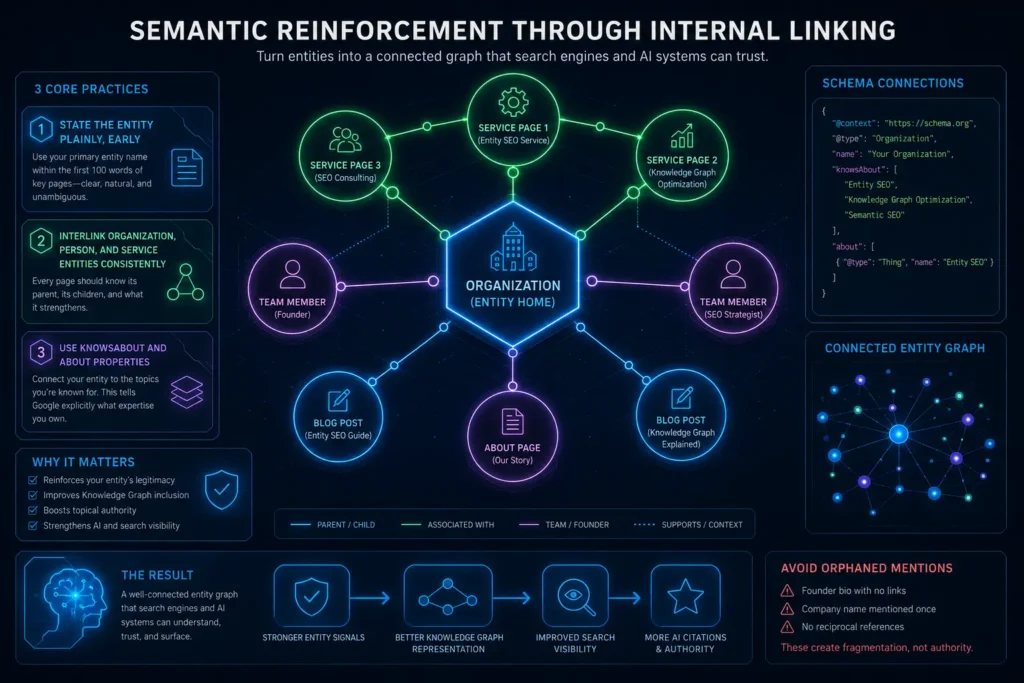
Structured data and external corroboration establish the entity. Internal linking is what proves your own site treats it as real and connected, rather than declared once on an About page and never touched again.
Three practices do most of the work:
- State the entity plainly, early, on pages where it matters. Your primary entity name in the first hundred words of key pages — not stuffed, just present and unambiguous — gives both crawlers and passage-extraction systems a clean anchor before they read further.
- Interlink Organization, Person, and Service entities consistently. A service page should link to the team member associated with it; a team bio should link to the services they lead; both should link back to the entity home. This is the same logic as MS’s Website Intelligence Engine applied at the entity level instead of the topic level — every page should know its parent, its children, and what it strengthens.
- Use knowsAbout and about properties to connect your entity to the topics you want associated with it. This is the schema-level version of topical authority: it tells Google explicitly that your Organization entity is connected to Entity SEO, Knowledge Graph Optimization, or whatever concepts define your actual expertise — rather than leaving that connection to be inferred from content alone.
Orphaned entity mentions — a founder bio that exists but links to nothing, a company name mentioned once on a partner’s site with no reciprocal reference — are missed opportunities more than errors, but at scale across a site they add up to the same fragmentation problem as inconsistent naming: a graph with isolated nodes instead of a connected one.
Stage 5 — Entity Authority Measurement
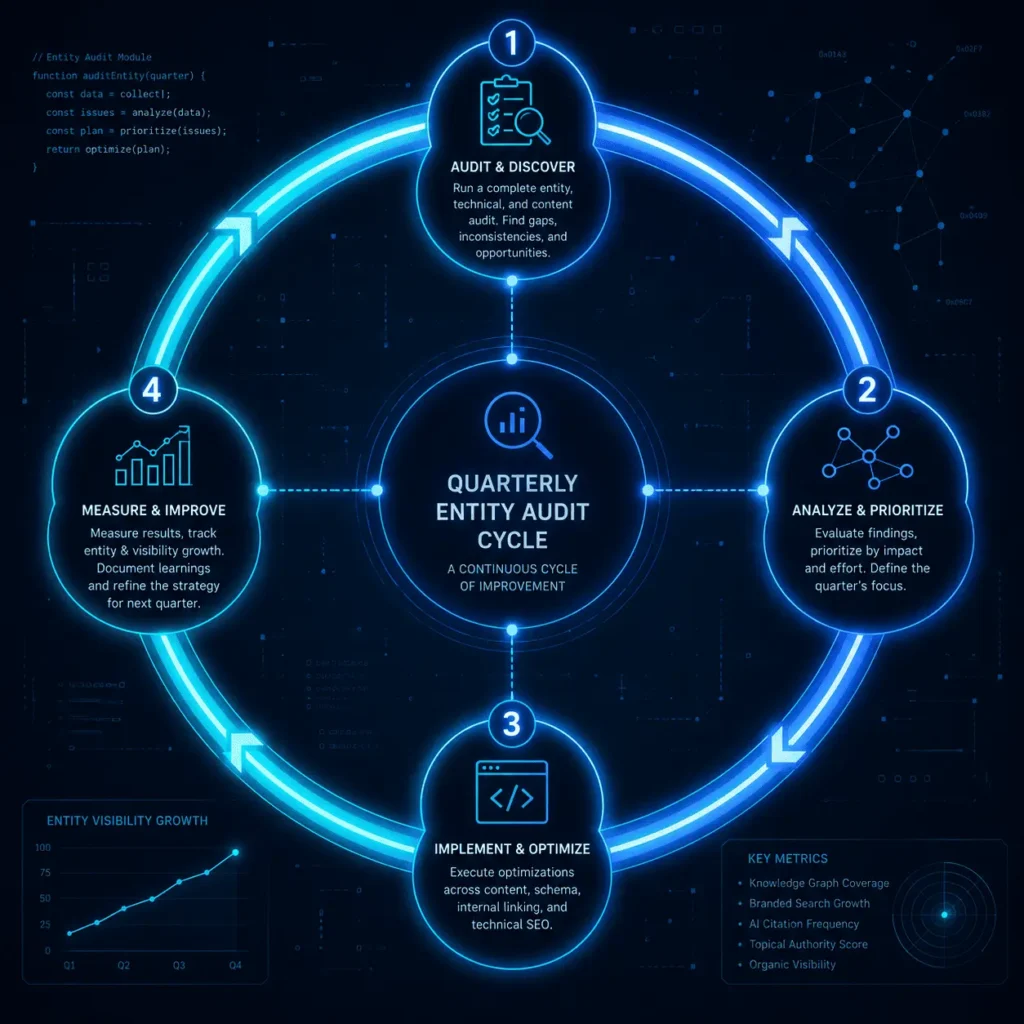
This is the stage most guides skip entirely, which is a problem, because none of the above is verifiable by rankings or traffic. You need a separate measurement layer:
5-Step Recurring Audit Framework
- Search your brand name logged out, incognito. Confirm whether a Knowledge Panel exists, and whether its description, image, and details are current. This costs nothing and takes thirty seconds — do it monthly.
- Query the Knowledge Graph Search API directly for your entity name and record the resultScore it returns. A rising score over successive checks is the closest thing to a leading indicator this work has.
- Validate schema on a recurring basis, not just at launch — Rich Results Test and the Schema.org Validator, quarterly, to catch template regressions before they silently break your @id consistency.
- Run direct prompt tests across ChatGPT, Gemini, Perplexity, and Claude: “What is [Company]?” and “Who is [Founder]?” Log whether the answer is accurate, whether it cites you, and whether it confuses you with anyone else. Repeat quarterly. This is the only measurement that directly reflects what you’re actually trying to achieve — AI systems describing you correctly — and it’s manual because no tool reliably automates it yet.
- Audit your sameAs array for rot — dead links, unclaimed profiles, abandoned accounts — on the same quarterly cadence. Corroboration signals decay; they aren’t a one-time setup.
We’re running this exact measurement sequence on our own hospitality-vertical work as the framework matures — full before/after detail will be published as a dedicated case study once that engagement reaches a reportable stage, rather than asserted here ahead of the data. Our State of SEO 2026 research covers the broader industry shift toward entity-first AI visibility in more depth if you want the wider context behind why this stage matters now specifically.

Common Mistakes (and What to Do Instead)
| Mistake | Why It Backfires | Do This Instead |
| Treating schema as the whole strategy | Schema confirms an entity Google already has some evidence for — it doesn’t manufacture credibility from nothing | Build external corroboration (Stage 3) before or alongside schema, not after |
| Skipping Wikidata because “we’re not big enough for Wikipedia” | Conflates two very different notability bars | Create a Wikidata item first — it accepts real, sourced businesses that Wikipedia would reject |
| Inconsistent name/description across profiles | Reads as entity fragmentation — multiple weak identities instead of one strong one | Lock one canonical name and description; audit and correct every existing profile against it |
| No stable @id anchor | Each page can declare a competing Organization node, splitting your own entity against itself | Use one @id pattern (e.g., /#organization) everywhere, without exception |
| Paying for a “guaranteed Knowledge Panel” service | Panels are algorithmically generated — there is no direct purchase path, and no legitimate service can create one on demand | Invest in the underlying citation density and structured data; the panel follows, on its own timeline |
| Publishing a Wikipedia page before notability exists | Rejected submissions get flagged, making every future attempt harder | Build press coverage and a Wikidata item first; let Wikipedia eligibility develop over 12–18 months |
| Letting sameAs links rot | Dead or abandoned profiles actively weaken confidence rather than sitting neutral | Quarterly audit; remove or fix anything no longer active |
Entity SEO & Knowledge Graph Implementation Checklist
A preview of the full checklist — the complete version, with prioritization guidance and a tracking sheet, is available as a download below.
Entity Foundation
- [ ] One canonical entity home confirmed for the Organization and for each key Person entity
- [ ] Canonical name and description locked and documented
- [ ] Full audit of existing brand mentions completed, inconsistencies flagged
Structured Data
- [ ] Organization schema live with name, url, logo, and a stable @id
- [ ] Person schema implemented for founders/experts, linked via founder/worksFor
- [ ] All JSON-LD validated in Rich Results Test and the Schema.org Validator
Wikidata & sameAs
- [ ] Wikidata item created or claimed
- [ ] sameAs array built in priority order (Wikidata → Wikipedia if eligible → LinkedIn → Crunchbase → other owned profiles)
- [ ] Every sameAs target checked and confirmed active
Semantic Reinforcement
- [ ] Primary entity named clearly in the first 100 words of key pages
- [ ] Organization, Person, and Service pages interlinked consistently
- [ ] knowsAbout/about properties connecting the entity to core topics
Measurement
- [ ] Logged-out brand search checked for Knowledge Panel status
- [ ] Knowledge Graph Search API queried and resultScore recorded
- [ ] Quarterly AI prompt test run across ChatGPT, Gemini, Perplexity, and Claude
If you’d rather have this implemented end-to-end than run it yourself, that’s the exact scope of our Entity SEO service.
📥 DOWNLOAD THE COMPLETE IMPLEMENTATION SHEET
The 2026 Entity SEO & Knowledge Graph Checklist
📥 DOWNLOAD THE COMPLETE IMPLEMENTATION SHEET
The 2026 Entity SEO & Knowledge Graph Checklist
Get the un-truncated, step-by-step PDF checklist including priority scoring, task owners, and tracking fields for your team.
FAQ
What is Entity SEO and how do I build a Knowledge Graph presence? Entity SEO is the practice of making search engines and AI systems recognize your brand, people, and topics as distinct, connected entities rather than just ranking pages. You build Knowledge Graph presence by combining consistent Organization/Person structured data anchored to a stable @id, a Wikidata entry and sameAs links to your other authoritative profiles, citation density across independent sources, and internal linking that reinforces the same entity relationships across your site. The five-stage sequence above — foundation, structured data, external corroboration, semantic reinforcement, measurement — is the practical order to run it in.
Do I need a Wikipedia page before I can get a Knowledge Panel? No. Wikidata has a much lower notability bar than Wikipedia and directly feeds the Knowledge Graph. Most businesses should start there, build citation density through press coverage, and let Wikipedia eligibility develop over time if it’s warranted — trying to force a Wikipedia page before genuine notability exists usually gets it rejected and makes future attempts harder.
Is adding Organization schema enough to create a Knowledge Graph entity? No. Schema confirms an entity Google already has some external evidence for — it doesn’t create credibility on its own. Without corroborating signals (Wikidata, consistent third-party mentions, active sameAs profiles), even flawless schema markup usually won’t be enough to trigger a Knowledge Panel or reliable AI citations.
How long does it take to build entity recognition? For most businesses executing the foundation, structured data, and corroboration stages properly, a Knowledge Panel typically appears somewhere in the 3-to-12-month range, and it appears silently — there’s no notification, so you check for it rather than wait for an alert. AI citation accuracy tends to improve on a similar or slightly longer timeline, since it depends on the same underlying corroboration compounding.
Can I pay someone to guarantee a Knowledge Panel? No legitimate service can guarantee one. Knowledge Panels are generated algorithmically from Google’s confidence in an entity — there’s no direct purchase or submission path that creates one on demand. Anyone promising a guaranteed panel is either overpromising or describing the underlying corroboration work (which is legitimate) using misleading language about the outcome.
What’s the difference between Entity SEO and Technical SEO? Technical SEO ensures your pages can be crawled, indexed, and rendered efficiently. Entity SEO ensures the organization, people, and topics behind those pages are recognized as distinct, connected concepts. They’re complementary — technical SEO gets your content in front of search systems; entity SEO determines whether those systems know who’s speaking. Our SEO Services hub covers where each discipline fits inside a full program.
How do I know if AI systems already recognize my brand? Run the direct test: ask ChatGPT, Gemini, Perplexity, and Claude “What is [your company]?” and “Who is [your founder]?” and evaluate the accuracy of each answer. Pair that with a logged-out Knowledge Panel check and a Knowledge Graph Search API query for your entity name. None of these are perfect signals individually, but together they give an honest picture of where you currently stand.
Next Step
Entity recognition compounds — it’s built once, correctly, and then maintained, not repeated from scratch every quarter. If you want a clear picture of where your brand currently stands with Google and with AI systems before deciding where to invest, that’s exactly what our Entity SEO & SEO Audit is built to answer. If AI visibility specifically is the priority, our AI Search Optimization service covers the GEO and AEO layer that sits directly on top of the entity work in this guide.