AI Overview Traffic Recovery: How to Recover Lost Organic Clicks in 2026
Recover AI Overview traffic by first confirming AI Overviews are the actual cause of the drop, then prioritizing the queries worth fighting for, rebuilding those pages as answer-first, citation-ready content, reinforcing the entity and technical signals that make a source easy to cite, and measuring recovery through Search Console and AI citation tracking rather than aggregate traffic alone. Some of the lost clicks are not coming back. The rest are recoverable — but only for the businesses that treat this as a structural shift in how SEO services operate.
If your rankings haven’t moved but your organic clicks have fallen off a cliff, you are not imagining it, and you are not alone. This guide walks through how to diagnose the cause with certainty, decide which queries are actually worth recovering, and apply a structured framework to rebuild the ones that are.
What Changed: Why Your Rankings Held But Your Clicks Didn’t
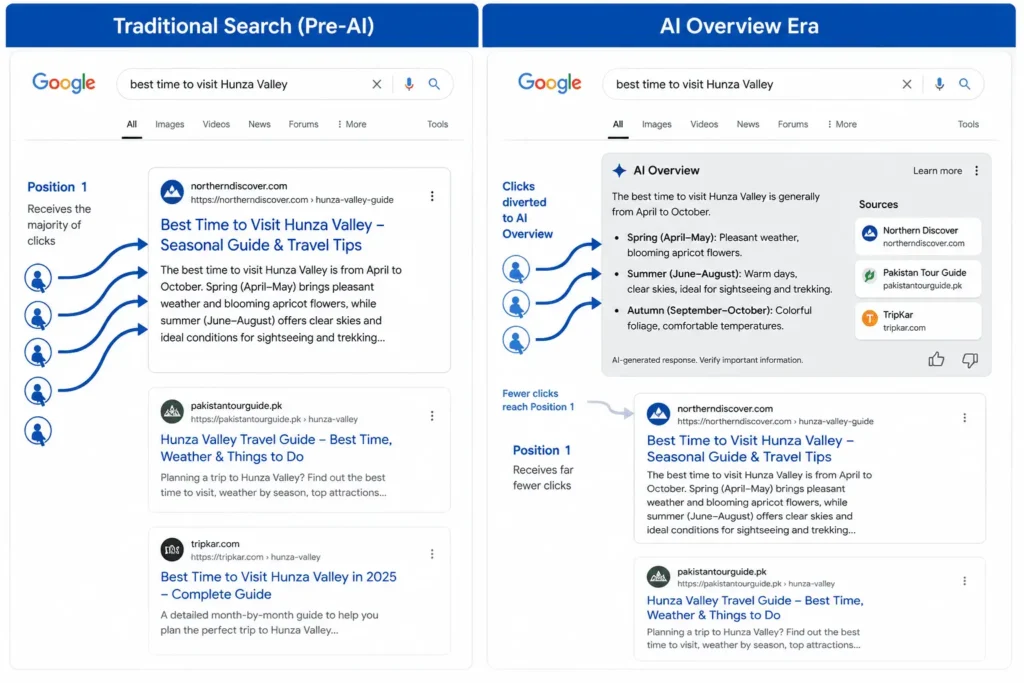
For most of the last two decades, ranking well and getting clicked were the same problem. Improve your position, and clicks followed. AI Overviews broke that relationship. A page can hold position one and still lose most of its traffic, because the answer the user was searching for now appears above it, generated directly on the results page.
Three independently conducted studies, using three different methods, all point in the same direction.
Pew Research Center analyzed the actual browsing behavior of 900 U.S. adults during March 2025, rather than relying on rank-tracking software. Fifty-eight percent of participants ran at least one Google search that month which produced an AI-generated summary. When a summary appeared, people clicked a traditional search result in only 8% of those searches, compared with 15% when no summary was present — close to a halving of outbound clicks. Clicking on the citation links embedded inside the summary itself was rarer still, at around 1% of visits. People who encountered a summary were also more likely to end their browsing session right there (26%)leading to higher zero-click search behavior.
Ahrefs took a different approach, pulling aggregated Google Search Console data across 300,000 keywords — half with an AI Overview present, half without. Their first pass, comparing March 2024 to March 2025, found a 34.5% lower average click-through rate for the top-ranking page when an AI Overview appeared. They re-ran the same methodology using December 2025 data and found the gap had widened to 58%. The effect also isn’t limited to position one: their data shows position two losing roughly half its clicks, and even position ten losing close to a fifth.
Seer Interactive runs the largest ongoing tracker of the three — 53 brands, 5.47 million queries, and 2.43 billion organic impressions from January 2025 through February 2026. Their data tells a more complete story than a single “clicks are down” headline. Organic CTR on AI-Overview-present queries fell for eighteen straight months, bottoming out around 1.3% in December 2025, then climbed to 2.4% by February 2026 — an 85% rebound off the floor. That’s genuine movement in the right direction, but it’s still well below the roughly 3.8% CTR that queries without an AI Overview were getting in the same month. The honest read: this isn’t a story of endless decline, and it isn’t a story of return-to-normal either. It’s a new, lower baseline, and where you sit on it now depends heavily on whether you’re the source the Overview cites.
That last point is the one most recovery advice skips past. Being cited inside an AI Overview delivered 120% more organic clicks per impression than appearing on the same SERP uncited, according to Seer’s data — but even cited pages still ran about 38% behind pages on queries with no AI Overview at all. Put in click terms, for every million informational-query impressions: pages with no AI Overview present earned roughly 33,500 clicks, cited pages inside an AI Overview earned roughly 20,743, and uncited pages sitting below the Overview earned roughly 9,445. Citation is a real advantage. It is not a return ticket to how things worked in 2023.
This reframes the entire recovery conversation. You are not fixing a penalty, an algorithm demotion, or a technical error. You are re-engineering for a smaller, more competitive click pool where being cited is the currency and everything else is a rounding error.
Diagnose the Cause: Confirm This Is Actually an AI Overview Problem
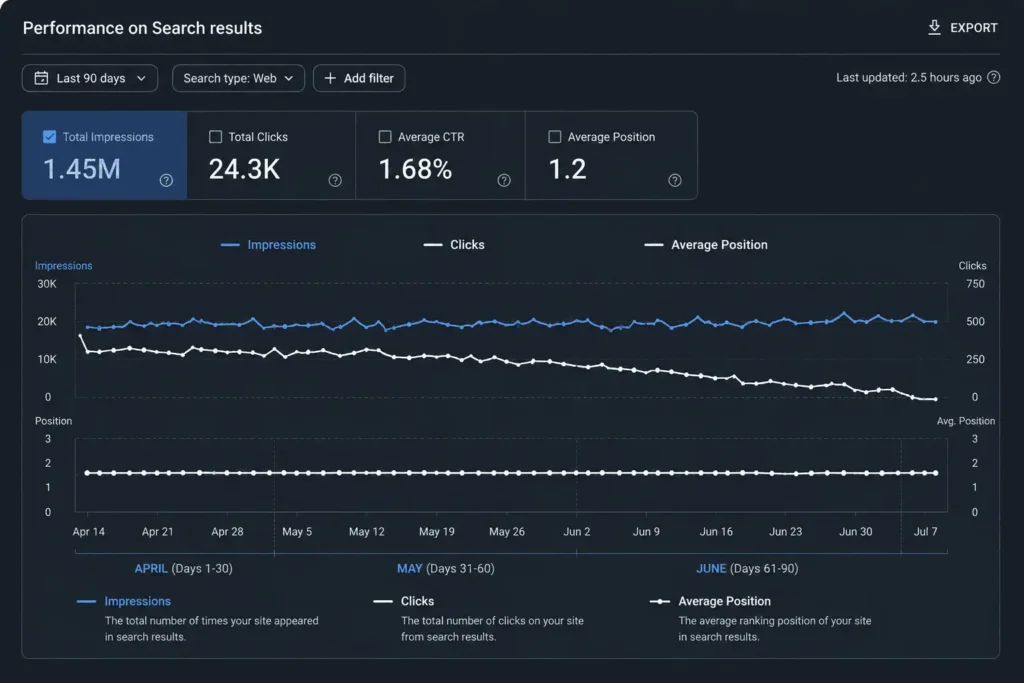
Before spending a single hour on recovery work, confirm the diagnosis. AI Overview traffic loss has a specific, recognizable signature in Google Search Console, and it’s easy to confuse with three or four other problems that require completely different fixes.
The AI Overview signature: impressions flat or rising, clicks and CTR falling, average position roughly unchanged, concentrated on informational, how-to, comparison, and question-format queries.
That combination matters because it’s the opposite of what a ranking loss looks like — a real ranking drop shows falling impressions and a worse average position, not a stable one.
A Practical GSC Diagnostic Checklist
Prefer We Handle the Diagnostic for You?
Our team will audit your Search Console performance, isolate queries displaced by AI Overviews, and deliver a prioritized page rebuild blueprint.
Book an SEO Audit →- Pull a Search Console Performance report comparing a stable trailing window (e.g., the last 3 months) against the prior equivalent window. Use a longer window than 30 days — AI Overview presence and citation status both fluctuate month to month, and a single month can mislead you.
- Filter to queries ranking in positions 1–10 where impressions held steady or grew, but clicks and CTR declined. This is your candidate list.
- Manually check the live SERP for your top 30–50 candidate queries. Confirm whether an AI Overview currently appears, and whether your domain is cited within it.
- Segment the candidates into three buckets: queries with an AI Overview present and confirmed impact, queries where it appears intermittently, and queries where it doesn’t appear at all. The third bucket has a different problem — don’t apply this framework to it.
- Rule out lookalike causes before committing resources:
| Symptom | Likely Cause | Where to Check |
| Impressions and average position both fall | Algorithm update or ranking loss, not AI Overviews | Position trend in GSC, cross-reference known update dates |
| Clicks fall site-wide, not concentrated on informational queries | Technical or indexing issue | Coverage report, sitemap status, server errors, robots.txt |
| Drop matches the same period last year | Seasonality | Year-over-year comparison, not just sequential months |
| Multiple URLs compete for the same query, both underperforming | Keyword cannibalization | Query-level page filter in GSC showing split impressions |
| Impressions and clicks both fall, average position stable, informational queries only | AI Overview displacement | Manual SERP check for AI Overview presence |
If the pattern matches the last row and the manual SERP check confirms an AI Overview is present, you have your diagnosis. If it matches any other row, this guide isn’t the fix you need — a technical SEO audit or a broader look at AI Search Optimization is the more accurate next step.
Identify the Impacted Queries: Where to Prioritize Recovery Effort
Not every query deserves the same recovery effort, because AI Overview exposure is wildly uneven across query types. Treating a “best of” comparison query the same as a transactional “book a consultation” query wastes effort on the wrong pages.
Exposure by Search Intent
Seer Interactive’s tracking shows how unevenly exposed different intents are:
| Search Intent | Average AI Overview Prevalence |
| Informational | ~36% |
| Commercial | ~8% |
| Transactional | ~5% |
An organic program built heavily around informational content — how-tos, explainers, definitions — is operating in roughly seven times more AI-Overview-exposed territory according to our 2026 search benchmarks.”
Exposure by Query Format
Intent is a useful filter, but query format is a sharper one. The same Seer dataset, analyzed across roughly 49,000 distinct queries, found:
| Query Format | AI Overview Trigger Rate |
| Comparison (“X vs. Y”) | 95.4% |
| Review queries | 86.3% |
| Question format (what/why/how/is/are) | 85.9% |
| Price / cost / buy | 83.4% |
| “Best of” lists | 81.3% |
| “Near me” (informational) | 76.9% |
| Single-word queries | 27.3% |
Two things stand out. First, comparison and review content — a staple of most content marketing strategies — is now the single highest-risk format on the web. Second, don’t assume short or broad queries are safe: even single-word informational searches trigger an AI Overview more than a quarter of the time, across tens of millions of impressions in Seer’s dataset.
A Simple Prioritization Matrix
Cross-reference two questions for every affected query: does it drive real business value (leads, revenue, qualified traffic), and is it realistically recoverable (can this specific page credibly earn a citation)?
| High Recoverability | Low Recoverability | |
| High Business Value | Rebuild first — this is your Phase 1 backlog | Diversify — protect the value via paid search, email, or other channels while monitoring |
| Low Business Value | Rebuild opportunistically, low priority | Deprioritize — not worth the effort right now |
This matrix is what turns a long list of declining keywords into an actual work plan, which is the starting point for the framework below.
The Scrapper Growth Engine™ AI Traffic Recovery Framework
Need an Ongoing AI Search Strategy?
Looking beyond standard recovery to build long-term topical authority across ChatGPT, Gemini, and Google AI Overviews?
Recovering AI Overview traffic isn’t a single tactic — it’s five sequential phases, each of which answers a different question.
| Phase | Core Question | Output |
| 1. Diagnose | Is AI Overview displacement the actual cause? | A confirmed list of affected queries and pages |
| 2. Prioritize | Which of these queries are worth recovering? | A ranked backlog by business value × recoverability |
| 3. Rebuild | Is this content structured to be extracted and cited? | Answer-first, passage-level content restructuring |
| 4. Reinforce | Do entity and technical signals support citation? | Author entity, schema, and crawlability confirmed |
| 5. Measure | Is the recovery actually happening? | A tracked, evidence-based view of citation and click recovery |
Phases 1 and 2 are covered above. The remainder of this guide covers Phases 3 through 5.
Phase 3: Content Optimization for AI Extraction
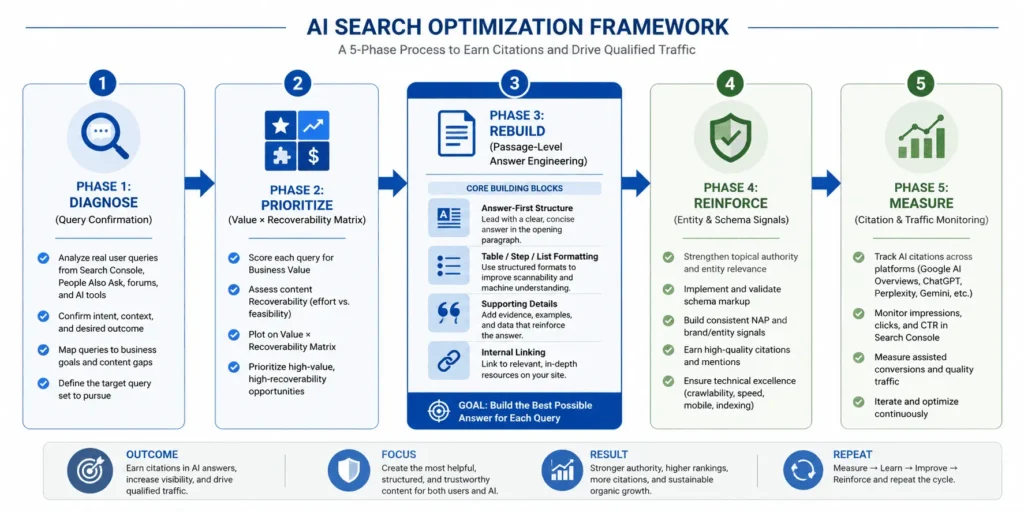
AI Overviews are built by selecting and synthesizing specific passages, not by reading and ranking entire pages the way traditional search does. That single fact should change how you write.
Lead with the complete answer, not the setup.
Place a direct, self-contained answer to the query in the first 40–60 words of the relevant section, before background, context, or a story. If a reader — or a language model — only sees the first sentence, that sentence should still be useful on its own.
Write in extractable, passage-
level blocks to align with modern Answer Engine Optimization (AEO) best practice
Use structured formats because they get selected, not because they look good.
Tables, numbered steps, and comparison lists aren’t decoration — they are the exact shape of content that generative systems most reliably extract and cite. If a paragraph is doing the job of a table (comparing three options across four criteria), make it a table.
Add what a two-sentence summary can’t replace.
An AI Overview can compress a generic explanation into a sentence. It’s much harder to compress a named framework, a specific worked example, an original recommendation tied to a scenario, or first-party data. If a section could be fully replaced by an AI-generated summary, it needs a differentiated angle, not just better formatting.
Don’t respond to lost clicks with more words. The instinct when traffic drops is to expand the content. Length isn’t the lever here — extractability, specificity, and citation-worthiness are. A tightly written 800-word answer with a clear framework will often out-cite a generic 3,000-word article covering the same ground.
Phase 4: Reinforcing Entity and Technical Signals
A complete implementation of Entity SEO belongs to its own guide — this is the subset that affects whether a struggling page is trusted enough to be cited
Entity Signals
- Attribute content to a real, credentialed author. A visible byline with relevant experience is one of the more consistent E-E-A-T signals across both traditional search and generative systems.
- Keep terminology and definitions consistent across your own site. If “AI Overview traffic recovery” means one thing here and something subtly different on another page, you’re working against your own entity clarity. Reuse existing definitions rather than rewriting them.
- Reinforce brand mentions in the sources AI systems already trust — consistent naming and descriptions build the broader topical authority that individual pages can’t build alone.
Technical Checks
Google Search Central has been explicit about this one: to be eligible as a supporting link inside AI Overviews or AI Mode, a page only needs to be indexed and eligible to appear in standard Search with a snippet. There is no separate technical layer required specifically for AI features.
A common and costly misunderstanding is worth correcting directly: disallowing the Google-Extended token in robots.txt does not opt a page in or out of AI Overviews. That token only controls whether content is used to train and ground Gemini app and Vertex AI responses — it has no effect on Google Search or AI Overviews, which run on the same Googlebot crawl as ordinary organic results. If a page is blocked from regular Search, it’s also ineligible for AI Overview citation; blocking or allowing Google-Extended changes neither outcome.
Practical checklist for this phase:
- ✓ Confirm the page is indexed and serving with a normal snippet in Search (Search Console → URL Inspection)
- ✓ Confirm Googlebot is not blocked in robots.txt or at the CDN/hosting layer
- ✓ Implement Article or BlogPosting schema with author and date fields
- ✓ Implement FAQPage schema on genuine FAQ content
- ✓ Implement BreadcrumbList schema to reinforce site hierarchy
- ✓ Use HowTo schema only where the content is a genuine sequential process
A full technical SEO audit — Core Web Vitals, crawl budget, indexation health — sits outside the scope of recovery work specifically and is better handled through a dedicated SEO Audit.
Phase 5: Measurement — Tracking Recovery Without Guessing
Aggregate “organic traffic” as a single number will hide this entire story. Recovery has to be measured at the query and page level the diagnosis was built on.
In Search Console: build a saved filter for the confirmed AI-Overview-affected query set from Phase 1, and track impressions, clicks, CTR, and average position monthly for that specific segment — not for the site as a whole.
In GA4: watch organic sessions and conversions for the specific affected landing pages, not the organic channel in aggregate. A recovering segment can be masked by unrelated movement elsewhere on the site.
AI citation monitoring: periodically query your priority questions directly in Google AI Mode, ChatGPT, Gemini, Perplexity, and Claude, and log whether and how your brand is referenced. A manual spreadsheet, updated monthly, is a legitimate starting point before investing in a dedicated AI-visibility tracking tool.
Set a realistic timeline. Plan for 60–120 days before drawing conclusions. This isn’t arbitrary — it reflects how long Google’s own recrawl-and-reassessment cycle typically takes, and it matches the volatility visible in Seer’s own tracking data, where individual query segments moved by double-digit percentages from one month to the next. A single month of data, in either direction, is not a verdict.
| Indicator Type | Examples | What It Tells You |
| Leading | Citation rate in target queries, schema validation status, AI referral clicks | Whether the rebuild is working, before traffic fully reflects it |
| Lagging | Organic sessions, clicks, leads, revenue from the affected segment | Whether the rebuild has translated into business outcomes |
Common Mistakes in AI Overview Recovery
- Waiting for Google to reverse it. Eighteen months of independent tracking across three separate methodologies point the same direction. Plan around the new baseline; don’t plan around it disappearing.
- Disallowing Google-Extended and assuming that reduces AI Overview exposure. It doesn’t touch Search eligibility at all — see the technical section above.
- Treating every declining query as equally worth saving. Recoverability and business value vary enormously by query type; the prioritization matrix exists specifically to stop this.
- Responding to lost clicks by writing more. Extractability and citation-worthiness are the levers, not word count.
- Reading one month of CTR data as the final answer. Seer’s own tracking moved from an 18-month decline story to an 85% rebound story within two reporting cycles. Use trailing windows, not snapshots.
- Ignoring paid search as a bridge. On high-value transactional queries — the segment least exposed to AI Overviews in the first place — paid search remains a stable, predictable lever while organic recovery plays out.
What Recovery Realistically Looks Like
Some volume is not coming back, and any recovery plan that promises otherwise isn’t being honest with you. On broad informational queries, an AI Overview is now Google’s default answer, and even a cited source sits meaningfully below the pre-AI-Overview baseline. The realistic goal on that segment is to become the cited source and convert citation-driven exposure into other measurable value — branded search later in the journey, newsletter or resource downloads, retargeting — rather than expecting a full click restoration.
Transactional and highly specific commercial queries carry the best odds of a genuine recovery, precisely because AI Overviews barely touch them today.
Frequently Asked Questions
How do I know if AI Overviews caused my traffic drop, and not something else?
Check Search Console for a specific pattern: impressions flat or rising, clicks and CTR falling, and average position roughly unchanged, concentrated on informational or question-format queries. If impressions and position are both falling, that points to a ranking or algorithm issue instead. See the diagnostic checklist above.
Can I block my content from appearing in AI Overviews?
Not without also removing it from regular Google Search — AI Overviews are built from the same eligible, indexed results as standard search, so there’s no separate opt-out that preserves your rankings. The more effective response is to optimize for citation rather than attempt to opt out.
How long does AI Overview traffic recovery take?
Plan for 60–120 days before evaluating results. Google’s recrawl-and-reassessment cycle and the natural month-to-month volatility in AI Overview citation behavior both make shorter windows unreliable.
If I get cited in an AI Overview, will I get my old traffic back?
Partially. Industry tracking shows cited pages earn significantly more clicks than uncited pages on the same AI-Overview SERP, but cited pages still typically underperform what the same query earned before AI Overviews existed. Citation is an advantage relative to your competitors on that SERP — not a full return to the prior baseline.
Do AI Overviews affect every keyword the same way? No. Informational, comparison, and question-format queries are far more likely to trigger an AI Overview than transactional or highly specific commercial queries. Diagnosing your exposure by query type, not just overall traffic, is essential to prioritizing recovery work correctly.
Is this the same as Answer Engine Optimization or Generative Engine Optimization?
Related, but narrower. This guide focuses specifically on diagnosing, prioritizing, and rebuilding pages that have already lost traffic to AI Overviews. AEO and GEO are the broader, ongoing practices of structuring a site for AI visibility generally — read more in our upcoming AI Search Optimization Framework guide.
Should businesses stop investing in informational content because of AI Overviews? No — but informational content now has to be built to earn a citation, not just to rank. Pairing informational depth with original data, named frameworks, or tools that a summary can’t replace remains a sound long-term investment.
Next Step
AI Overview traffic loss isn’t a one-time problem to patch — it’s an ongoing condition of how search works now, and it needs an ongoing response, not a single content refresh. The businesses seeing real recovery are the ones treating diagnosis, prioritization, and citation-building as a repeatable operating habit.
If you’re not sure how exposed your own site is, a query-level diagnostic is the fastest way to find out. Book an SEO Audit to get a prioritized breakdown of which of your pages are losing clicks to AI Overviews and which are worth rebuilding first. If you’re ready to go further, our AI Search Optimization services cover the full ongoing GEO and AEO practice this guide only partially addresses.